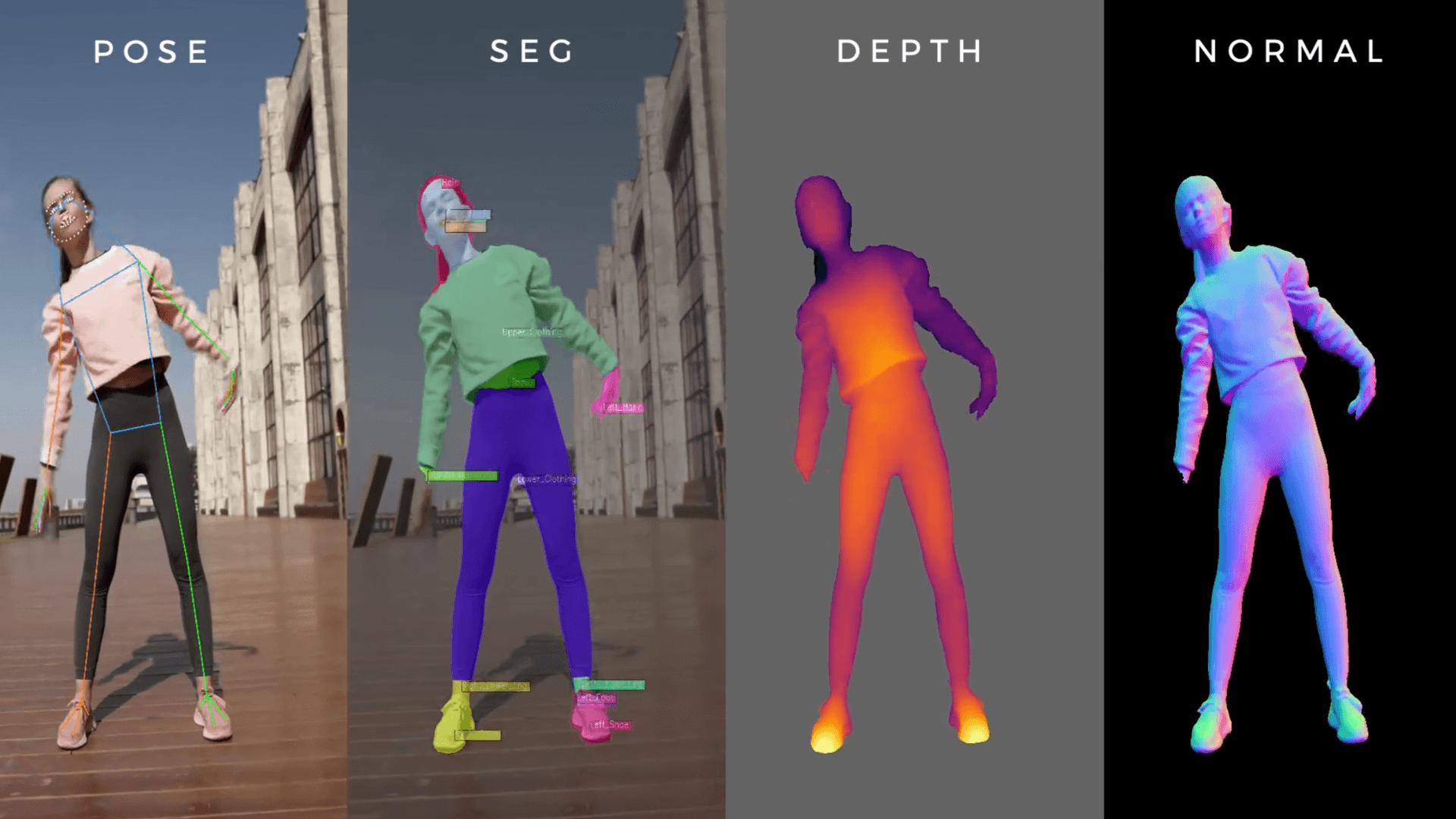
Meta has released Sapiens2 on Hugging Face, a suite of high-resolution vision transformers (ViTs) pretrained on an unprecedented 1 billion human images. The models are designed specifically for human-centric perception tasks: pose estimation, body part segmentation, surface normal estimation, and point map generation.
Key Takeaways
- Meta open-sourced Sapiens2 on Hugging Face, a family of vision transformers pretrained on 1 billion human images for pose estimation, segmentation, normal estimation, and point maps.
- The models target high-resolution human-centric perception.
What's New
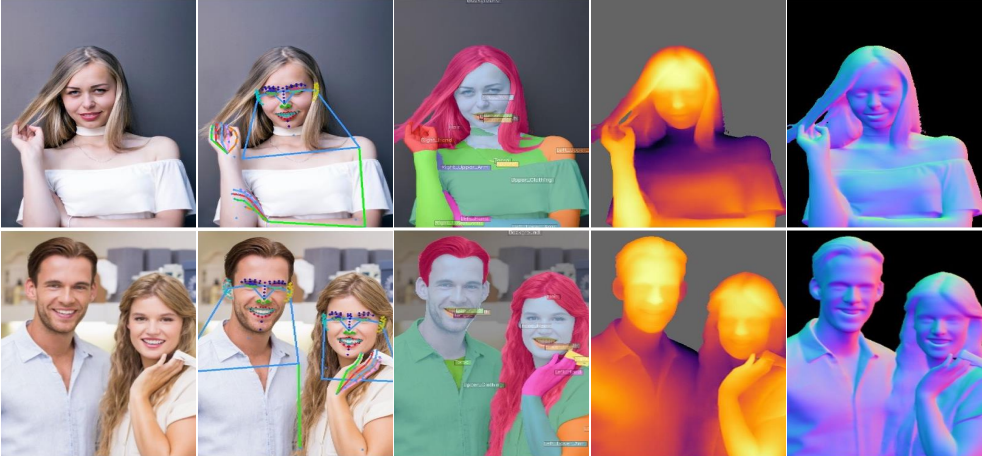
Sapiens2 is a direct follow-up to the original Sapiens models, which were first introduced in a research paper earlier this year. The new version scales up pretraining data to 1 billion images — all human-centric — and uses high-resolution inputs (up to 1024×1024 pixels).
The models are available on Hugging Face under the Sapiens2 repository, with checkpoints for different model sizes and task-specific heads.
Technical Details
- Architecture: Vision Transformers (ViTs) with high-resolution processing
- Pretraining Data: 1 billion human images (proprietary, not publicly released)
- Input Resolution: Up to 1024×1024 pixels
- Tasks:
- 2D pose estimation (keypoint detection)
- Body part segmentation (semantic segmentation)
- Surface normal estimation
- Point map generation (dense correspondence)
- Model Sizes: Multiple variants available (likely ranging from small to large, exact sizes not specified in the announcement)
The pretraining approach uses self-supervised learning on the massive human image dataset, enabling the models to learn robust representations of human appearance, pose, and shape before fine-tuning on specific downstream tasks.
How It Compares
Pretraining Data 1 billion human images 300 million human images Typically millions or less Architecture High-res ViT ViT CNN or hybrid Tasks Pose, seg, normals, pointmaps Pose, seg, normals Varies (often single-task) Resolution Up to 1024×1024 Up to 1024×1024 Typically 256×256 to 512×512 Availability Open source on Hugging Face Open source on Hugging Face VariesThe key differentiator is the scale of pretraining data — 1 billion human images is 3× more than the original Sapiens and orders of magnitude more than most competing models. This scale, combined with high-resolution inputs, should improve performance on fine-grained human understanding tasks, especially for rare poses, occlusions, and diverse body types.
What to Watch

While the pretraining data is proprietary and not released, the model weights are open source. Practitioners can fine-tune Sapiens2 on their own datasets for specific applications. Potential use cases include:
- AR/VR: Accurate body tracking and scene understanding
- Fitness and sports: Pose estimation for form correction
- Fashion and e-commerce: Virtual try-on and body measurement
- Healthcare: Movement analysis and rehabilitation monitoring
Limitations to consider:
- The models are optimized for human-centric tasks and may not generalize well to other object categories
- High-resolution processing requires significant compute (likely a GPU with 16GB+ VRAM)
- The pretraining data may have biases toward certain demographics or environments
gentic.news Analysis
Meta's release of Sapiens2 on Hugging Face continues a clear pattern: the company is aggressively open-sourcing its human perception research. This follows the original Sapiens release and aligns with Meta's broader strategy of building the AR/VR ecosystem (think Quest headsets and smart glasses) where accurate, real-time human understanding is critical.
The scale of 1 billion human images is striking. For context, LAION-5B, one of the largest open image datasets, contains 5.85 billion images — but Sapiens2's dataset is entirely human-centric. This focused curation likely yields better representations for human tasks than general-purpose models trained on broader data.
What's notable is that Meta is releasing these models without the training data. This is a common pattern — the weights are open, but the data remains proprietary. For researchers and practitioners, this means they can use the models but cannot replicate the pretraining or study data composition effects.
From a competitive landscape perspective, Sapiens2 goes head-to-head with Google's MediaPipe, Microsoft's DensePose, and various academic models (OpenPose, HRNet). The advantage of a unified model that handles multiple human-centric tasks from a single backbone is significant for deployment efficiency — one model instead of four.
The timing is interesting. With Apple's Vision Pro and Meta's own Quest line pushing spatial computing, high-quality human perception models are becoming infrastructure. Meta is essentially commoditizing this layer by open-sourcing Sapiens2, potentially accelerating the ecosystem while maintaining an edge through proprietary data and hardware integration.
Frequently Asked Questions
What is Sapiens2?
Sapiens2 is a family of vision transformers pretrained on 1 billion human images for human-centric perception tasks including pose estimation, body part segmentation, surface normal estimation, and point map generation. It was released by Meta on Hugging Face.
How is Sapiens2 different from the original Sapiens?
Sapiens2 uses 1 billion pretraining images (up from 300 million in the original Sapiens) and likely includes architectural improvements for better performance on high-resolution inputs. The model weights are available on Hugging Face.
What can I use Sapiens2 for?
Sapiens2 can be used for 2D pose estimation (keypoint detection), semantic segmentation of body parts, surface normal estimation for 3D understanding, and point map generation for dense correspondence. Applications include AR/VR, fitness tracking, virtual try-on, and healthcare movement analysis.
Is Sapiens2 free to use?
Yes, the model weights are open source and available on Hugging Face under a permissive license (likely Meta's standard research license). The pretraining data is proprietary and not publicly released.