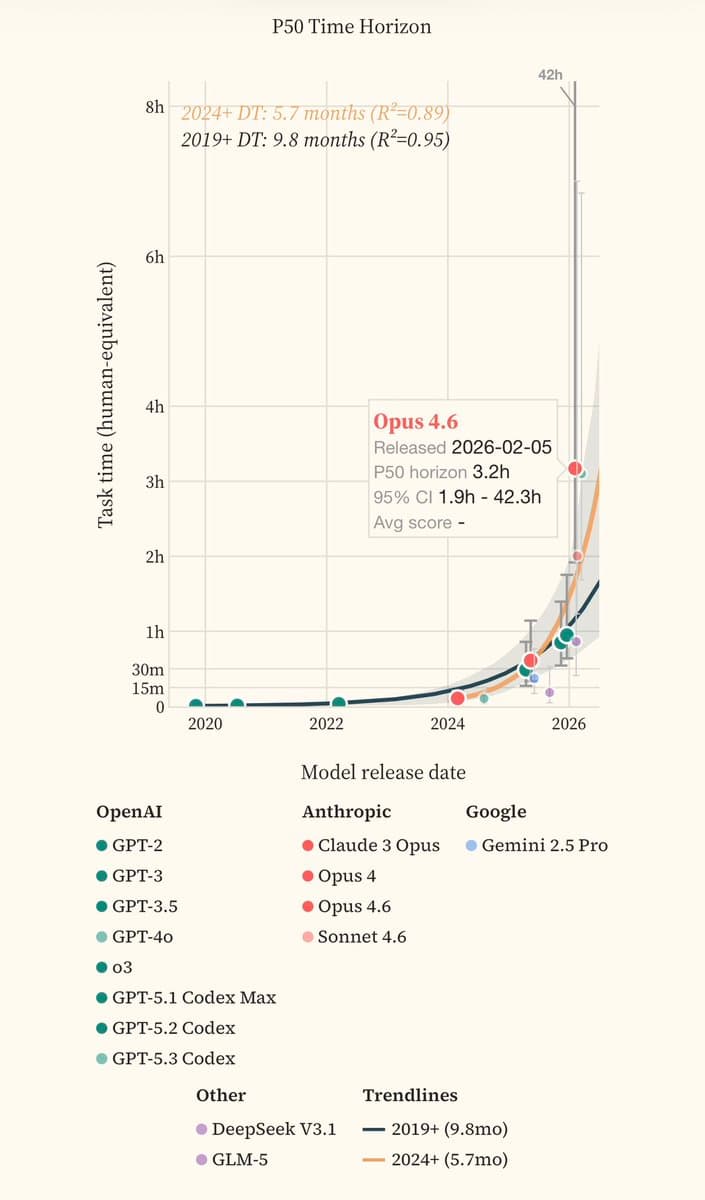
An independent domain extension of the Model Evaluation and Threat Research (METR) team's influential timeline analysis has been applied to offensive cybersecurity, revealing a consistent and rapid acceleration of AI capabilities in this critical domain.
The analysis, highlighted by researcher @emollick, applies METR's methodology—originally used to forecast general AI capabilities—to the specific field of offensive cybersecurity, using real human expert timing data as a benchmark. The key finding is stark: AI capabilities in offensive cybersecurity are doubling approximately every 5.7 months. This aligns directly with the 5-6 month doubling time METR previously estimated for general frontier model capabilities on a broad set of tasks.
What the Data Shows
The core metric from the analysis is a direct comparison between human expert performance and frontier AI model performance on offensive security tasks.
- Doubling Time: 5.7 months. This is the estimated rate at which AI capability (measured by time-to-complete a task) is improving.
- Current Benchmark: Frontier AI models now succeed 50% of the time at tasks that take a human expert 10.5 hours to complete.
This 50% success rate at the 10.5-hour human-expert level represents a significant inflection point. It indicates that for a substantial portion of mid-complexity offensive security work—tasks that occupy a skilled professional for over a full workday—cutting-edge AI can now achieve parity half the time.
Context: The METR Timeline Framework
To understand the significance, one must recall the original METR analysis. METR (formerly ARC Evals) has been a leading organization in evaluating emergent capabilities and forecasting AI progress. Their "time-to-complete" methodology measures how long a human expert takes to perform a task and tracks how quickly AI models close that gap. Their previous research suggested a consistent 5-6 month halving time for the gap between human and AI performance across a wide range of cognitive tasks.
This new analysis confirms that the aggressive trend METR identified is not an average diluted by easier tasks; it holds even in a specialized, high-skill domain like offensive cybersecurity. This domain involves activities like vulnerability discovery, exploit development, and network penetration—areas requiring deep technical knowledge, creativity, and logical reasoning.
Implications for Cybersecurity and AI Governance
The 5.7-month doubling time has immediate, concrete implications:
- Red Team & Penetration Testing: The tools available to both attackers and defenders are evolving at a pace far beyond traditional software development cycles. Defensive strategies and security postures that are updated annually or even quarterly are becoming obsolete against AI-driven offensive tools that improve multiple times per year.
- Automated Threat Generation: The barrier to generating novel, functional exploits is plummeting. Tasks that required weeks of expert time may soon be compressed into days or hours with AI assistance, potentially increasing the volume and sophistication of attacks.
- Validation of AI Timelines: This study provides external, domain-specific validation for METR's broader timeline predictions. If the trend holds, the capability gap for tasks taking experts 20 hours, 40 hours, or more will close on a predictable, exponential curve.
What This Means in Practice: Security teams can no longer assume that advanced offensive techniques remain the exclusive domain of well-resourced nation-states or elite hackers. The democratization of high-level offensive capability is accelerating, compressing years of expected tooling advancement into a few calendar years.
gentic.news Analysis
This independent analysis acts as a crucial data point in the ongoing debate about AI capability growth rates. It moves the conversation from abstract, aggregated benchmarks to a concrete, high-stakes domain. The fact that the 5.7-month doubling time so closely mirrors METR's general finding suggests the underlying driver of progress—likely scaling laws and improved training techniques—is domain-agnostic. This reinforces a model of AI advancement where capabilities diffuse rapidly across specialties once a certain generality is achieved in foundation models.
The focus on offensive cybersecurity is particularly salient given the current landscape. As we covered in our analysis of Project 2025's call for a "Cyber Force", national security frameworks are already grappling with the militarization of cyberspace. The timeline presented here suggests the technological substrate for that conflict is advancing faster than most bureaucratic or policy responses can accommodate. Furthermore, this aligns with trends we've noted in entities like Anthropic and OpenAI, which have shown increased activity (📈) in publishing research on AI safety and evaluations, partly in response to just these kinds of forecasts about rapidly scaling capabilities in sensitive domains.
This research also creates a tangible benchmark for companies like CrowdStrike, Palo Alto Networks, and Microsoft Security that are integrating AI into their platforms. The question is no longer if AI will perform advanced offensive tasks, but when it will exceed human expert reliability at specific time thresholds. Defensive AI will need to advance on a comparable or faster curve—a daunting requirement given the inherent advantages often held by offensive actors.
Frequently Asked Questions
What is METR's timeline analysis?
METR (Model Evaluation and Threat Research) developed a methodology to forecast AI progress by measuring how long it takes human experts to complete various tasks and then tracking how quickly the performance gap between humans and frontier AI models closes. Their original research indicated AI capabilities were doubling (or the gap was halving) every 5-6 months across a broad set of cognitive tasks.
What does a "5.7-month doubling time" mean for cybersecurity?
It means the capability of AI systems to perform offensive cybersecurity tasks (like finding vulnerabilities or creating exploits) is improving exponentially. A capability that takes an AI system 100 hours today might take only 50 hours in about 5.7 months, and 25 hours roughly 5.7 months after that. This drastically compresses the timeline for developing advanced cyber threats.
Does this mean AI can now hack any system?
No. The finding states that frontier AI models succeed 50% of the time on tasks that take a human expert 10.5 hours. This represents a specific point on a spectrum of difficulty. Highly complex, novel attacks requiring deep system-specific knowledge and weeks of work are not yet fully automated. However, the trend suggests the difficulty barrier for such attacks is falling rapidly.
Who conducted this independent analysis?
The source is a post by researcher @emollick citing an independent extension of METR's work. The specific analysis applying it to offensive cybersecurity with human expert timing data appears to be from other researchers in the field, though the full report or paper is not linked in the initial tweet.