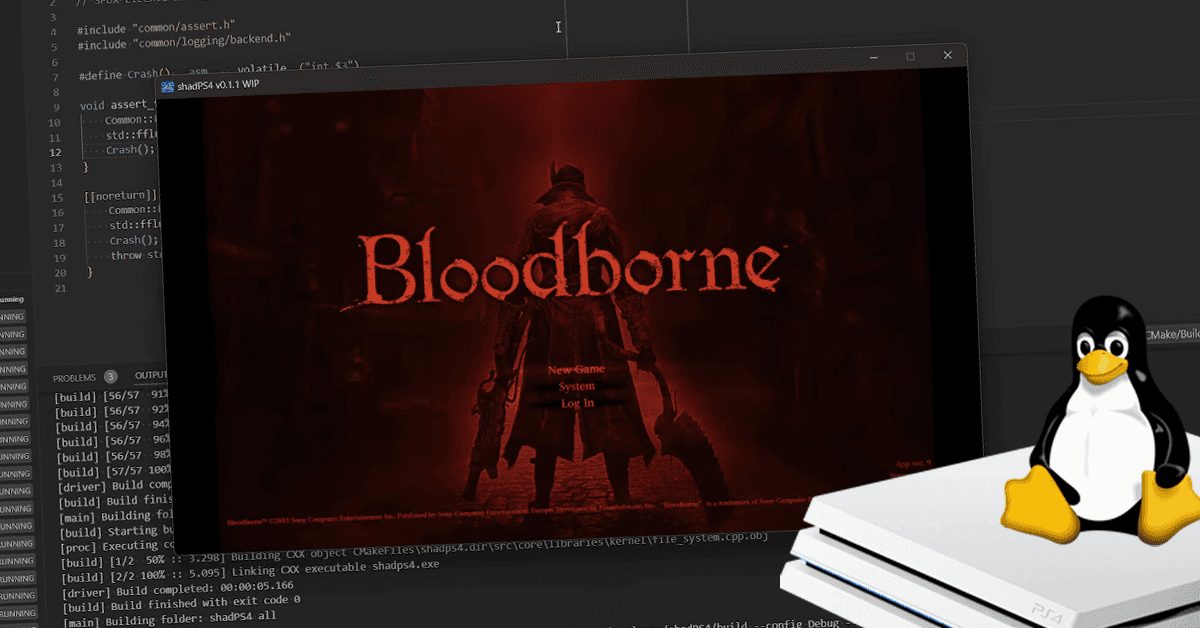
A developer has released a functional PlayStation 4 emulator for PC capable of running the acclaimed game Bloodborne entirely locally, a feat long considered a significant technical hurdle. The emulator, named Spine, works on Windows, Linux, and macOS and is already available for download, signaling a rapid acceleration in the reverse-engineering of modern console architecture.
Key Takeaways
- A developer has released Spine, a PS4 emulator that uses AI techniques to run Bloodborne fully on PC.
- This represents a major step forward in console emulation, previously considered years away.
What Happened

Developer Alex (aka devofspine) announced the release of the Spine PS4 emulator, demonstrating it successfully running FromSoftware's Bloodborne. The emulator operates 100% locally on a user's PC, without relying on cloud streaming or remote play services. This is a landmark achievement, as the PlayStation 4's complex x86-64 architecture and proprietary software layers have made functional, game-compatible emulation a daunting challenge for the community. Previous progress has been slow, with projects like RPCSX4 in early stages. Spine's ability to boot and run a commercially demanding title like Bloodborne suggests a breakthrough in interpreting the PS4's system calls (syscalls) and GPU commands.
Technical Context & How It Works
While the source tweet does not provide exhaustive technical details, the achievement implies the use of advanced techniques common in modern emulation. The core challenge of PS4 emulation lies in accurately translating its custom AMD "Jaguar" CPU instructions and, more critically, its Radeon GCN GPU commands for execution on a different PC GPU (e.g., NVIDIA or Intel).
Key technical hurdles that Spine likely addresses:
- Syscall Translation: The PS4's operating system, Orbis OS (a fork of FreeBSD), uses unique system calls for hardware access. The emulator must intercept these and translate them to equivalent Windows/Linux/macOS system calls.
- GPU Command Processing (GCN to Vulkan/DirectX): This is often the most complex part. The emulator must recompile the PS4's GPU shaders (written for the GCN architecture) on-the-fly for the host's GPU architecture. This process, known as shader translation or recompilation, is computationally intensive and prone to graphical bugs if not handled precisely. AI or machine learning techniques are increasingly being explored to optimize this translation process, predict shader behavior, and upscale textures, which may be a factor in Spine's development.
- Memory and Security Emulation: The emulator must faithfully replicate the PS4's memory layout and security model, including its hypervisor-level protections.
The fact that Spine runs on all three major desktop operating systems suggests it uses a portable graphics API like Vulkan as its backend, which provides low-level access to GPU hardware across platforms.
Current Status and Limitations
According to the announcement, Spine is already available for users to test. However, it is crucial to temper expectations:
- Performance: Early versions of complex emulators are typically far from full-speed. Bloodborne may run, but likely with significant frame rate drops, audio stuttering, and graphical artifacts.
- Game Compatibility: Running one game is a proof-of-concept, but broad compatibility across the PS4's library of thousands of titles requires handling an enormous variety of engine-specific tricks and hardware usage patterns. Spine's compatibility with other games is untested.
- Legality: Emulators themselves are legal tools, but users must dump game files (the PS4's PKG format and decryption keys) from their own physical PS4 consoles to use with the emulator legally. Distributing copyrighted game files or system firmware is illegal.
Why This Matters for AI/ML Practitioners

This development is noteworthy for the AI/ML community not because the emulator itself is necessarily an AI model, but because the field of emulation is becoming a fertile ground for applied machine learning. The problems inherent in emulation—binary translation, shader compilation, performance optimization, and bug prediction—are classic challenges in systems programming that are increasingly being tackled with data-driven approaches.
Researchers have explored using neural networks for:
- Binary Translation: Learning mappings between instruction sets (e.g., PS4's x86-64 extensions to standard x86-64).
- Shader Decompilation/Optimization: Using models to translate and optimize GPU shader code between architectures more efficiently than hand-written rules.
- Performance Prediction: Modeling system behavior to pre-cache assets or schedule instructions.
Spine's emergence, whether it uses these techniques or not, highlights a real-world, high-stakes domain where AI could dramatically accelerate development. Success here validates the utility of ML in low-level systems engineering.
gentic.news Analysis
This breakthrough with the Spine emulator arrives amid a clear trend of AI and high-performance computing techniques converging with the demanding field of video game preservation and system simulation. For years, the emulation community's progress has been linear, relying on meticulous manual reverse-engineering. The leap from early PS3 emulation (RPCS3) to a functional PS4 emulator appears to be happening faster than many anticipated, suggesting the adoption of more powerful tooling and possibly algorithmic assistance.
This development directly intersects with another major trend we've covered: AI-powered texture upscaling and frame generation. Projects like NVIDIA's DLSS and open-source tools like Lossless Scaling use AI to enhance gaming visuals and performance. It is almost inevitable that future iterations of emulators like Spine will integrate similar AI upscalers (e.g., FSR, or community-driven models) to improve the visual fidelity of older games running at higher resolutions—a feature that has driven the popularity of emulators for older consoles. The technical report on DLSS 4's temporal coherence advancements we analyzed last month shows how critical AI-based reconstruction is becoming for performance. An emulator that can leverage these technologies would offer a superior experience.
Furthermore, this touches on the legal and ethical discussions around preserving digital art. As platforms like the PlayStation 4 reach end-of-life, functional emulators become the primary tools for long-term preservation. The acceleration of this process through advanced computing techniques, including AI, is a net positive for cultural heritage, though it will undoubtedly reignite debates with platform holders like Sony. The rapid progress seen here suggests the next generation of console emulation may arrive sooner than the traditional 10-15 year lag, fundamentally changing the software preservation timeline.
Frequently Asked Questions
Is the Spine PS4 emulator legal?
Yes, the emulator software itself is legal as it is original code that does not contain any copyrighted Sony software. However, to use it legally, you must dump the game files (the PS4's PKG format) and necessary decryption keys from a PS4 console that you own. Downloading game ROMs/ISOs from the internet is copyright infringement.
What are the system requirements to run Spine?
Specific requirements are not yet detailed, but running a PS4 emulator will be extremely demanding. You will need a powerful modern CPU (likely a high-core-count Ryzen or Intel Core i7/i9 from the last 3-4 generations) and a dedicated GPU (RTX 3060 or Radeon 6600 equivalent or better) with strong Vulkan API support. Even with high-end hardware, expect performance issues in early releases.
Can I play Bloodborne at 60fps or 4K with this emulator?
Not yet. Early emulation focuses on basic functionality and compatibility. Features like frame-rate unlocking, resolution upscaling, and graphical enhancements are typically added later, after the core emulation is stable. AI-powered upscaling (like FSR) could be integrated in the future to help with 4K rendering.
How does this compare to the RPCS3 (PS3) emulator?
RPCS3 is a mature, community-driven project that can run most of the PS3 library at full speed. It took over a decade to reach that point. Spine is in its absolute infancy, analogous to RPCS3's early days around 2012. It proves that PS4 emulation is possible, but it will likely take years of development to approach the stability and compatibility of RPCS3.