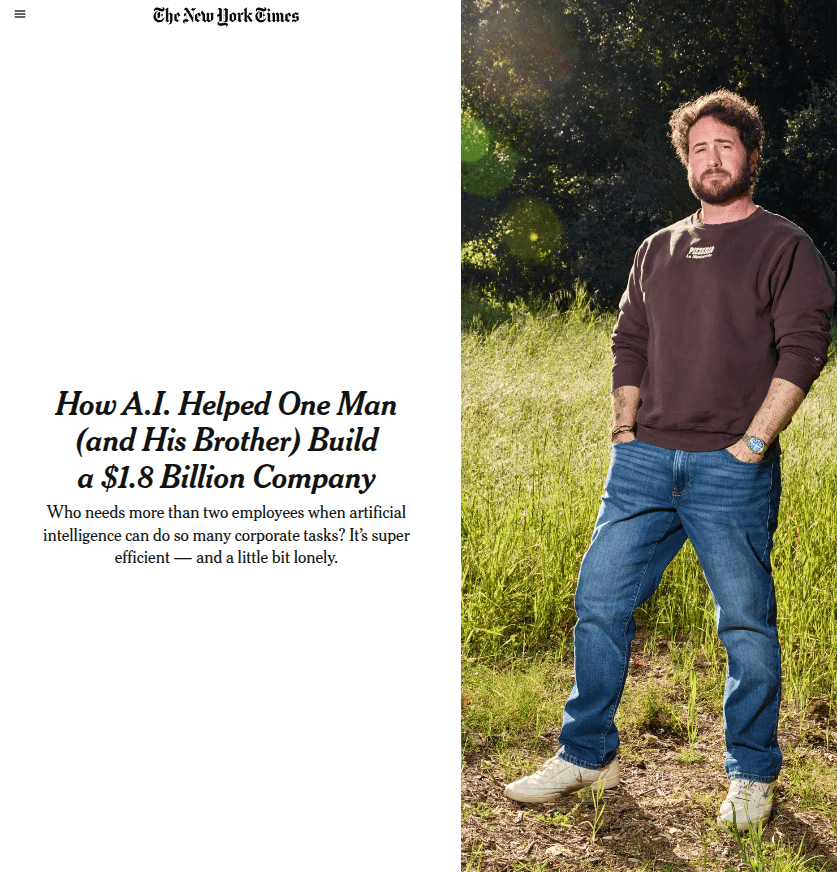
A new pattern of company building is emerging, powered not by massive venture capital rounds and hiring sprees, but by artificial intelligence acting as a force multiplier for individual founders. The concept, dubbed "vibe-coding," describes using AI to automate the layers of labor that traditionally sit between business demand and delivery, allowing a single person or tiny team to operate with the output of a large corporation.
The case study comes from entrepreneur Matthew Gallagher, who systematically used AI tools to strip away staffing needs across his company's core functions. According to a report shared by AI commentator Rohan Paul, Gallagher pushed code generation, ad creative development, website copy, analytics, customer support triage, scheduling, and even parts of his personal workflow into software. The result: his company could grow rapidly without building the "managerial middle"—the layers of managers, coordinators, and specialists typically required to scale operations.
What 'Vibe-Coding' Actually Means in Practice
While the term "vibe-coding" might sound abstract, it refers to a concrete operational approach: using AI as a co-pilot across every business function that would traditionally require specialized human labor.
Code Generation: Instead of hiring a full engineering team, founders use AI coding assistants (like GitHub Copilot, Cursor, or Claude Code) to generate, debug, and maintain production code. This collapses what would be multiple engineering roles into a single founder-technical lead who can direct the AI.
Creative & Marketing: AI image generators (Midjourney, DALL-E 3), video tools (Sora, Runway), and copywriting models (GPT-4, Claude) replace the need for graphic designers, video editors, and marketing copywriters. A founder can now produce professional-grade ad creative and website copy in minutes rather than weeks.
Operations & Support: AI chatbots (trained on company documentation) handle initial customer support triage. AI scheduling assistants manage calendars and meetings. Analytics dashboards are built and queried using natural language instead of requiring data analysts.
The key insight is that AI doesn't just automate individual tasks—it collapses entire coordination costs. In traditional companies, scaling requires hiring specialists, then hiring managers to coordinate those specialists, then directors to coordinate those managers. AI eliminates many of those specialist roles entirely, and with them, the managerial overhead required to coordinate human teams.
The Technical Stack Behind the Solo Corporation
While the specific tools used by Gallagher aren't detailed in the source, the current AI landscape in early 2026 makes this pattern technically feasible:
- Code Generation: Advanced coding models now achieve 80-90% accuracy on SWE-Bench and similar benchmarks, making them reliable for generating production-ready code with proper oversight.
- Multimodal Creativity: Models like GPT-4o, Gemini 2.0, and Claude 3.5 Sonnet can generate coherent marketing copy, design social media assets, and even produce short video scripts from a single prompt.
- Workflow Automation: AI agents can now chain together multiple tools—pulling data from a database, analyzing it, generating a report, and scheduling a follow-up meeting—without human intervention at each step.
This technical capability has reached an inflection point where the latency and reliability of AI outputs are sufficient for business-critical functions. Three years ago, AI could generate a rough draft of marketing copy; today, it can produce final-draft quality. Two years ago, AI could suggest code snippets; today, it can implement entire features with proper testing.
Why This Matters: The Economics of Solo Scaling
The business implications are profound. Traditionally, scaling a company required proportional increases in headcount, office space, management overhead, and communication overhead (the "mythical man-month" problem). AI changes this equation fundamentally.
Capital Efficiency: A "vibe-coded" company can achieve revenue milestones with 1/10th the headcount of a traditional company, meaning it needs far less venture capital and can reach profitability faster.
Speed of Iteration: Without layers of management approval and departmental handoffs, a solo founder can pivot product direction, test new marketing channels, or redesign features in days rather than quarters.
Talent Access: This model democratizes company building beyond traditional tech hubs. A founder in a smaller city with limited local talent can use AI to access "virtual talent" that matches Silicon Valley capabilities.
The limiting factor is no longer access to human specialists, but rather a founder's ability to orchestrate AI systems effectively. The new core skill is prompt engineering, workflow design, and quality control—not managing large teams.
Limitations and Caveats
This pattern isn't universal. "Vibe-coding" works best for:
- Software and digital product companies
- Businesses with repeatable, pattern-based tasks
- Founders with strong technical/AI literacy
It struggles with:
- Physical products requiring manufacturing
- Businesses needing deep domain expertise (like medical devices)
- Highly regulated industries where human oversight is legally required
- Creative endeavors where unique human perspective is the product
Additionally, there's a risk of AI homogeneity—if every company uses the same AI models for marketing, design, and coding, products may converge toward similar patterns and lose differentiation.
gentic.news Analysis
This development represents the logical next step in a trend we've been tracking since 2024. In November 2024, we covered "The Rise of the Solo Founder" phenomenon, where AI coding tools first enabled individual developers to build what previously required small teams. At that time, the capability was primarily in code generation. What's changed in 2026 is the expansion of AI competency across the entire business stack—not just coding, but marketing, operations, and customer support.
This aligns with our December 2025 analysis of "AI-Native Business Models," where we predicted that the most successful new companies wouldn't just use AI as a tool, but would architect their entire operations around AI-first principles. Matthew Gallagher's company appears to be an early example of this prediction materializing.
The trend also connects to the increased venture capital activity in AI agent startups throughout 2025. Investors have poured billions into companies like Cognition Labs (AI software engineers), Sierra (AI customer support agents), and MultiOn (AI personal assistants), betting that AI will replace not just tasks but entire job functions. Gallagher's case study validates that these investments are hitting real-world utility.
However, there's an important counter-trend to monitor: increased regulatory scrutiny of AI in employment. The European Union's AI Act, which fully came into force in 2025, imposes strict transparency requirements for AI used in hiring and employment decisions. While "vibe-coding" is about avoiding hiring altogether rather than using AI for hiring, regulators may eventually examine whether AI-driven solo corporations create new forms of market concentration or labor market disruption that require policy response.
Frequently Asked Questions
What does 'vibe-coded' mean?
"Vibe-coded" refers to building and operating a company primarily through AI tools rather than traditional human staffing. The founder sets the vision and "vibe," while AI systems handle the execution across coding, design, marketing, and operations. It's a play on the traditional concept of "founder-led" companies, but with AI as the primary workforce.
What AI tools are needed to build a vibe-coded company?
The essential stack includes: 1) AI coding assistants (GitHub Copilot, Cursor, or Claude Code), 2) Multimodal creative models (GPT-4o, Midjourney, or DALL-E 3 for images; Sora or Runway for video), 3) AI workflow automation (Zapier with AI, Make.com, or custom AI agents), and 4) AI customer support (Intercom with Fin, or custom chatbot solutions). The exact tools evolve rapidly, but the categories remain consistent.
Can a vibe-coded company scale to billions in revenue?
The theory suggests yes—if AI can handle the increasing complexity of operations at scale. The current evidence shows solo founders reaching millions in revenue with minimal staff. The unanswered question is whether there's a complexity ceiling where human management becomes necessary again, or whether advancing AI will continue to handle increasingly complex coordination tasks.
What are the risks of relying too heavily on AI for business operations?
Key risks include: 1) Homogeneity—if all companies use similar AI models, products may become indistinguishable; 2) Systemic fragility—dependence on a few AI providers creates central points of failure; 3) Quality erosion—without human oversight, AI may gradually introduce errors or suboptimal patterns; 4) Regulatory uncertainty—new laws may restrict certain AI uses in business contexts; and 5) Market saturation—as barriers to entry fall, competition may intensify dramatically.
How is this different from earlier automation trends?
Previous automation (outsourcing, software tools, cloud services) made human workers more efficient. AI-driven "vibe-coding" aims to eliminate the need for most human workers altogether in certain business functions. It's not about making a marketing team 2x more efficient—it's about enabling a founder to do marketing without having a marketing team. The difference is qualitative, not just quantitative.