What Happened
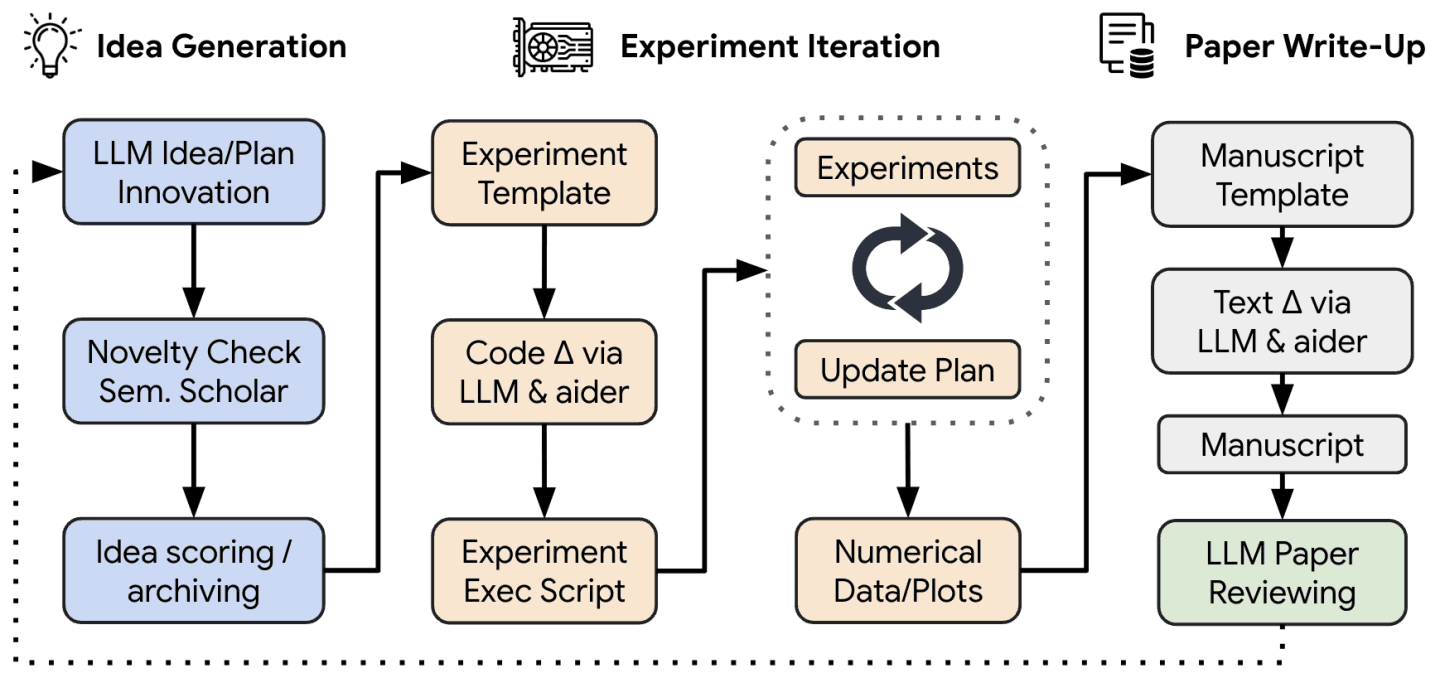
A paper shared on social media by AI commentator Rohan Paul proposes a method for using artificial intelligence to accelerate AI research. The core claim is that AI can run a "mostly automated loop of experiments," creating a self-improving cycle where AI systems design, execute, and potentially analyze experiments to advance the field.
The source tweet is brief, stating: "This paper shows that AI can speed up AI research by running a mostly automated loop of experiments. The problem is that…" The tweet cuts off, indicating the author intended to highlight a specific challenge or limitation with the proposed approach, but the full critique is not provided in the available source material.
Context
The concept of using AI to automate parts of the scientific research process is an active area known as AI for Science (AI4Science) or automated machine learning (AutoML) at a meta-level. The idea extends beyond hyperparameter tuning to potentially include hypothesis generation, experimental design, and result interpretation. This aligns with broader industry efforts to reduce the manual, iterative "grunt work" in ML experimentation, which consumes significant researcher time and computational resources.
Previous public work in this domain includes Google's work on AlphaFold for protein folding and various labs using AI to guide material discovery. The notion of a fully or mostly automated research loop represents a more ambitious, generalized application of these principles to AI research itself.
The Implied Challenge
While the source does not complete the thought, the truncated sentence "The problem is that…" suggests the paper likely addresses significant hurdles. Common challenges in such automated research loops include:
- Credit Assignment: Determining which algorithmic changes led to improvements in a complex, multi-step loop.
- Out-of-Distribution Search: The AI may efficiently exploit known search spaces but struggle to propose genuinely novel, paradigm-shifting architectures or algorithms outside its training distribution.
- Evaluation Bottlenecks: Automating experiment execution is one thing, but automating accurate, nuanced evaluation of results—especially for open-ended research goals—remains difficult.
- Computational Cost: The overhead of running a meta-learning system that orchestrates thousands of sub-experiments could be prohibitive.
Without access to the full paper, the specific "problem" referenced cannot be detailed, but it likely falls into one of these categories or discusses the risk of generating inscrutable, black-box AI research methods.
gentic.news Analysis
This snippet points to a critical, meta-level trend in AI: the field seeking tools to overcome its own scaling limitations. As model sizes and experiment costs balloon, manual research cycles become a major bottleneck. The promise of an automated research loop is a direct response to this, akin to how compilers accelerated software development after the era of hand-written assembly.
If viable, such technology would create a compounding effect. It wouldn't just incrementally improve a single model; it would increase the rate of iteration for all subsequent AI research. This connects directly to ongoing discussions about recursive self-improvement and AI accelerating AI development, a key consideration in AI safety and capability forecasts. However, the tweet's abrupt cutoff on "The problem is that…" is a crucial reminder. The history of AutoML shows that full automation often hits diminishing returns or produces solutions that are optimal in a narrow benchmark sense but lack the robustness or elegance of human-designed systems. The real test for such a loop is whether it can produce novel, understandable insights, not just incrementally optimize known metrics.
This development sits within a broader ecosystem trend we've tracked, where infrastructure to support AI development (MLOps, experiment trackers, orchestration platforms) is itself becoming increasingly automated and intelligent. The logical endpoint of that trend is a system that closes the loop entirely. The unanswered problem hinted at is likely the central hurdle between a useful assistant and a truly autonomous researcher.
Frequently Asked Questions
What is an automated AI research loop?
An automated AI research loop is a proposed system where an AI agent is tasked with designing machine learning experiments, executing them (e.g., training models), evaluating the outcomes, and using those results to formulate new, better experiments. The goal is to create a self-directed cycle that discovers improved algorithms or architectures with minimal human intervention.
Has any company built an automated AI researcher?
As of 2026, no company or lab has publicly demonstrated a fully general, autonomous AI researcher. However, components of this vision exist. Advanced AutoML systems can automate architecture search and hyperparameter tuning for specific tasks. Research projects like Google's Brain team explorations and various academic labs are actively working on meta-learning and AI-guided discovery, but these are typically constrained to well-defined problem domains.
What are the biggest challenges for automated AI research?
The primary challenges include the evaluation problem (how does the AI assess if a new discovery is truly novel and valuable beyond a simple metric?), the credit assignment problem (tracing which change caused an improvement in a complex chain), and the exploration-exploitation trade-off at a meta-level. The system might efficiently optimize within a known framework but fail to invent radically new approaches, which are often the source of major breakthroughs.
Could automated AI research be dangerous?
The potential risks mirror those of advanced AI generally. An automated system that rapidly iterates could potentially discover capable, unexpected AI behaviors before safety researchers can analyze them. It could also accelerate capabilities research far ahead of alignment research if not governed carefully. This makes the transparency and interpretability of the automated loop's decisions a critical safety concern, not just an engineering hurdle.