A groundbreaking study has revealed a surprising truth about artificial intelligence: even when working with what researchers describe as "pretty mediocre" skills, AI systems can deliver substantial practical value, particularly when applied outside their traditional software domains. The research, highlighted by Wharton professor Ethan Mollick on social media, represents one of the first systematic attempts to measure AI's practical capabilities beyond benchmark tests.
The Methodology: Testing Real-World Utility
The study examined AI skills primarily harvested from platforms like GitHub, assigning them a quality rating of just 6.2 out of 12—what researchers characterized as mediocre quality. Despite this seemingly modest starting point, the AI systems demonstrated remarkable ability to transform these imperfect capabilities into valuable outputs.
Researchers tested these AI skills across various practical applications, moving beyond theoretical benchmarks to measure real-world utility. The approach represents a significant shift in how we evaluate AI capabilities, focusing less on perfect performance in controlled environments and more on practical value in messy, real-world scenarios.
The Surprising Results: Beyond Software
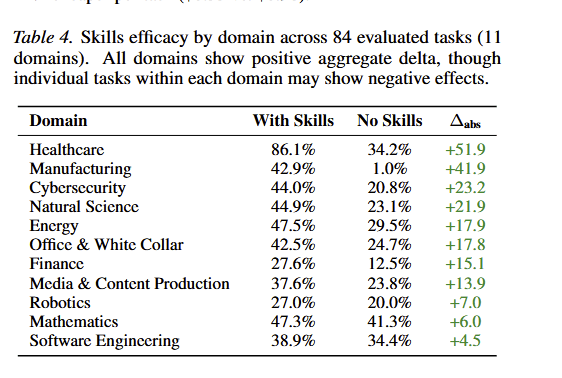
The most striking finding emerged when examining where AI delivered the greatest value. While improvements were noted within software development contexts, the "large boosts" in productivity and capability were most pronounced "outside software." This suggests that AI's greatest immediate impact may not be in creating better code, but in applying computational thinking and automation to fields that have traditionally been less technologically intensive.
This finding challenges conventional wisdom about where AI delivers the most value. Rather than simply making programmers more efficient, the research suggests AI may have its most transformative effects when bringing computational approaches to domains like healthcare, education, manufacturing, and creative fields.
The Quality Paradox: Why Mediocre Skills Succeed
The study raises intriguing questions about why AI systems with objectively mediocre skills can still deliver high practical value. Several factors likely contribute to this phenomenon:
- Complementary capabilities: AI may excel at specific subtasks within larger workflows, even when its overall skill rating is modest
- Amplification effects: Small improvements in certain areas can create disproportionate value in complex systems
- Accessibility advantage: Even imperfect AI tools can make capabilities available to non-experts who previously had no access to them
- Iterative improvement: AI systems can rapidly refine outputs based on feedback, effectively upgrading mediocre starting points
This quality paradox suggests we may need to reconsider how we evaluate AI systems, placing greater emphasis on practical utility rather than theoretical perfection.
Implications for Industry and Education
The research has significant implications for how organizations approach AI adoption. Rather than waiting for perfect AI solutions, companies might benefit from implementing current-generation AI tools that, while imperfect, can still deliver substantial value. This is particularly true for industries outside traditional technology sectors, where even basic automation and computational assistance can represent a major advancement.
For education and workforce development, the findings suggest a need to focus less on teaching people to compete with AI on technical perfection, and more on developing skills in directing, refining, and applying AI outputs in practical contexts. The most valuable human skills may become those related to problem-framing, quality assessment, and practical implementation rather than technical execution.
The Future of AI Evaluation
This study represents an important step toward more meaningful evaluation of AI systems. As Mollick notes, this is "one of the first" attempts to systematically test AI skills for practical value rather than theoretical capability. Future research in this direction could help us better understand:
- Which types of "mediocre" skills deliver the most practical value
- How different domains benefit from AI assistance
- What human-AI collaboration patterns maximize practical outcomes
- How to design AI systems for maximum real-world utility rather than benchmark performance
Conclusion: Rethinking AI's Value Proposition
The research highlighted by Professor Mollick suggests we may be underestimating AI's near-term practical impact by focusing too much on technical perfection and too little on real-world utility. The finding that even mediocre AI skills can deliver substantial value—particularly outside traditional software domains—points toward a future where AI's most important contributions may come not from superhuman performance on narrow tasks, but from making computational capabilities broadly accessible across society.
As AI continues to evolve, this research reminds us that practical value often emerges from unexpected places, and that sometimes, "good enough" really is good enough—especially when it brings new capabilities to fields that have never had them before.
Source: Research highlighted by Ethan Mollick (@emollick) on social media, referencing a study examining the practical value of AI skills harvested primarily from GitHub and other repositories.