What the Data Shows
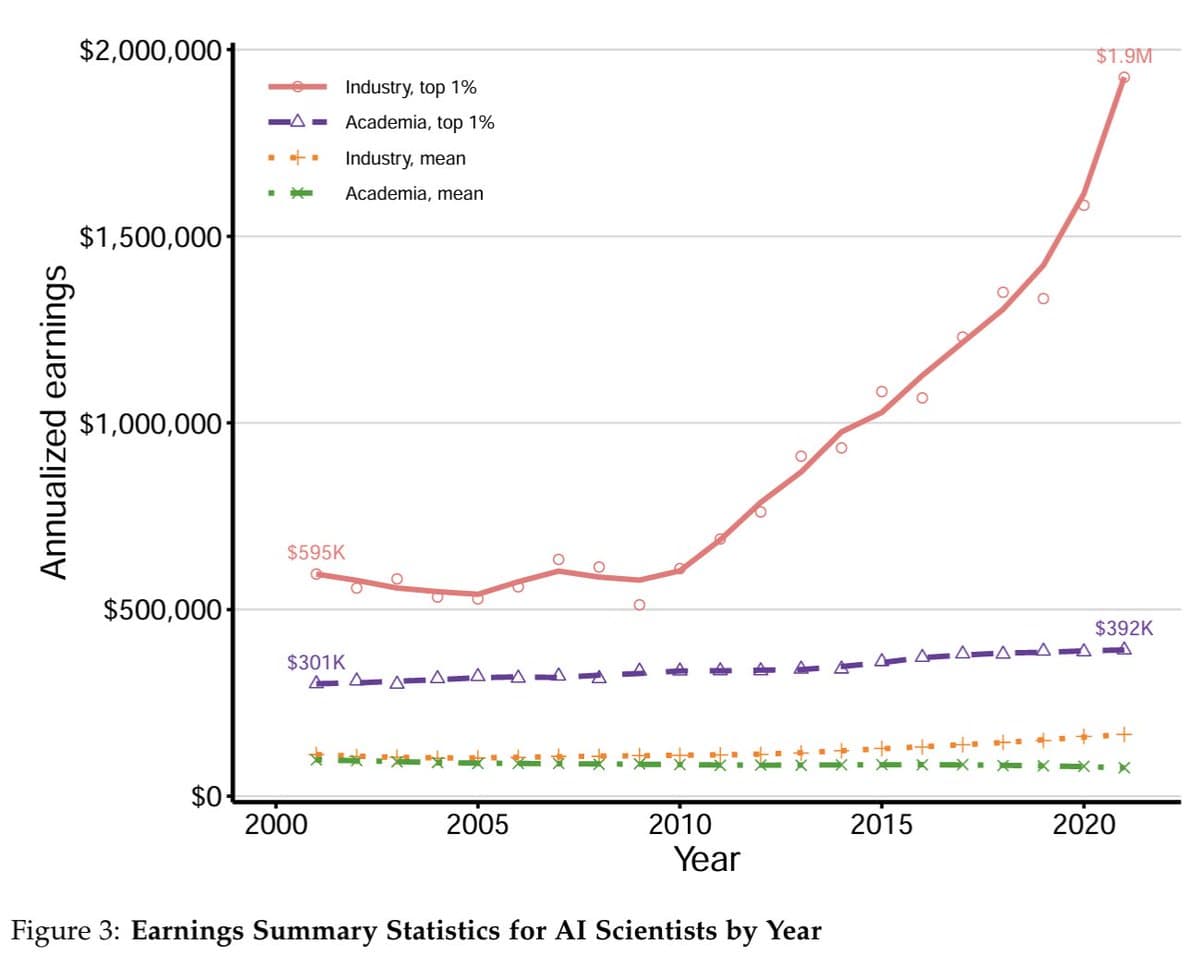
According to research cited by Ethan Mollick, a professor at Wharton who studies AI's impact on work and education, the compensation gap between elite AI researchers in industry and their academic counterparts has widened dramatically. The top 1% of publishing scientists working in the AI industry now earn approximately $1.5 million more per year than comparable researchers who remain in academia.
This represents a fivefold increase in the pay gap since 2001. While the exact methodology behind the underlying study isn't detailed in Mollick's post, the figure points to a significant and accelerating financial divergence.
The Academic Trade-Off
Mollick's central observation is that many talented AI researchers at universities "pay a VERY steep price" to stay in academia and maintain the ability to publish their work openly. This "price" is the foregoing of substantially higher industry compensation.
Open publication is a cornerstone of academic science, allowing for peer review, replication, and the broad dissemination of knowledge. In contrast, much frontier AI research within large technology companies is kept proprietary or published with significant delays and restrictions.
Context and Implications
The $1.5 million annual gap for top-tier researchers underscores the intense competition for AI talent. Companies like Google DeepMind, OpenAI, Anthropic, and Meta are engaged in a high-stakes race for breakthroughs, driving salaries for proven researchers to extraordinary levels. This market pressure creates a powerful financial pull away from universities.
For academia, this trend risks creating a "brain drain," where the most sought-after researchers and recent PhD graduates are incentivized to leave public institutions for corporate labs. This could gradually shift the center of gravity for cutting-edge AI research from open academic circles to closed corporate environments.
The long-term effects on innovation, talent development, and the diversity of AI research directions remain an open question, but the financial incentives are now overwhelmingly skewed.