Researchers from MIT, NVIDIA, UC Berkeley, and Clarifai have unveiled a groundbreaking approach to AI video processing that achieves a remarkable 19-fold speed increase by fundamentally changing how visual AI models handle video data. The innovation addresses a critical bottleneck in contemporary AI systems that has limited their ability to process long or high-resolution videos efficiently.
The Problem: Processing Every Pixel Equally
Current visual AI models face significant challenges when dealing with extended or high-quality video content. These systems typically process every pixel in every frame with equal computational intensity, regardless of whether that pixel contains meaningful information or remains static throughout the sequence. This brute-force approach creates substantial inefficiencies, particularly for videos containing large areas of unchanging background elements like walls, skies, or stationary objects.
As video resolutions increase to 4K and beyond, and as applications demand analysis of longer video sequences, this computational burden becomes increasingly prohibitive. The researchers recognized that this uniform processing approach wasted enormous computational resources on redundant information.
The Solution: A Smart Filter for Video Data
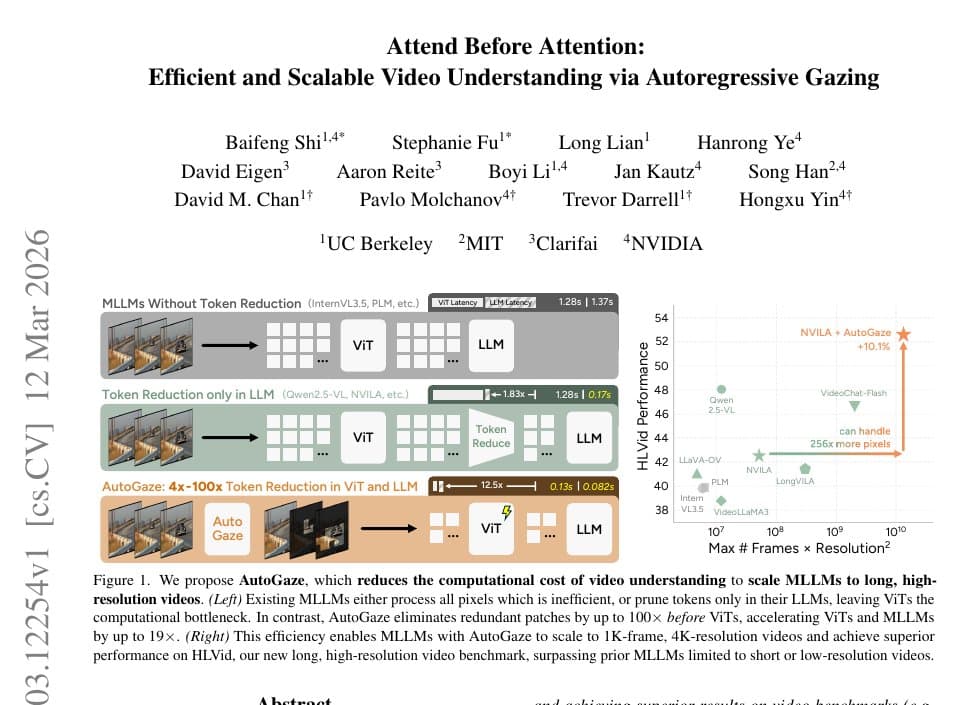
The team's innovation, detailed in their paper "Attend Before Attention: Efficient and Scalable Video Understanding via Autoregressive Gazing," introduces a novel preprocessing tool that sits in front of the main AI model. This system functions as an intelligent filter that selectively identifies and extracts only the patches of video where meaningful movement or change occurs.
Rather than processing the entire video frame uniformly, the system uses an autoregressive gazing mechanism to determine which regions warrant attention. It employs multiple zoom levels to capture fine details when necessary while completely ignoring large static areas that contain no new information.
How It Works: Selective Attention Mechanism
The system's core innovation lies in its ability to "attend before attention"—it makes preliminary decisions about which video regions contain valuable information before the main AI model begins its detailed analysis. This approach mimics how human visual attention works, focusing computational resources on changing elements while disregarding static background.
By implementing this selective processing strategy, the researchers achieved astonishing data reduction rates. Their testing demonstrated that the system could discard up to 99% of video data without compromising the AI's ability to understand the content or "lose the plot" of what's happening in the video.
Performance Results: 19x Speed Improvement
The practical impact of this approach is transformative. The 19x speed improvement enables standard AI models to easily process full 5-minute videos in stunning 4K resolution—a task that was previously computationally prohibitive. This acceleration doesn't come at the cost of accuracy; the system maintains the AI's understanding capabilities while dramatically reducing processing time and computational requirements.
This breakthrough has immediate implications for numerous applications including video surveillance, content moderation, autonomous vehicle perception, medical video analysis, and entertainment industry applications. The ability to efficiently process high-resolution, long-duration videos opens new possibilities for real-time analysis and broader deployment of video AI systems.
Technical Implementation and Future Directions
The research paper, available on arXiv (arxiv.org/abs/2603.12254), details the autoregressive gazing mechanism that powers this innovation. The system learns to predict which video regions will contain meaningful changes, creating an efficient pipeline that only processes relevant data.
This approach represents a paradigm shift in video AI processing—from uniform, brute-force analysis to intelligent, selective attention. As video data continues to grow in volume and resolution, such efficiency improvements will become increasingly critical for practical AI deployment.
Broader Implications for AI Development
The research demonstrates that significant performance gains can be achieved not just through hardware improvements or larger models, but through smarter algorithmic approaches to data processing. By rethinking fundamental assumptions about how AI systems should handle video data, the team has unlocked orders-of-magnitude improvements in efficiency.
This work also highlights the value of interdisciplinary collaboration, bringing together expertise from academic institutions (MIT, UC Berkeley) and industry leaders (NVIDIA, Clarifai) to solve a fundamental challenge in computer vision. The approach could potentially be extended to other domains where data contains significant redundancy, suggesting broader applications beyond video processing alone.
Source: Research published in "Attend Before Attention: Efficient and Scalable Video Understanding via Autoregressive Gazing" by MIT, NVIDIA, UC Berkeley, and Clarifai researchers. Original announcement via @rohanpaul_ai on X.