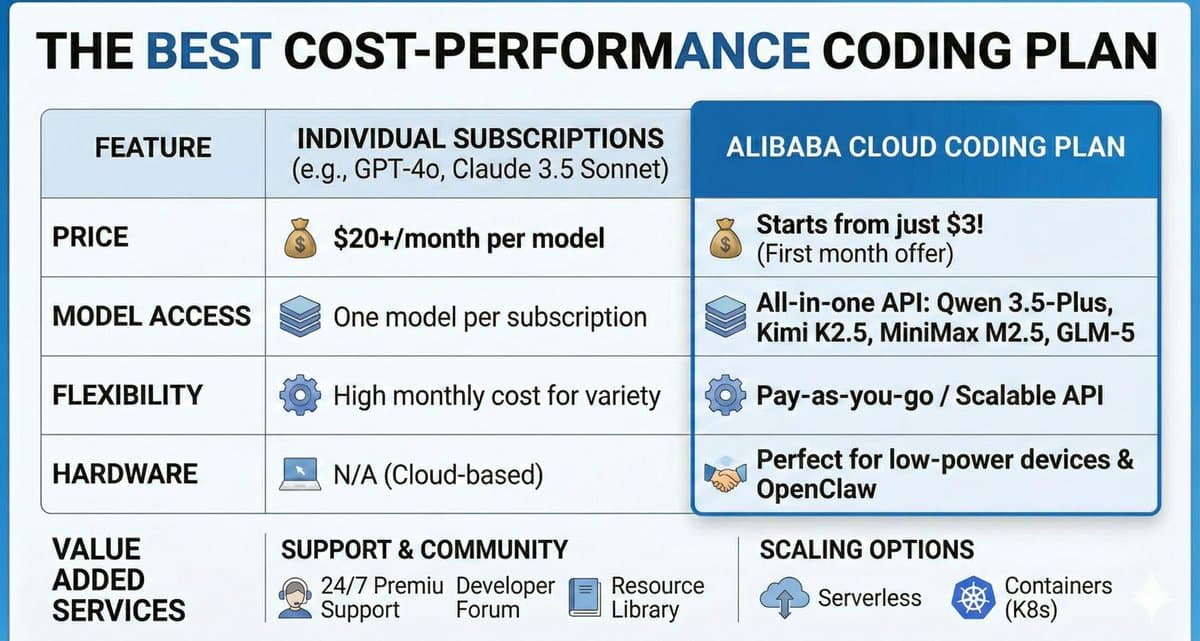
Alibaba Cloud has launched what may be the most aggressive pricing move in the AI coding assistant space to date: a unified subscription plan offering access to four frontier coding models for just $3. The "Coding Plan," as announced through social media channels, bundles Qwen 3.5-Plus, Kimi K2.5, MiniMax M2.5, and GLM-5 in a single package that dramatically undercuts existing offerings from competitors like OpenAI's ChatGPT Plus.
The Four-Model Bundle
The plan includes what Alibaba describes as "4 frontier coding models" from leading Chinese AI developers:
- Qwen 3.5-Plus: The latest iteration of Alibaba's own Qwen series, known for strong coding capabilities and multilingual support
- Kimi K2.5: An enhanced version of Moonshot AI's Kimi model, which has gained popularity for its long-context capabilities
- MiniMax M2.5: From the company behind the popular Glow app, offering specialized coding assistance
- GLM-5: The latest generation of Zhipu AI's GLM series, known for strong performance on technical tasks
This bundling approach represents a significant departure from the current market norm, where developers typically subscribe to individual services or choose between competing offerings.
Pricing Disruption
At $3 for the entry-level plan, Alibaba's offering comes in at approximately one-sixth the cost of ChatGPT Plus ($20/month) while providing access to multiple models rather than just one. This aggressive pricing strategy appears designed to capture market share in the competitive AI coding assistant space, particularly among developers in price-sensitive markets.
According to the announcement, the plan eliminates the need for "switching between tools" or "paying for 4 separate subscriptions," addressing a common pain point for developers who currently juggle multiple AI assistants for different tasks.
Market Context and Implications
The AI coding assistant market has seen rapid growth since GitHub Copilot's launch in 2021, with numerous competitors entering the space. However, pricing has remained relatively high, typically ranging from $10-30 per month for premium offerings. Alibaba's move represents the first major price disruption in this segment.
This development comes at a time when:
- Developer adoption of AI coding tools has reached critical mass, with surveys suggesting over 50% of professional developers now use AI assistants regularly
- Market consolidation has been anticipated as the space matures beyond the initial proliferation of specialized tools
- Regional competition between Western and Chinese AI companies has intensified, particularly in developer tools
Technical Considerations
While pricing is the headline feature, the technical implications are equally significant. Offering multiple models in a single plan suggests Alibaba has developed:
- Unified API access that allows seamless switching between different model architectures
- Comparative benchmarking capabilities that let developers choose the best model for specific tasks
- Potential ensemble approaches where multiple models could be used in combination for complex coding problems
The inclusion of models from different developers (Alibaba, Moonshot AI, MiniMax, and Zhipu AI) also suggests significant partnership development behind the scenes, potentially indicating a broader ecosystem play.
Competitive Landscape Impact
Alibaba's move puts immediate pressure on several categories of competitors:
Premium standalone services like ChatGPT Plus, Claude Pro, and GitHub Copilot Business now face a dramatically lower-priced alternative that offers model diversity rather than just a single model.
Regional competitors in Asian markets, where Alibaba Cloud has strong infrastructure presence, may need to respond with similar bundling or price adjustments.
Open-source alternatives, while free, typically require more technical expertise to deploy and maintain compared to Alibaba's managed service approach.
Developer Experience and Workflow Integration
The announcement emphasizes workflow efficiency, suggesting that Alibaba has focused on reducing the friction developers experience when switching between different AI coding tools. This could include:
- Unified interface for accessing all four models
- Consistent API patterns across different model providers
- Integrated tooling that understands when to use which model based on task requirements
- Cost optimization features that route requests to the most cost-effective model for each task
Global Expansion Considerations
While initially announced in Chinese markets, this pricing strategy could have global implications if Alibaba decides to expand the offering internationally. The $3 price point would be disruptive in Western markets where developer salaries and tool budgets are typically higher.
However, international expansion would face challenges including:
- Language and localization requirements
- Data sovereignty concerns in different regions
- Competitive responses from established players
- Infrastructure requirements for low-latency global access
Business Model Implications
The extremely low price point raises questions about Alibaba's business model for this offering:
Loss leader strategy: The plan may be designed to attract developers to Alibaba's broader cloud ecosystem, where they might purchase additional services.
Scale economics: At sufficient volume, even $3/month could be profitable given Alibaba's existing infrastructure.
Data value: The coding patterns and preferences captured from developers using these tools could have significant value for model improvement.
Partnership revenue sharing: The included models from other companies likely involve revenue sharing arrangements that make the low price sustainable.
Future Developments to Watch
This announcement likely represents just the beginning of a new phase in AI coding tool competition. Key developments to monitor include:
- Competitive responses from other cloud providers and AI companies
- Feature expansion beyond the initial four models
- Integration depth with development environments and workflows
- Quality benchmarks comparing the bundled models against established alternatives
- Enterprise adoption patterns as organizations evaluate cost savings versus established tools
Conclusion
Alibaba Cloud's $3 coding plan represents a significant moment in the evolution of AI-assisted development tools. By bundling multiple frontier models at a disruptive price point, Alibaba is challenging the prevailing subscription models in the space while addressing developer frustrations with tool fragmentation.
The success of this approach will depend on execution quality, model performance, and ecosystem development. However, the mere announcement has already shifted pricing expectations in the market and demonstrated that consolidation and bundling may be the next phase in the AI coding assistant evolution.
As the source tweet suggests, this may indeed become "the coding stack the top 1% of devs are about to quietly use while everyone else argues about Claude vs GPT"—if Alibaba can deliver on the promise of seamless access to multiple high-quality models at this unprecedented price point.
Source: @hasantoxr on X/Twitter