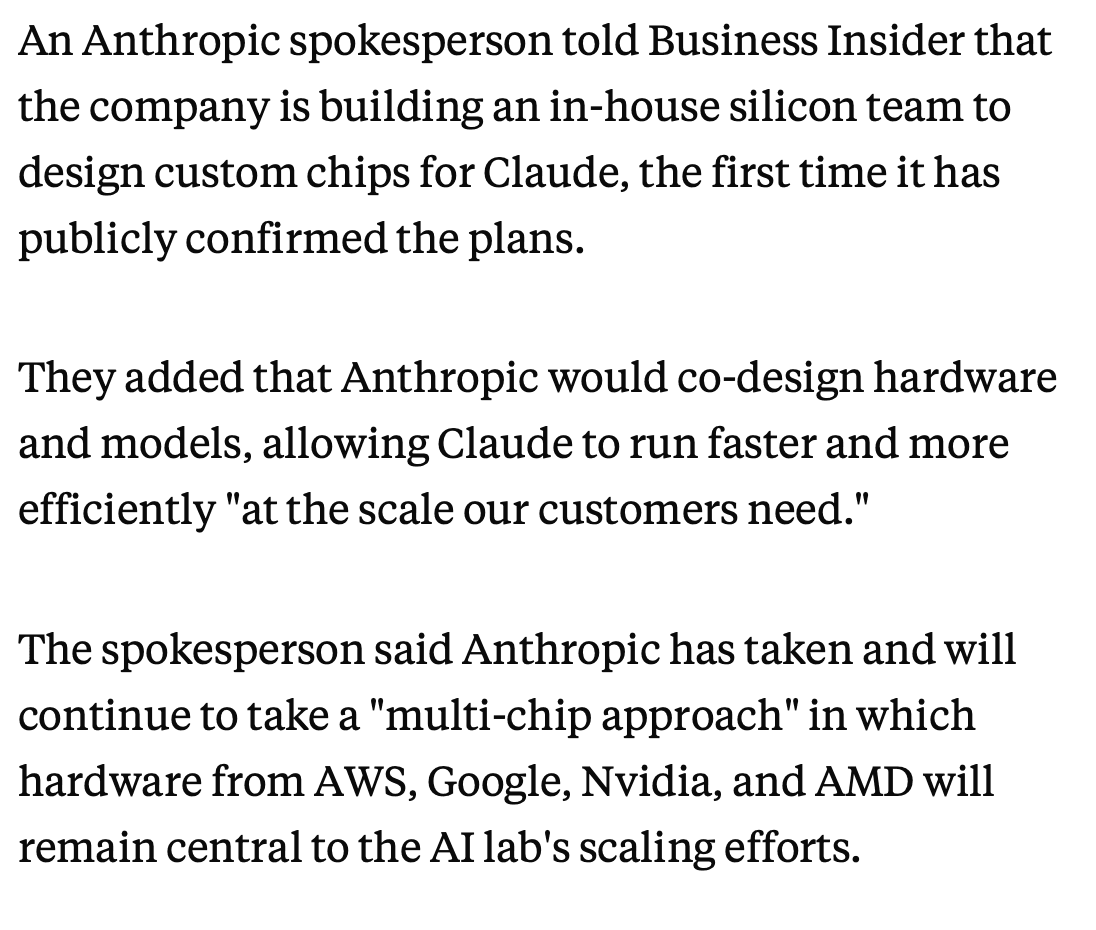
Anthropic is building an in-house chip team for Claude, according to Business Insider. The move aims to co-design hardware and models for faster, more efficient inference.
Key facts
- Anthropic building in-house chip team
- Goal: co-design hardware and models for Claude
- Multi-chip approach with AWS, Google, Nvidia, AMD
- No timeline or team size disclosed
- Follows Google TPU and AWS Trainium pattern
Anthropic is assembling an internal chip team to co-design hardware with its models, a strategy that could give the company more control over inference performance and cost at customer scale. According to Business Insider, the team's goal is to make Claude "run faster and more efficiently at customer scale." The company did not disclose the size of the team or a timeline for first silicon.
Anthropic says it will maintain a "multi-chip approach," with AWS, Google, Nvidia, and AMD remaining central to its infrastructure. That means the in-house effort is additive, not a replacement — at least for now. The company's own chips would likely target specific workloads where co-design yields the biggest gains, such as inference serving or memory-bound operations.
The move follows a broader industry pattern. Google has deployed its TPUs for years, and Amazon's Trainium and Inferentia chips now power a significant share of AWS AI workloads. Anthropic has previously used AWS Trainium for training, though the company has also relied heavily on Nvidia GPUs. An in-house chip team signals Anthropic's intent to control more of its silicon stack, a pattern already set by Google and Amazon.
Key Takeaways
- Anthropic is building an in-house chip team to co-design hardware with Claude, aiming for faster, cheaper inference.
- The company maintains a multi-chip strategy with AWS, Google, Nvidia, and AMD.
What co-design means in practice
Co-design is not just about building a chip; it's about aligning the model architecture with the hardware's memory hierarchy, interconnect, and instruction set. For Claude, this could mean optimizing attention mechanisms or quantization schemes to exploit custom silicon. The payoff is lower latency per token and reduced cost per inference — critical metrics as Anthropic scales enterprise deployments.
The company is not abandoning its partners. AWS remains its primary cloud provider, with a multi-year, multi-billion-dollar commitment. Google and Nvidia supply compute for training and inference. AMD's MI300 series has also been part of Anthropic's infrastructure mix. The in-house team is likely to focus on specialized accelerators that complement, rather than replace, these existing chips.
Why this matters beyond Anthropic
This is a signal to the broader AI infrastructure market. If Anthropic ships custom silicon, it could reduce its dependence on Nvidia, which currently dominates AI accelerators. It also pressures AWS, which sells Trainium as a differentiated product — if Anthropic builds its own chips, AWS's value proposition shifts. And it validates the co-design approach that Google has long championed.
The company did not disclose the size of the chip team or a timeline for first silicon. Hiring for silicon architects and engineers is likely to ramp up, and any public partnership with a foundry would be a major signal. For now, the multi-chip strategy means Anthropic is hedging its bets, but the in-house team is a clear step toward vertical integration.
What to watch
Watch for Anthropic job postings for silicon architects and any public partnership with a foundry like TSMC or Intel. Also track whether AWS Trainium usage in Anthropic's infrastructure grows or stalls — that will indicate whether the in-house effort is complementary or competitive.