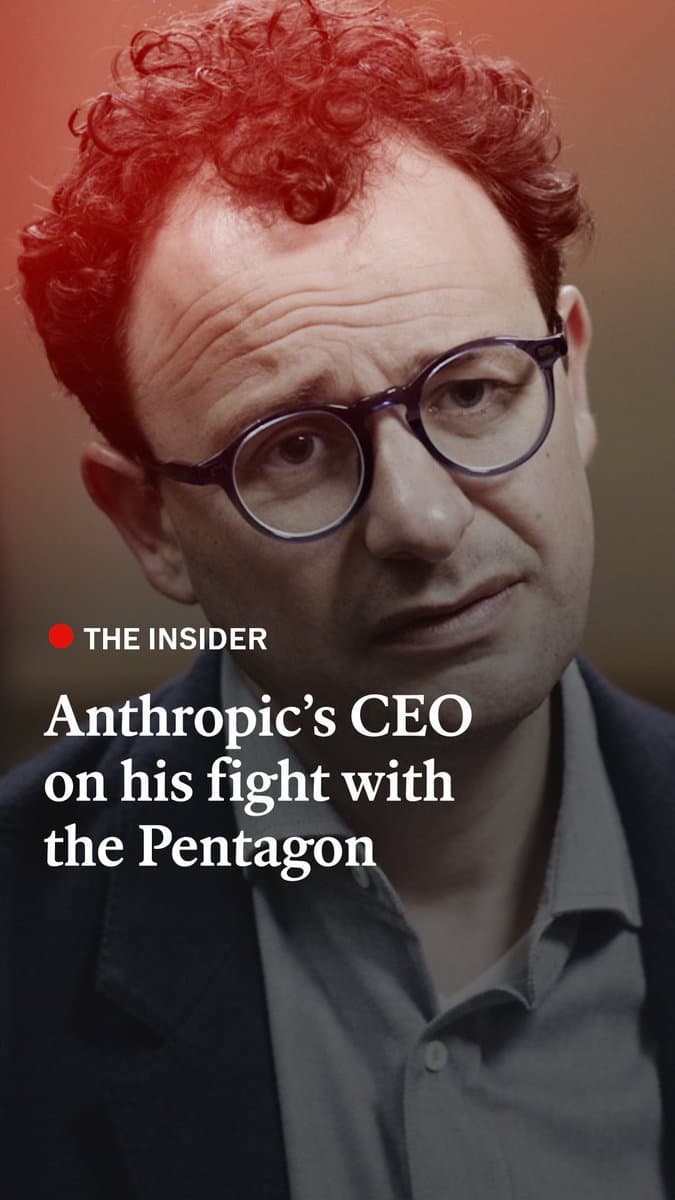
In a striking public statement, Anthropic CEO Dario Amodei has articulated one of the central dilemmas of the artificial intelligence era: the simultaneous risk of corporations wielding more power than governments, and governments becoming so powerful they cannot be constrained. This warning comes at a critical juncture as AI capabilities accelerate and regulatory frameworks struggle to keep pace.
The Statement and Its Context
Speaking recently, Amodei stated: "We don't want to make companies more powerful than the government. But we also don't want to make government so powerful that it can't be stopped. We have both problems at once."
This concise formulation captures the essential tension in AI governance. On one hand, AI companies—particularly those developing frontier models—are accumulating unprecedented technological capabilities, economic influence, and geopolitical leverage. On the other hand, governments worldwide are responding with regulatory proposals that could potentially grant them sweeping authority over technological development.
Amodei's comments reflect Anthropic's distinctive position in the AI landscape. Founded by former OpenAI researchers concerned about AI safety, Anthropic has positioned itself as a "public benefit corporation" with an explicit focus on developing AI responsibly. Unlike some competitors, Anthropic has actively engaged with policymakers and advocated for certain regulatory measures while warning against others.
The Corporate Power Problem
The first half of Amodei's warning addresses what many observers call the "corporate sovereignty" problem. As AI systems become more capable, the companies that control them gain influence across multiple domains:
Economic Dominance: AI companies are achieving valuations that rival small nations' GDPs, with the potential to disrupt entire industries and labor markets.
Technological Asymmetry: Corporations often possess more advanced AI capabilities than government agencies, creating an information and capability gap that challenges traditional governance.
Geopolitical Influence: AI development has become a strategic arena where corporate decisions can affect national security and international relations.
This concentration of power raises fundamental questions about democratic accountability. When private entities control technologies that can influence elections, shape public discourse, or potentially automate significant portions of military and economic systems, traditional checks and balances may prove inadequate.
The Government Overreach Problem
The second half of Amodei's warning addresses what might be called the "regulatory overreach" or "authoritarian capture" problem. As governments recognize AI's transformative potential, many are proposing regulatory frameworks that could:
Stifle Innovation: Overly restrictive regulations could hamper beneficial AI development, particularly in open-source communities and smaller research organizations.
Centralize Control: Some regulatory approaches could concentrate power in executive agencies with limited transparency or accountability.
Enable Surveillance: AI governance frameworks could potentially be used to justify expanded surveillance capabilities that threaten civil liberties.
This concern is particularly acute in an era when many democracies are experiencing democratic backsliding and authoritarian tendencies. The tools developed for AI governance could potentially be repurposed for social control if they fall into the wrong hands or lack sufficient safeguards.
The Simultaneity Problem
What makes Amodei's formulation particularly insightful is his emphasis that "we have both problems at once." This isn't a sequential challenge where we solve corporate power and then address government overreach, or vice versa. The two risks are developing concurrently and may even reinforce each other:
Regulatory Capture: Powerful corporations might shape regulations to entrench their dominance while appearing compliant.
Public-Pruthoritarian Partnerships: Governments and corporations could form alliances that combine corporate technological capabilities with state authority in ways that evade traditional checks.
Policy Whiplash: Inadequate responses to corporate power might trigger overcorrections toward excessive government control, or vice versa.
Anthropic's Governance Approach
Anthropic's response to this dilemma has been multifaceted. The company has:
- Adopted a public benefit corporate structure that legally requires consideration of societal impacts
- Implemented Constitutional AI techniques designed to align models with specified principles
- Engaged in policy discussions advocating for "sensible regulation" that addresses safety without stifling innovation
- Supported third-party auditing and evaluation frameworks
However, critics argue that even well-intentioned corporate governance measures cannot substitute for robust democratic institutions and legal frameworks. The fundamental challenge remains: how to distribute power in a way that prevents concentration while preserving innovation and liberty.
International Dimensions
The corporate-government power balance varies significantly across jurisdictions. In China, the state maintains firm control over corporate AI development. In the European Union, comprehensive regulations like the AI Act are advancing. In the United States, a more fragmented approach has emerged with executive orders, legislative proposals, and voluntary corporate commitments.
These divergent approaches create additional complications. Corporations can engage in "regulatory arbitrage" by locating operations in favorable jurisdictions, while governments may compete to attract AI investment through permissive policies—potentially creating a "race to the bottom" on safety standards.
Paths Forward
Addressing Amodei's dual challenge will require innovative approaches to governance that go beyond traditional regulatory models. Potential directions include:
Distributed Governance: Mechanisms that involve multiple stakeholders—including civil society, academic institutions, and international organizations—in AI oversight.
Technical Safeguards: Building transparency, auditability, and controllability directly into AI systems through architectural choices.
International Cooperation: Developing multilateral frameworks that establish baseline standards while respecting democratic diversity.
Adaptive Regulation: Creating regulatory approaches that can evolve alongside technological capabilities without requiring constant legislative revision.
Conclusion
Dario Amodei's warning about the simultaneous risks of corporate and government power concentration in AI represents a crucial framing of one of our era's defining challenges. As AI capabilities continue to advance, finding the delicate balance between enabling innovation and preventing power concentration will test our political institutions, ethical frameworks, and technical ingenuity.
The path forward likely lies not in choosing between corporate or government control, but in designing new forms of governance that distribute power, ensure accountability, and preserve the democratic values that underpin free societies. How we navigate this challenge will significantly shape whether AI becomes a tool for human flourishing or a source of unprecedented concentration of power.
Source: Statement by Anthropic CEO Dario Amodei as reported by @rohanpaul_ai on X/Twitter