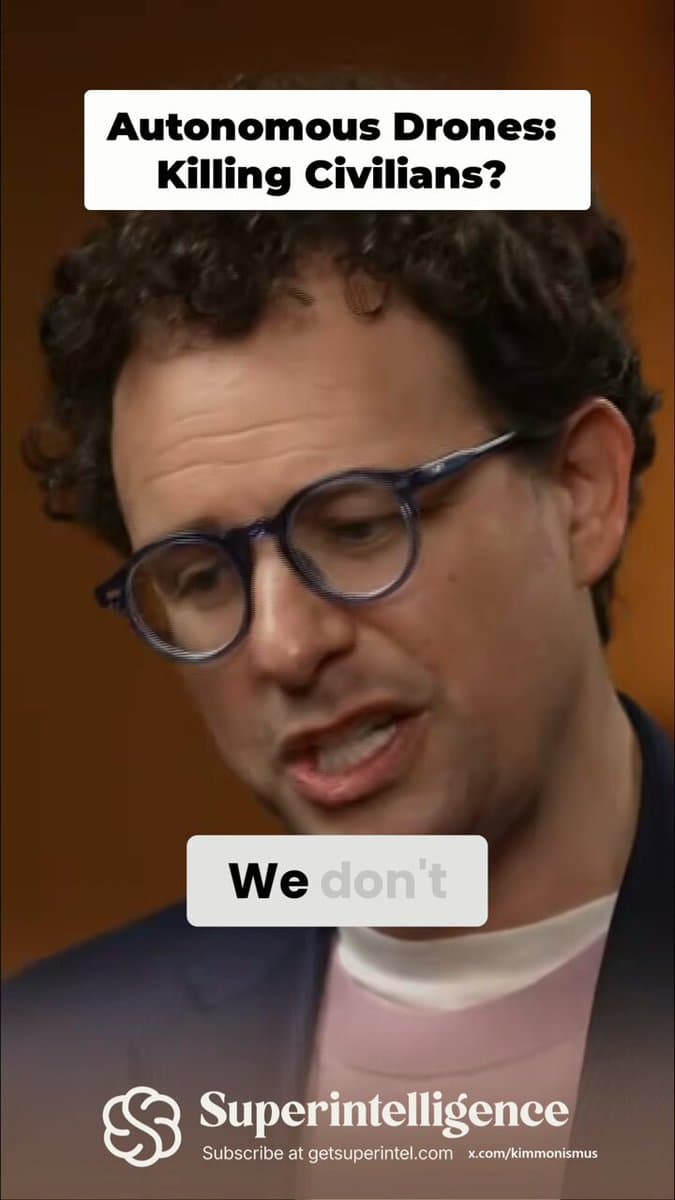
In a striking intervention that cuts to the heart of contemporary AI ethics debates, Anthropic CEO Dario Amodei has publicly articulated grave concerns about the proliferation of artificial intelligence in military applications. Speaking about conflicts like the ongoing war in Ukraine, Amodei highlighted two critical dangers: the sale of unreliable technology that could harm civilians or friendly forces, and the concentration of power in autonomous drone fleets that creates profound accountability issues. His comments, shared via social media, signal a growing rift between AI developers and military contractors, while underscoring the urgent need for regulatory frameworks that haven't kept pace with technological advancement.
The Reliability Crisis in Battlefield AI
Amodei's first concern addresses what might be considered the most immediate technical danger: deploying AI systems that simply aren't reliable enough for life-or-death decisions. "Selling unreliable tech that could harm civilians or own forces is a major concern," he stated, pointing to what many in the field see as a dangerous commercialization race where ethical considerations are secondary to market opportunities.
This reliability question isn't merely theoretical. Modern conflict zones have become testing grounds for autonomous and semi-autonomous systems, from drone swarms to AI-assisted targeting systems. Unlike traditional weapons with predictable failure modes, AI systems can fail in unexpected ways—misidentifying targets, behaving unpredictably in novel environments, or being vulnerable to adversarial attacks that wouldn't affect conventional systems. The consequences of such failures in active combat zones could be catastrophic, potentially violating international humanitarian law and causing irreversible harm.
The Accountability Vacuum in Autonomous Fleets
Perhaps more philosophically troubling is Amodei's second point about concentrated power. "Beyond reliability, concentrated power in drone fleets raises accountability issues," he noted, touching on a problem that legal scholars and ethicists have been wrestling with for years. When decision-making is distributed across hundreds or thousands of autonomous units, traditional chains of command and responsibility begin to break down.
Who is accountable when an autonomous drone fleet makes a collective decision that results in civilian casualties? Is it the programmer who wrote the algorithms? The military commander who deployed the system? The manufacturer who sold it? Or does accountability simply dissipate in the complexity of the system? This "accountability vacuum" represents one of the most significant challenges to modern military ethics and international law.
The Growing Divide Between AI Developers and Military Applications
Amodei's comments reflect a broader tension within the AI community. While some companies aggressively pursue military contracts, others—including Anthropic—have taken more cautious approaches. This divide mirrors earlier tech industry debates about surveillance, facial recognition, and other dual-use technologies.
What makes Amodei's intervention particularly significant is his position as CEO of one of the world's leading AI safety companies. Anthropic's constitutional AI approach, which emphasizes alignment with human values, appears fundamentally at odds with applications that could bypass human judgment in lethal decisions. His statement suggests that at least some AI leaders see military applications as crossing ethical red lines that other commercial applications might not.
The Urgent Need for Oversight Conversations
"We need a conversation on oversight and who can ultimately say no," Amodei concluded, pointing toward what might be the most challenging aspect of military AI governance. Current regulatory frameworks were designed for human-operated systems and struggle to address autonomous decision-making.
Effective oversight would need to address multiple levels:
- Technical oversight: Standards for testing, validation, and reliability of military AI systems
- Operational oversight: Rules of engagement and human supervision requirements
- Strategic oversight: Broader policies about which applications should be developed at all
- International oversight: Agreements comparable to chemical weapons bans or nuclear non-proliferation treaties
The question of "who can ultimately say no" touches on fundamental issues of democratic control over military technology. Should decisions about autonomous weapons be made by military leaders, elected officials, international bodies, or some combination thereof?
Industry Responsibility and the Path Forward
Amodei's statement raises important questions about industry responsibility. As AI capabilities accelerate, developers face increasing pressure to consider not just what they can build, but what they should build. Some companies have adopted internal ethics boards or published principles governing military applications, but these remain voluntary and inconsistent across the industry.
The conversation Amodei calls for will need to include multiple stakeholders: AI developers, military organizations, ethicists, legal experts, policymakers, and civil society. It will need to address both immediate concerns about existing technology and longer-term questions about more advanced systems that might emerge in coming years.
What makes this moment particularly urgent is the rapid deployment of AI in current conflicts. Unlike previous military revolutions that developed over decades, AI capabilities are advancing—and being deployed—on timescales of months. The oversight conversations Amodei advocates need to happen now, before new technologies become entrenched and their governance becomes even more difficult.
Source: Dario Amodei via @kimmonismus on X/Twitter