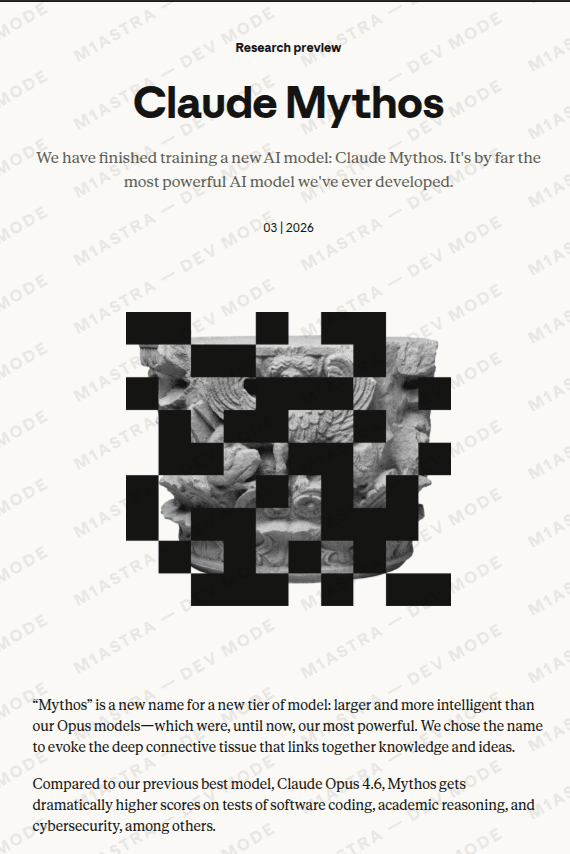
A new rumor circulating in AI circles suggests that Anthropic is preparing to launch two new models, codenamed Mythos and Capybara. According to a post by AI researcher Rohan Paul, Mythos is being built as "a brand-new tier that is larger than Opus"—specifically, Claude 3.5 Opus—and represents "a step above Opus 4.6 rather than a routine upgrade."
The leak, which has not been confirmed by Anthropic, indicates a potential strategic shift for the company. Rather than pursuing a broad, rapid release, Anthropic appears to be targeting a slower, more controlled launch, beginning with "a small set of security-focused users." This approach suggests an initial market focused on high-stakes applications like cyber defense, where extreme capability may justify higher cost and limited availability.
What the Rumor Says
The information comes from a single social media post and should be treated as unverified speculation. However, the details align with observable trends in Anthropic's recent release strategy.
- Mythos as a Premium Tier: Mythos is described as a new tier above the current flagship Claude 3.5 Opus. The phrasing "larger than Opus" typically points to a model with more parameters, a more sophisticated architecture, or both.
- Extreme Cost to Run: The leak emphasizes that Mythos is "extremely expensive to run." In large language model development, this usually correlates with a massive parameter count, longer chain-of-thought reasoning processes, or the use of more expensive inference techniques (like speculative decoding with very large draft models). The source notes that "cost is part of the product story, not just an engineering detail," implying that the high price is a deliberate positioning for a premium, capability-first product.
- Targeted, Security-First Launch: The rumor states Anthropic is "slowing release, limiting access, and starting with a small set of security-focused users." This contrasts with the broader availability of Claude 3.5 Sonnet and Opus via the developer console and API. A focused launch in cybersecurity allows for controlled testing in a domain where high cost can be offset by the value of preventing breaches.
- The Capybara Model: The mention of a second model, Capybara, is not elaborated upon. The name follows Anthropic's tradition of animal-themed codenames (Claude itself, plus previous internal names). Its relationship to Mythos or the existing Claude lineup is unclear.
Strategic Context: Defining a Premium Tier
The rumor, if accurate, points to Anthropic attempting to carve out a new market segment. The AI landscape is increasingly stratified:
- High-Volume, Lower-Cost Tier: Models like GPT-4o, Claude 3.5 Sonnet, and Gemini 1.5 Flash are optimized for balanced performance and cost, targeting broad application development.
- Flagship Capability Tier: Claude 3.5 Opus, GPT-4 Turbo, and Gemini 1.5 Pro compete on top-tier benchmarks for general reasoning.
- Specialized, Premium Tier: A hypothetical tier above this, where marginal gains in reasoning, coding, or security auditing capability command a significantly higher price. This is the niche Mythos is rumored to target.
By launching first with security-focused partners, Anthropic could validate the model's superior performance in tasks like vulnerability detection, threat analysis, and secure code generation before a wider release. This follows a pattern of cautious, enterprise-focused deployment seen in other areas of their business.
Limitations and Caveats
This report is based entirely on an unverified rumor. Key details are missing:
- No technical specifications (parameter count, architecture changes, training data).
- No performance benchmarks or comparisons.
- No official timeline, pricing, or availability information.
- The nature and purpose of the "Capybara" model are unknown.
Until Anthropic makes an official announcement, the existence and specifications of Mythos and Capybara remain speculative.
gentic.news Analysis
This rumor, while unconfirmed, fits neatly into the strategic trajectory we've observed from Anthropic and the competitive pressures of the frontier model landscape. If we examine this through the lens of our knowledge graph, several connections become apparent.
First, this follows Anthropic's established pattern of tiered, capability-driven releases. The launch of the Claude 3 model family in March 2024 clearly stratified Sonnet, Opus, and Haiku based on speed, cost, and intelligence. The rumored "Mythos" represents a logical, if ambitious, extension of this strategy: creating a new top shelf. This aligns with the broader industry trend where, after scaling model parameters and data, the next competitive battleground is increasingly specialized architectures and reasoning techniques—which are notoriously expensive to develop and run. The mention of extreme cost directly reflects this shift from scaling laws to engineering ingenuity.
Second, the rumored focus on a security-first launch is strategically sound and leverages Anthropic's perceived strengths. Our coverage of the AI cybersecurity market has highlighted a growing demand for advanced AI agents in threat detection and response. By targeting this vertical first, Anthropic can deploy Mythos in a domain where its output can be heavily constrained, monitored, and validated, mitigating early risks. It also creates a compelling narrative of building the most secure and capable AI, which is core to Anthropic's brand identity. This would be a direct competitive move in a space where other players are also active, potentially setting the stage for a new wave of enterprise-focused, high-stakes AI tools.
Finally, the rumor of a slowed, limited release contradicts the industry's typical "race to market" narrative but is consistent with Anthropic's cautious, safety-first ethos. It suggests a company confident enough in its roadmap to prioritize controlled, valuable deployments over mass market hype. The success of this strategy hinges on whether the purported capability gap between Mythos and Opus is substantial enough for enterprises to justify a potentially order-of-magnitude higher cost. The answer to that will determine if "Mythos" becomes a new category-defining product or a niche offering.
Frequently Asked Questions
What are the rumored Anthropic models Mythos and Capybara?
Based on an unverified leak, Anthropic is reportedly developing two new AI models. Mythos is described as a new premium tier positioned above the current flagship Claude 3.5 Opus, characterized by larger scale and extremely high operational cost. Capybara is another rumored model, but no details about its capabilities or positioning have been suggested.
How would Mythos differ from Claude 3.5 Opus?
The rumor suggests Mythos would be a significant step up from Opus, not just an incremental update. The key differentiators implied are superior reasoning capability (likely through a larger model size or novel architecture) and a much higher cost to run. Its initial launch is speculated to be narrowly focused on security applications, unlike the general availability of Opus.
Why would Anthropic launch an extremely expensive model?
Creating a new, ultra-premium tier allows Anthropic to serve markets where the absolute highest level of AI performance justifies significant expense, such as advanced cybersecurity, complex scientific research, or high-value financial modeling. It also establishes a new technical ceiling, reinforcing Anthropic's position as a leader in frontier AI research, even if the customer base for such a model is initially small.
When will Anthropic's Mythos model be released?
There is no official release date or even confirmation that Mythos exists. The rumor suggests a slowed, limited release strategy, starting with a select group of security-focused users. If development is underway, a controlled beta or early access program for enterprise partners would be a likely first step before any public announcement or broader API availability.