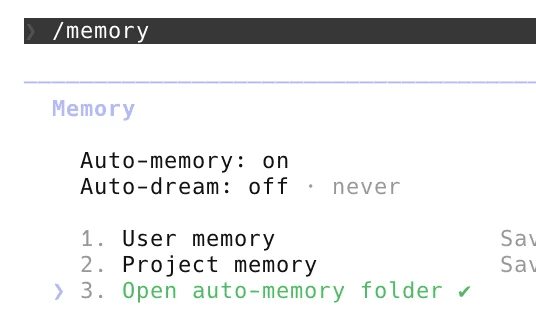
A potentially unreleased feature for Anthropic's Claude Code, dubbed "Auto-dream," has been spotted in the /memory interface. The feature appears to be an advanced automation layer for the AI assistant's project memory system, designed to maintain an efficient and organized knowledge base without manual intervention.
What the Feature Reportedly Does
Based on the observation shared by AI researcher Rohan Pandey, the "Auto-dream" feature seems to run a background Claude subagent. This agent periodically reviews recent coding sessions, consolidates what was learned, and updates the project's primary memory index file, MEMORY.md. Crucially, its function is not to amass raw notes in a single, unwieldy file. Instead, it actively prunes or reorganizes stale details into separate, topic-specific memory files. The goal is to keep the core memory "short, indexed, and durable."
This process complements the existing "auto memory" system described in Anthropic's public documentation. That system functions as a per-project memory where Claude writes relevant information during a session. The /memory command is the user interface to inspect or toggle this system. The core architecture involves a concise MEMORY.md file that is loaded at the start of a project session, alongside separate topic files that Claude can read on-demand when context is needed.
In essence, while the standard auto memory writes memories during active work, the new Auto-dream feature appears to handle post-processing: it compacts and restructures those memories after the fact, during idle or background periods.
Context: Anthropic's Project Memory for Claude Code
Claude Code, part of the Claude developer tools, includes a project-level memory system designed to help the AI maintain context across long, multi-session coding projects. This addresses a common limitation of large language models (LLMs) where context is lost once a chat session ends or the context window is exceeded.
The documented system works by creating a project-specific directory containing:
MEMORY.md: A high-level index of key facts, decisions, and project structure.- Topic files (e.g.,
memory_database_schema.md,memory_auth_logic.md): Detailed notes on specific subjects, referenced by the index.
When a user starts a new session in a project with memory enabled, Claude loads the MEMORY.md file to re-establish context. It can then pull in details from the topic files as needed during the conversation, creating a persistent, evolving knowledge base for the project.
The discovery of "Auto-dream" suggests Anthropic is investing in making this system more autonomous and less burdensome for the developer. Manual memory management—deciding what to keep, where to put it, and when to archive it—can itself become a chore. An AI that can self-organize its own contextual knowledge would be a significant step toward more seamless, long-term collaboration.
Potential Implications for Developer Workflow
If released, a feature like Auto-dream could shift how developers interact with AI coding assistants over the lifecycle of a project.
- Reduced Cognitive Load: Developers would not need to manually prompt Claude to "summarize what we learned" or "clean up the memory file." The maintenance happens automatically, ensuring the memory stays useful without user intervention.
- Improved Memory Quality: An AI agent specifically tasked with review and consolidation might produce more coherent, well-structured, and de-duplicated memory files than ad-hoc notes written during a fast-paced coding session.
- Durability of Context: By actively pruning stale details (like abandoned approaches or outdated API references) into archived files, the core
MEMORY.mdindex remains relevant and fast to load, preventing "memory bloat" that could degrade performance over time.
This aligns with a broader industry trend of moving from single-session AI tools to persistent, agent-like systems that learn and adapt alongside a user or project.
Current Status and Next Steps
The feature was identified as "possibly unreleased." It was visible within the /memory interface but may be an internal test, an upcoming beta feature, or an experimental build. There has been no official announcement or documentation from Anthropic regarding "Auto-dream" at this time.
Developers interested in the current, documented memory system can explore it within Claude Code. The potential addition of Auto-dream highlights the ongoing evolution of AI assistants from reactive tools to proactive, context-aware partners in complex software development.
gentic.news Analysis
This leak of "Auto-dream" fits directly into the intensifying platform war among frontier AI companies, where long-context, persistent memory is becoming a critical battleground. Anthropic's documented project memory system for Claude Code was already a direct counter to OpenAI's custom GPTs and the now-deprecated Code Interpreter, which lacked persistent, structured memory between sessions. The development of an automated compaction agent like Auto-dream suggests Anthropic is pushing beyond simple storage to tackle the usability and scalability of long-term AI memory—a known pain point. As project memories grow over weeks or months, they risk becoming noisy and inefficient; Auto-dream appears to be an algorithmic solution to this information entropy.
This move is highly consistent with Anthropic's recent strategic focus. Following their landmark $4 billion investment from Amazon in late 2023 and the subsequent release of the Claude 3 model family, the company has sharply increased its developer-facing activities. The trend line shows a clear pivot from a pure research lab to a platform contender. The introduction of Claude Code and its associated features represents a direct challenge to GitHub Copilot and Cursor, aiming to capture the professional developer workflow. Auto-dream, as an automation layer, is precisely the kind of deep workflow integration that locks in users, making the tool indispensable for long-term projects.
The concept also resonates with broader research into LLM self-improvement and reflection. The described subagent that "periodically reviews recent sessions" mirrors techniques used in advanced AI agents like those built on the ReAct (Reasoning + Acting) framework, where an LLM is prompted to critique and refine its own previous outputs. By baking this reflection loop directly into a core product feature for memory management, Anthropic is productizing a research concept, moving it from experimental notebooks to a practical developer tool. If successful, it could set a new standard for how AI coding assistants maintain and curate their own growing knowledge of a codebase.
Frequently Asked Questions
What is Claude Code's Auto-dream feature?
Auto-dream is a potentially unreleased feature for Anthropic's Claude Code that uses a background AI subagent to automatically review, consolidate, and reorganize a project's memory files. Its job is to keep the primary memory index (MEMORY.md) concise and useful by moving stale or detailed information into separate topic files, functioning as an automated maintenance system for the AI's project knowledge.
How is Auto-dream different from Claude's existing auto memory?
The existing auto memory system actively writes relevant information to memory files during a coding session. Auto-dream operates after the session, in the background, to compact, prune, and reorganize those memories. Think of auto memory as the note-taker and Auto-dream as the librarian who files, indexes, and archives the notes later.
Has Anthropic officially released the Auto-dream feature?
No. As of this report, Auto-dream has not been officially announced or documented by Anthropic. It was discovered as a visible but possibly inactive element within the /memory interface of Claude Code, suggesting it is in development or internal testing.
Why is automated memory management important for AI coding assistants?
As developers use AI assistants on longer projects, the memory of past decisions, code structures, and APIs can grow large and disorganized. Manual management of this memory becomes a task itself. Automated compaction and indexing ensure the memory stays fast-loading, relevant, and durable over time, reducing developer cognitive load and making the AI a more effective long-term partner.