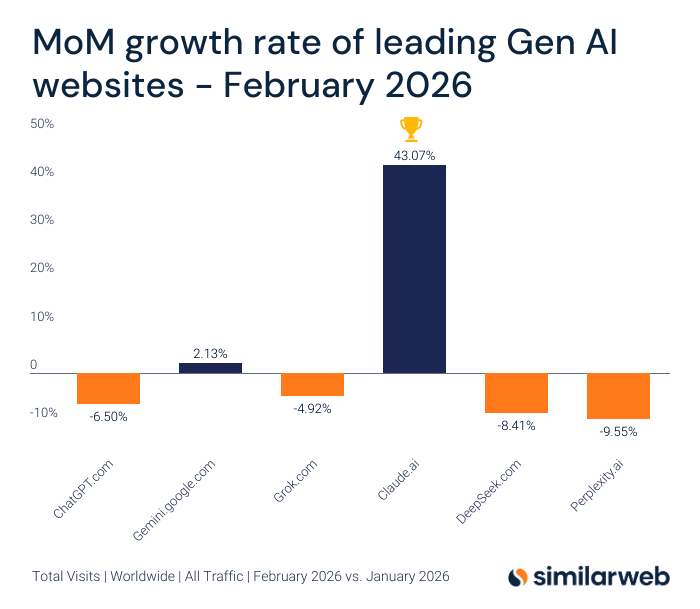
In a striking demonstration of how public adoption can diverge from institutional validation, Anthropic's Claude AI has emerged as the fastest-growing generative AI tool by website visits in February 2024. This surge in popularity comes despite the company's recent loss of a significant Department of Defense contract to rival OpenAI, highlighting the complex dynamics shaping the competitive AI landscape.
The Growth Metrics That Matter
According to data referenced in recent reports, Claude.ai experienced the most substantial month-over-month growth in website traffic among major generative AI platforms during February. While specific percentage increases weren't detailed in the source material, the designation as "fastest-growing" indicates Claude is gaining substantial traction with general users, researchers, developers, and businesses seeking alternatives to the dominant players in the field.
This growth trajectory is particularly noteworthy given Anthropic's position as a relative newcomer compared to established giants like OpenAI's ChatGPT and Google's Gemini. The company's focus on constitutional AI—a framework designed to create more aligned, helpful, and harmless AI systems—appears to be resonating with a segment of users concerned about AI safety and ethical considerations.
The Department of Defense Decision
The contrasting narrative emerges from the government sector, where Anthropic reportedly lost a significant contract with the Department of Defense to OpenAI. While details about the specific contract weren't provided in the source material, such defense contracts typically involve substantial funding, long-term partnerships, and validation of a company's technical capabilities and security protocols.
Government contracts, particularly in defense and intelligence sectors, carry weight beyond their monetary value. They serve as endorsements of a company's reliability, security posture, and ability to meet stringent requirements. Losing such a contract to a direct competitor represents more than just a financial setback—it signals that institutional evaluators found another solution more suitable for sensitive applications.
The Public-Government Disconnect
The simultaneous occurrence of these two developments—rapid public adoption and government contract loss—reveals an interesting disconnect between different types of AI adoption. Public users appear to be prioritizing different factors than government evaluators when selecting AI tools.
For general users, factors like ease of use, output quality, conversational ability, and perceived ethical stance may weigh more heavily. Anthropic's emphasis on constitutional AI and transparent development practices may be particularly appealing to users concerned about AI alignment and responsible development.
Government agencies, particularly defense departments, likely prioritize different criteria: proven security protocols, integration capabilities with existing systems, scalability for large-scale deployment, and demonstrated reliability in high-stakes environments. The fact that OpenAI secured the contract suggests their offering better met these specific institutional requirements.
Implications for the AI Competitive Landscape
This development highlights several important trends in the AI industry:
1. Multiple Paths to Success: Success in AI isn't monolithic. Companies can thrive through different strategies—some through government and enterprise contracts, others through mass public adoption, and many through a combination of both.
2. The Value of Public Trust: Anthropic's growth suggests that a focus on AI safety and ethical development isn't just a philosophical stance but potentially a competitive advantage in attracting users who prioritize these values.
3. Market Segmentation: The AI market appears to be segmenting, with different providers excelling in different domains. OpenAI continues to demonstrate strength in institutional adoption, while Anthropic is gaining ground with public and potentially research-oriented users.
4. Validation Beyond Contracts: While government contracts provide important validation, public adoption metrics offer their own form of market validation, particularly for companies aiming to build broadly used AI systems.
Looking Forward
Anthropic's position as the fastest-growing generative AI tool by website visits, even after losing a significant government contract, suggests the company has tapped into substantial public interest. This growth provides valuable momentum as the company continues to develop its technology and business model.
The divergent outcomes also raise questions about how different sectors evaluate and adopt AI technologies. As AI systems become increasingly sophisticated and integrated into various aspects of society, understanding these different adoption patterns will be crucial for companies navigating the competitive landscape.
For users, the growth of Claude provides more choice in the AI ecosystem and potentially pushes all providers toward higher standards of transparency and safety. For the industry, it demonstrates that there's room for multiple approaches to AI development and deployment, with different value propositions resonating with different audiences.
Source: Rohan Paul (@rohanpaul_ai) on X/Twitter, referencing Claude.ai's growth metrics and Department of Defense contract developments.