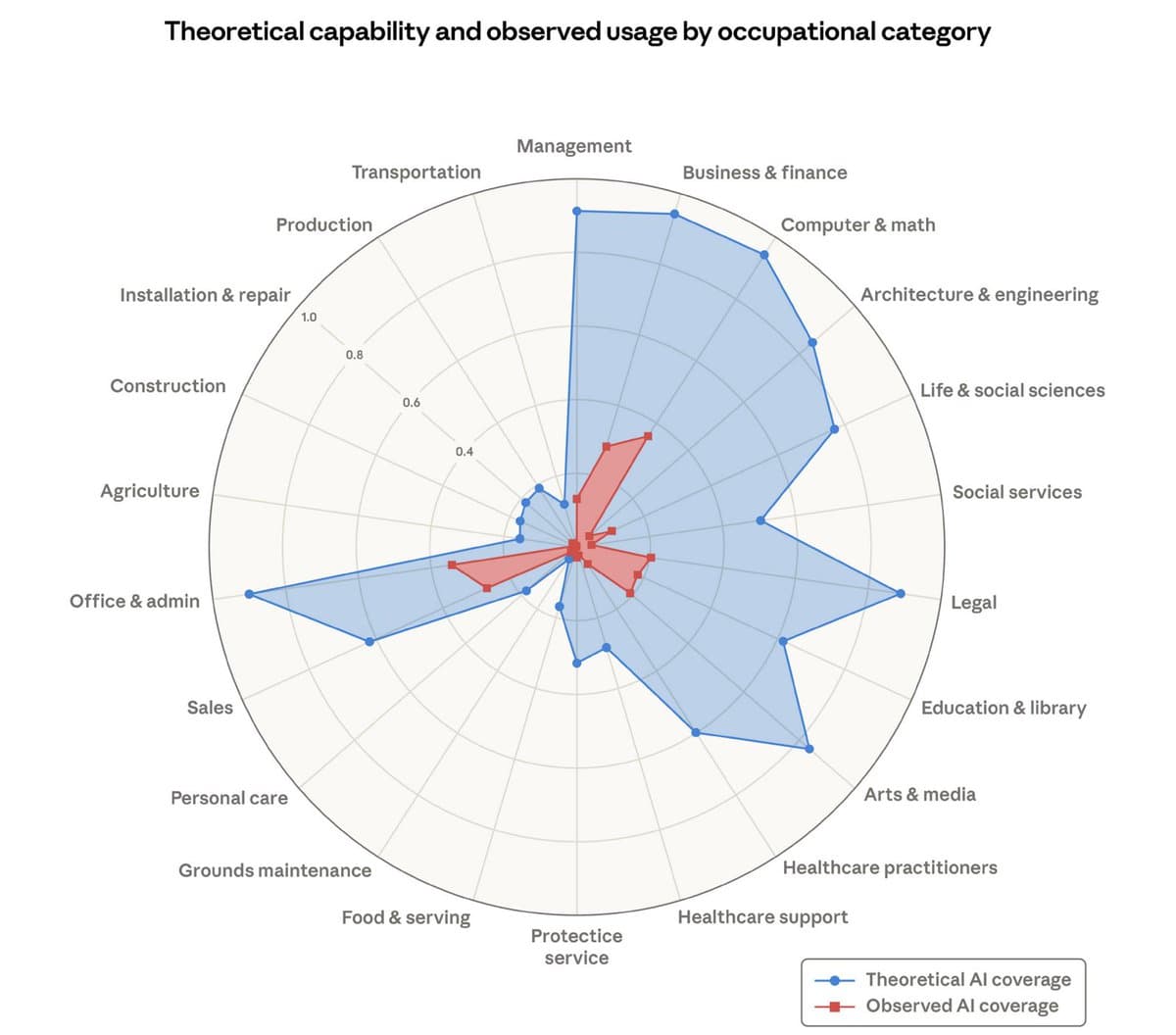
Artificial intelligence research company Anthropic has published a significant study examining AI's impact on labor markets, revealing what researchers describe as "a huge difference between what AI can do today and what it will theoretically be able to do in the future." This gap between present capabilities and future potential represents more than just technological progress—it's creating what the study identifies as "a serious problem for those starting their careers in the field."
The Present-Future Disconnect
Anthropic's research highlights a fundamental challenge in workforce planning: while current AI systems demonstrate impressive capabilities in specific domains, their rapid evolution means that the skills needed today may become obsolete or significantly transformed within just a few years. This acceleration creates uncertainty for both educational institutions designing curricula and individuals planning career paths.
The study suggests that traditional career planning models—which typically assume gradual technological change—are increasingly inadequate in the face of AI's exponential development. This disconnect is particularly pronounced in fields directly related to AI development, data science, and technology implementation, where the tools and methodologies are evolving at unprecedented rates.
Implications for Early-Career Professionals
For those entering the workforce or early in their careers, Anthropic's findings present a paradox: how to prepare for jobs that may not yet exist using technologies that haven't been invented? The research indicates that this uncertainty extends beyond technical fields, affecting how AI will transform roles in marketing, finance, healthcare, education, and creative industries.
The study emphasizes that the problem isn't simply about job displacement but about the difficulty of developing sustainable career paths when the technological foundation keeps shifting. This creates what researchers call "career planning vertigo"—the disorientation that comes from trying to navigate a professional landscape that's being reshaped in real-time.
Educational System Challenges
Anthropic's analysis extends to educational institutions, which face their own version of this challenge. Universities and training programs must decide whether to teach current AI tools and techniques (which may become obsolete) or focus on fundamental principles (which may not provide immediately marketable skills). The study suggests that the most effective approach may involve hybrid models that combine theoretical foundations with adaptive learning frameworks.
This educational dilemma has significant implications for workforce development, particularly as governments and organizations invest in retraining programs. If the target keeps moving, how can these programs remain relevant and effective?
Industry Adaptation Strategies
The research also examines how companies are responding to this uncertainty. Some organizations are developing more flexible role definitions, creating "adaptive positions" that can evolve with technological changes. Others are investing in continuous learning cultures that prioritize skill development over static job descriptions.
Anthropic's findings suggest that companies that successfully navigate this transition will be those that view AI not just as a tool to implement but as a dynamic element requiring ongoing organizational adaptation. This represents a shift from traditional technology adoption models to what researchers call "adaptive integration frameworks."
Policy and Economic Considerations
Beyond individual and organizational impacts, the study addresses broader economic implications. The gap between current and future AI capabilities creates what economists might call a "planning horizon problem"—difficulty in making long-term investments in human capital when the return on those investments is uncertain.
This has implications for everything from immigration policies (how to attract talent for future needs) to social safety nets (how to support workers during transitional periods). The research suggests that traditional policy tools may need rethinking in light of AI's unique development trajectory.
The Psychological Dimension
Anthropic's study doesn't ignore the human element of this transition. Researchers note that the uncertainty created by rapidly evolving AI capabilities can lead to career anxiety, decision paralysis, and what they term "future skill fatigue"—the exhaustion that comes from constantly trying to anticipate what skills will be valuable tomorrow.
This psychological dimension is particularly relevant for younger workers who face what the study describes as "extended uncertainty horizons"—longer periods of career ambiguity than previous generations experienced during technological transitions.
Moving Forward: Adaptive Approaches
The research concludes by suggesting several adaptive approaches to this challenge:
- Meta-skills development: Focusing on skills that enable continuous learning and adaptation
- Scenario-based planning: Developing multiple potential career paths rather than single trajectories
- Modular education: Creating educational systems that allow for easier updating and specialization
- Transparent roadmaps: Better communication from AI developers about likely capability trajectories
Conclusion: Navigating the AI Transition
Anthropic's study represents an important contribution to our understanding of how AI development affects labor markets beyond simple job replacement metrics. By highlighting the gap between current capabilities and future potential, the research provides a framework for thinking about career development in an age of accelerating technological change.
The challenge isn't just about preparing for AI's impact—it's about developing the flexibility to adapt as that impact evolves. As the study makes clear, the most valuable skill in the coming years may not be proficiency with any particular AI system, but the ability to navigate uncertainty and continuously reinvent one's professional capabilities.
Source: Anthropic research on AI and labor markets, as highlighted in social media discussions about career planning challenges in rapidly evolving technological landscapes.