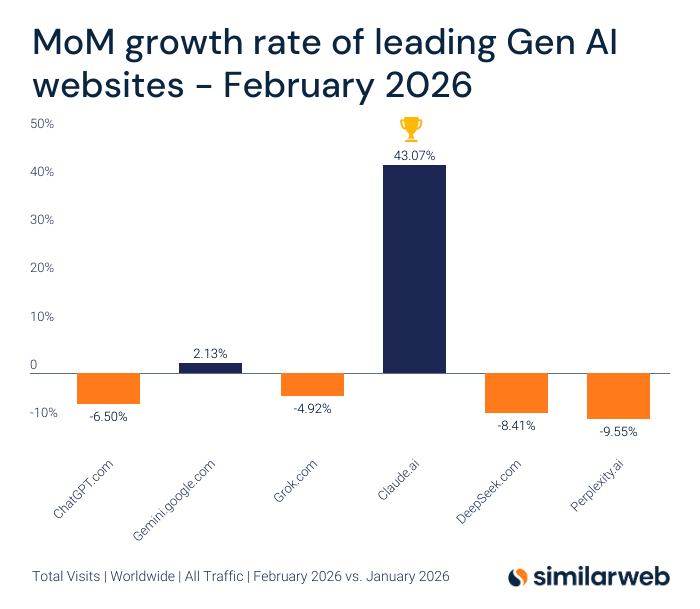
In a surprising twist of corporate fate, Anthropic's recent conflict with the U.S. Department of War (DoW) has created what industry observers are calling a "regulatory paradox" - while causing significant business-to-business (B2B) challenges, the same conflict appears to have accelerated the company's success in the consumer market.
The Conflict That Created Two Different Outcomes
According to industry analyst Kimmonismus, Anthropic's engagement with the Department of War resulted in "serious problems in the business sector," specifically highlighting supply chain risks as a primary concern. For an AI company like Anthropic, which relies on specialized hardware and infrastructure, supply chain disruptions can have cascading effects on enterprise partnerships, cloud deployments, and large-scale implementations.
Yet simultaneously, this same conflict appears to have generated what the analyst describes as "great success in the B2C sector." This divergence between business and consumer outcomes presents a fascinating case study in how regulatory friction can affect different market segments in opposite directions.
The Consumer Trust Factor
Industry experts point to several factors that may explain this paradoxical outcome. First, Anthropic's public positioning around AI safety and constitutional AI principles may have resonated more strongly with consumers amid regulatory scrutiny. When a company faces government oversight, particularly in the sensitive area of defense applications, consumers may perceive that company as more responsible or trustworthy.
Second, the conflict may have generated significant media attention that raised Anthropic's profile among general consumers who previously might not have been aware of the company or its Claude AI assistant. In the competitive AI landscape, where OpenAI's ChatGPT dominates consumer mindshare, any differentiation can provide a crucial advantage.
The Business Sector Fallout
The supply chain risks mentioned in the analysis likely stem from several potential factors. Defense-related conflicts can trigger:
- Vendor restrictions: Technology providers may limit sales to companies engaged in controversial government work
- Infrastructure challenges: Cloud providers and data center operators may become more cautious
- Partner hesitancy: Enterprise clients in regulated industries may delay or reconsider deployments
- Investment uncertainty: Venture capital and corporate investors may perceive increased risk profiles
These business challenges are particularly significant for Anthropic, which has positioned itself as an enterprise-friendly alternative to OpenAI, emphasizing reliability, safety, and business-ready features.
The Broader AI Industry Context
This development occurs against a backdrop of increasing regulatory scrutiny of AI companies. The European Union's AI Act, U.S. executive orders on AI safety, and growing international concern about dual-use AI technologies have created a complex compliance landscape. Companies like Anthropic that engage with government agencies must navigate these waters carefully, balancing opportunity against reputational risk.
What makes Anthropic's case particularly interesting is the apparent divergence between business and consumer reactions. Typically, regulatory conflicts create challenges across all market segments, but here we see consumers responding positively to what might be perceived as responsible engagement with government oversight.
Implications for AI Strategy
This case study suggests several important considerations for AI companies:
- Market segmentation matters: Different customer groups may respond differently to the same corporate events
- Transparency can build trust: Clear communication about government engagements may reassure certain audiences
- Risk diversification is crucial: Over-reliance on any single market segment creates vulnerability
- Brand positioning influences perception: Companies with strong safety narratives may weather controversies better
Looking Forward
The long-term implications of this regulatory paradox remain uncertain. Will Anthropic's consumer success compensate for its business challenges? Can the company leverage its increased consumer trust to eventually overcome enterprise hesitancy? These questions will likely shape Anthropic's strategy in the coming months.
What's clear is that the traditional assumption that regulatory conflicts uniformly harm companies may need revision in the AI era. In a field where trust and safety are paramount concerns, certain types of government engagement may actually enhance rather than diminish consumer confidence.
Source: Analysis based on reporting from @kimmonismus regarding Anthropic's conflict with the Department of War and its differential impact on business versus consumer sectors.