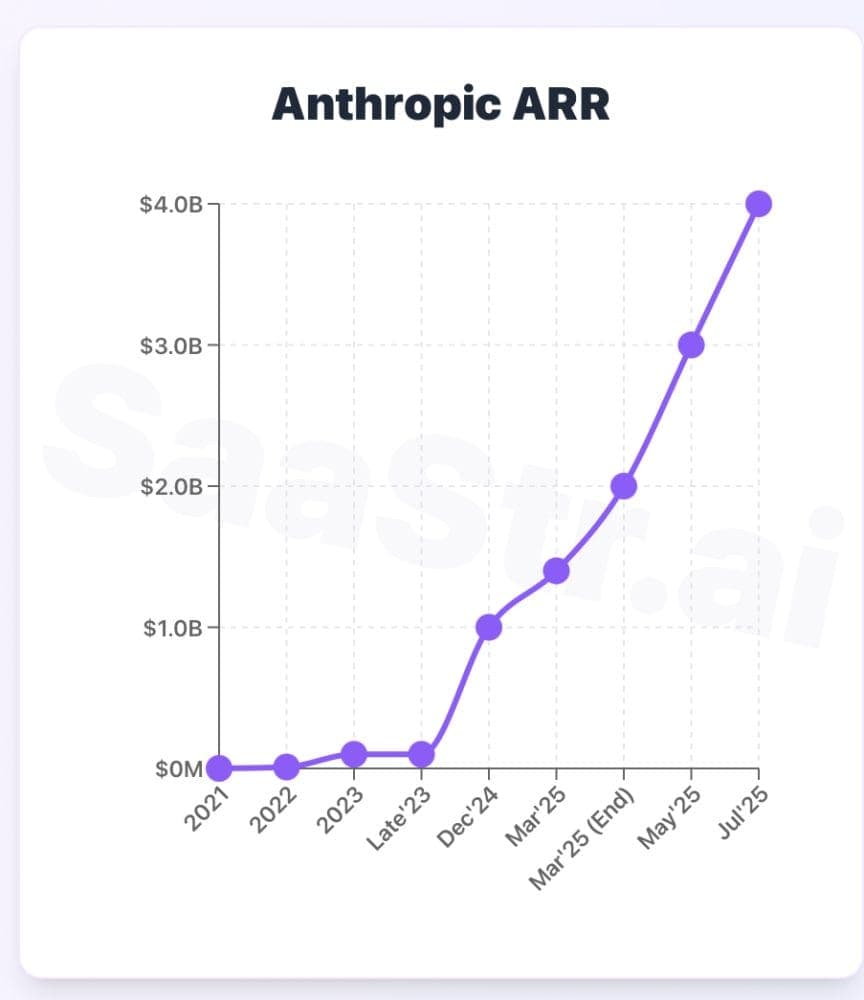
A new analysis from research firm Melius, highlighted by tech analyst Ben Bajarin, reveals that Anthropic's revenue growth is accelerating at a rate that is "staggering" industry observers. The company's annualized run rate has reportedly hit $3.4 billion, a figure that has doubled in just the last six months.
This explosive growth underscores the intense enterprise demand for large language models (LLMs) as businesses move from pilot projects to full-scale deployment. Anthropic, with its Claude 3.5 Sonnet and Claude 3 Opus models, has positioned itself as a primary competitor to OpenAI in the high-stakes race to provide foundational AI to corporations.
Key Takeaways
- Anthropic's annualized revenue run rate has reportedly reached $3.4 billion, doubling from ~$1.7B six months ago.
- The company is scaling enterprise deployments of its Claude models at a staggering pace.
The Revenue Trajectory
While Anthropic is a private company and does not publicly disclose detailed financials, analyst estimates based on deal flow and customer adoption point to a steep upward curve. The jump from an estimated ~$1.7 billion run rate to $3.4 billion in half a year indicates not just new customer acquisition, but significant expansion within existing enterprise accounts.
This growth is being fueled by:
- Enterprise Contracts: Large-scale, multi-year agreements with corporations across finance, healthcare, technology, and professional services.
- API Consumption: Increased usage of Anthropic's API as developers build the model into production workflows.
- Amazon & Google Partnerships: Strategic cloud partnerships with AWS and Google Cloud, which include substantial committed funding and co-selling agreements, are major growth channels.
The "Eat the World" Ambition
The Melius note, as quoted, states plainly: "Anthropic wants to eat the world." This reflects a strategic shift from being a research-heavy AI safety lab to a full-throttle commercial entity. The company's ability to scale its infrastructure, sales, and support to match this revenue growth is now a critical test.
Competitive Context
Anthropic's reported $3.4B run rate places it in the top tier of generative AI pure-plays.
Anthropic $3.4B (per Melius analysis) Claude 3.5 Sonnet, Claude 3 Opus Amazon, Google, SK Telecom OpenAI ~$7B+ (estimated) GPT-4o, o1-series Microsoft xAI N/A (Pre-launch) Grok-2 Elon Musk, Sequoia Cohere ~$500M (estimated) Command R+ Oracle, NVIDIA, SalesforceThis revenue scale provides Anthropic with immense resources to continue the expensive cycle of model training, GPU procurement, and talent acquisition. It validates the "multi-model" competitive landscape, where enterprises are willing to invest heavily in more than one foundational AI provider for redundancy, specific capabilities, or pricing leverage.
What to Watch
The key questions moving forward:
- Margin vs. Growth: How much of this revenue is consumed by the immense compute costs of running inference on state-of-the-art models? Profitability remains a longer-term goal for all major AI labs.
- Product Pace: Can Anthropic maintain its rapid release cadence (Claude 3.5 Sonnet launched June 2024) to keep technical parity or an edge over OpenAI and Google's Gemini?
- Scaling Challenges: Doubling revenue in six months strains every part of an organization. Anthropic's ability to manage this growth while maintaining model performance and reliability will be scrutinized.
gentic.news Analysis
This financial update is a concrete data point in the trend we've been tracking: the enterprise AI market is consolidating around a few well-capitalized players, but is still large enough to support multiple giants. Anthropic's trajectory mirrors the pattern we observed after its $4 billion funding round from Amazon in Q1 2025, which was explicitly aimed at scaling cloud infrastructure and go-to-market efforts. The reported run rate suggests that strategy is working aggressively.
This growth also contextualizes the intensifying competition with OpenAI. While OpenAI holds a first-mover and scale advantage, Anthropic's surge proves that superior model performance (as seen with Claude 3.5 Sonnet's strong benchmarks) and a focus on enterprise safety and customization can capture massive market share. It creates a near-duopoly in the high-end foundational model space for now, putting pressure on other well-funded players like xAI and Cohere to accelerate their own enterprise sales execution.
Furthermore, this validates the strategic bets made by Amazon and Google. Their multi-billion dollar investments in Anthropic were not merely charitable; they were purchases of a fast lane into the enterprise AI stack, competing directly with Microsoft's ownership stake in OpenAI. The next phase will be watching how deeply Claude gets integrated into AWS Bedrock and Google Vertex AI, and whether these channels can sustain this hyperbolic growth rate.
Frequently Asked Questions
What is a "revenue run rate"?
A revenue run rate is an estimate of a company's annual financial performance based on current monthly or quarterly revenue. It's calculated by taking revenue for a shorter period (e.g., a month) and extrapolating it to a full year. For a fast-growing company like Anthropic, it's a snapshot of its current scaling pace, not a guarantee of future annual revenue.
How does Anthropic's $3.4B run rate compare to OpenAI's?
While exact figures are private, industry estimates suggest OpenAI's annualized run rate is significantly higher, likely in the $7-10 billion range as of early 2026, owing to its earlier start, massive consumer user base via ChatGPT, and deep Microsoft Azure integration. However, Anthropic's reported doubling in six months indicates it is closing the gap in the enterprise sector specifically.
Where does Anthropic's revenue come from?
The primary sources are enterprise subscription contracts for API access and the Claude console, often involving committed minimum spend. A significant portion also flows through its cloud partnerships, where Amazon and Google commit funds and resell Anthropic's models on their respective platforms (AWS Bedrock, Google Vertex AI).
What does this mean for the AI model market?
It signals that the market for large, general-purpose LLMs is not a winner-take-all scenario. Enterprises are diversifying their AI providers, and there is room for at least two major, independent model companies (OpenAI and Anthropic) to achieve multi-billion dollar scale, with others like Google DeepMind (Gemini) and xAI also competing. It ensures continued competition in model capabilities, pricing, and terms of service.