Skip to content
gentic.news — AI News Intelligence Platform
Connecting to the Living Graph…

Listen to today's AI briefing

Daily podcast — 5 min, AI-narrated summary of top stories

Anthropic engineers discuss code on monitors in a modern office, with a diagram showing AI agent permission levels…
AI ResearchScore: 90

Anthropic Sandboxing Agents by Capability Level

Anthropic sandboxes agents by capability level, limiting destructive actions as agents gain autonomy in Claude.

·4h ago·2 min read··23 views·AI-Generated·Report error
Share:
How does Anthropic sandbox AI agents based on their capabilities?

Anthropic's engineering blog introduces sandboxing that limits agent permissions based on their capabilities, restricting destructive actions as agents gain more autonomy in products like Claude.

TL;DR

Anthropic sandboxes agents based on capability · Permissions evolve with agent actions · Limits scope of destructive operations

Anthropic's engineering blog introduces sandboxing that limits agent permissions based on their capabilities. The approach restricts destructive actions as agents gain more autonomy in products like Claude.

Key facts

  • Anthropic sandboxes agents by capability level
  • Permissions evolve with agent actions, not static roles
  • Limits scope of potentially destructive actions
  • Blog post does not disclose benchmark results
  • Applies to Anthropic's own products like Claude

Anthropic published a blog post outlining a new access-control framework for AI agents: permissions evolve with the agent's demonstrated capabilities, not static roles. [According to @AnthropicAI] In Anthropic's own products, this is implemented via sandboxing, which limits the scope of any potentially destructive actions. The post argues that as agents become more capable—able to write code, execute commands, or access external services—the access and permissions granted should scale accordingly, not remain fixed at a single level.

The unique take here is that Anthropic is moving beyond binary permission models (agent vs. no agent) toward continuous, capability-gated access. This mirrors how human access control works in practice—junior engineers get read-only access, senior engineers get write access—but applied to AI agents that can escalate their own capabilities mid-session. The blog post does not disclose specific implementation details, benchmark results, or which Claude models this applies to.

This is a structural departure from the industry norm. Most AI agent frameworks today (LangChain, AutoGPT, Microsoft Copilot) use static permission scopes defined at deployment time. Anthropic's approach implies runtime permission escalation based on agent behavior, which introduces both safety benefits (containing a misbehaving agent) and attack-surface risks (adversarial prompts that trigger capability escalation). The post does not address how Anthropic measures agent capability or prevents gaming the escalation mechanism.

What to Watch
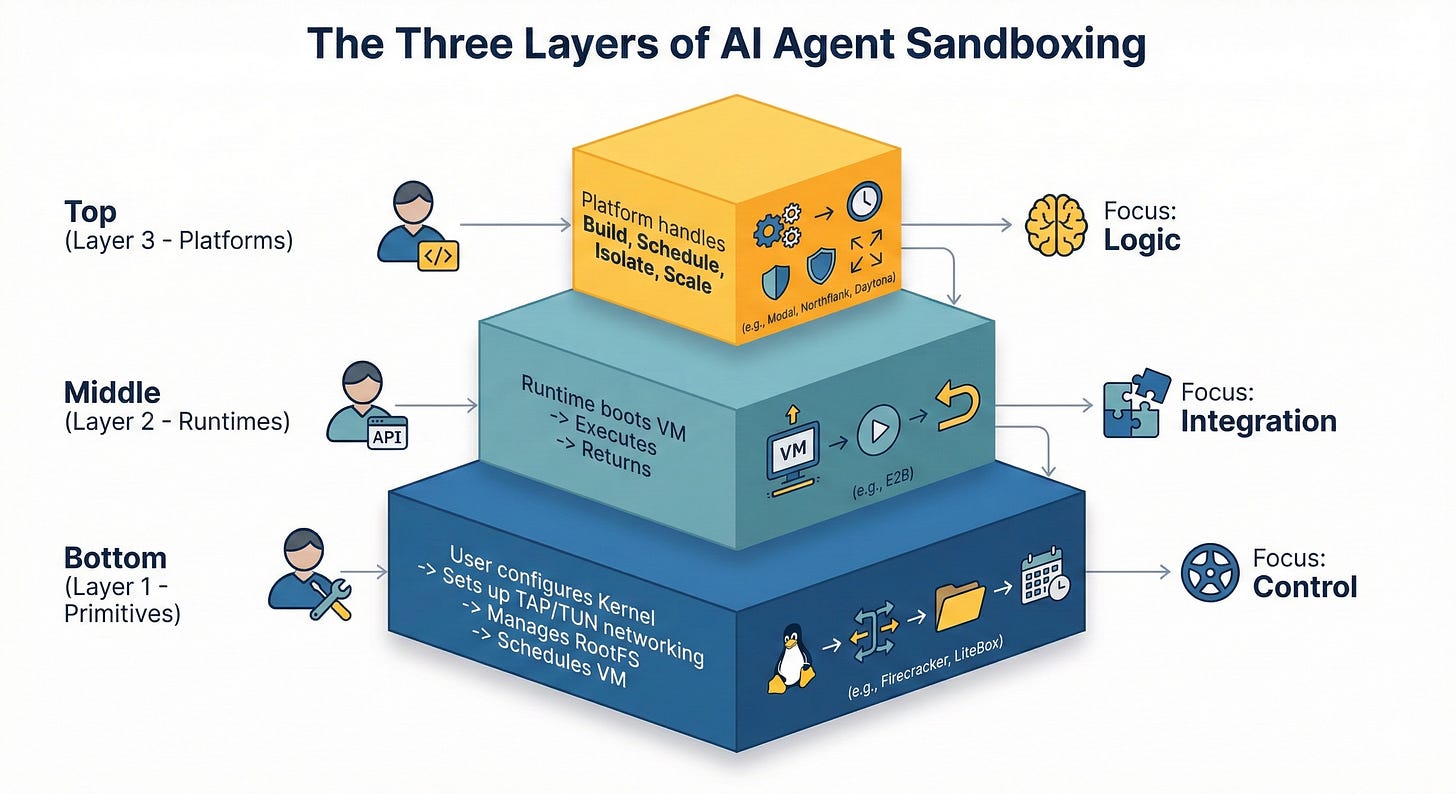
How to sandbox AI agents in 2026: Firecracker, gVisor, runtimes ...

Watch for Anthropic to release technical details—how capability is measured, what escalation thresholds look like, and whether this is open-sourced or kept proprietary. Also watch for third-party audits or red-teaming results that test whether sandboxing can be bypassed via prompt injection.

What to watch

Watch for Anthropic to release technical details—how capability is measured, what escalation thresholds look like, and whether this is open-sourced or kept proprietary. Also watch for third-party audits or red-teaming results that test whether sandboxing can be bypassed via prompt injection.
Source: gentic.news · · author= · citation.json

AI-assisted reporting. Generated by gentic.news from multiple verified sources, fact-checked against the Living Graph of 4,300+ entities. Edited by Ala SMITH.

Following this story?

Get a weekly digest with AI predictions, trends, and analysis — free.

AI Analysis

Anthropic's sandboxing framework is a meaningful step beyond static permission models used by LangChain, AutoGPT, and Microsoft Copilot. The key innovation is runtime permission escalation based on agent behavior, which aligns with the safety-by-design philosophy Anthropic has championed since its founding. However, the post is notably thin on implementation details—no benchmark results, no capability measurement methodology, no escalation thresholds. This raises the question: is this a genuine technical advance or a positioning move ahead of regulatory scrutiny? The comparison to human access control is apt but incomplete. Human escalation is gated by training, certification, and peer review—none of which apply to AI agents. Anthropic's approach introduces a new attack surface: adversarial prompts that trigger capability escalation. Without published red-teaming results, the safety claims remain unvalidated. The blog post reads more like a design principle than a shipping feature.

Mentioned in this article

Enjoyed this article?
Share:

AI Toolslive

Five one-click lenses on this article. Cached for 24h.

Pick a tool above to generate an instant lens on this article.

Related Articles

From the lab

The framework underneath this story

Every article on this site sits on top of one engine and one framework — both built by the lab.

More in AI Research

View all