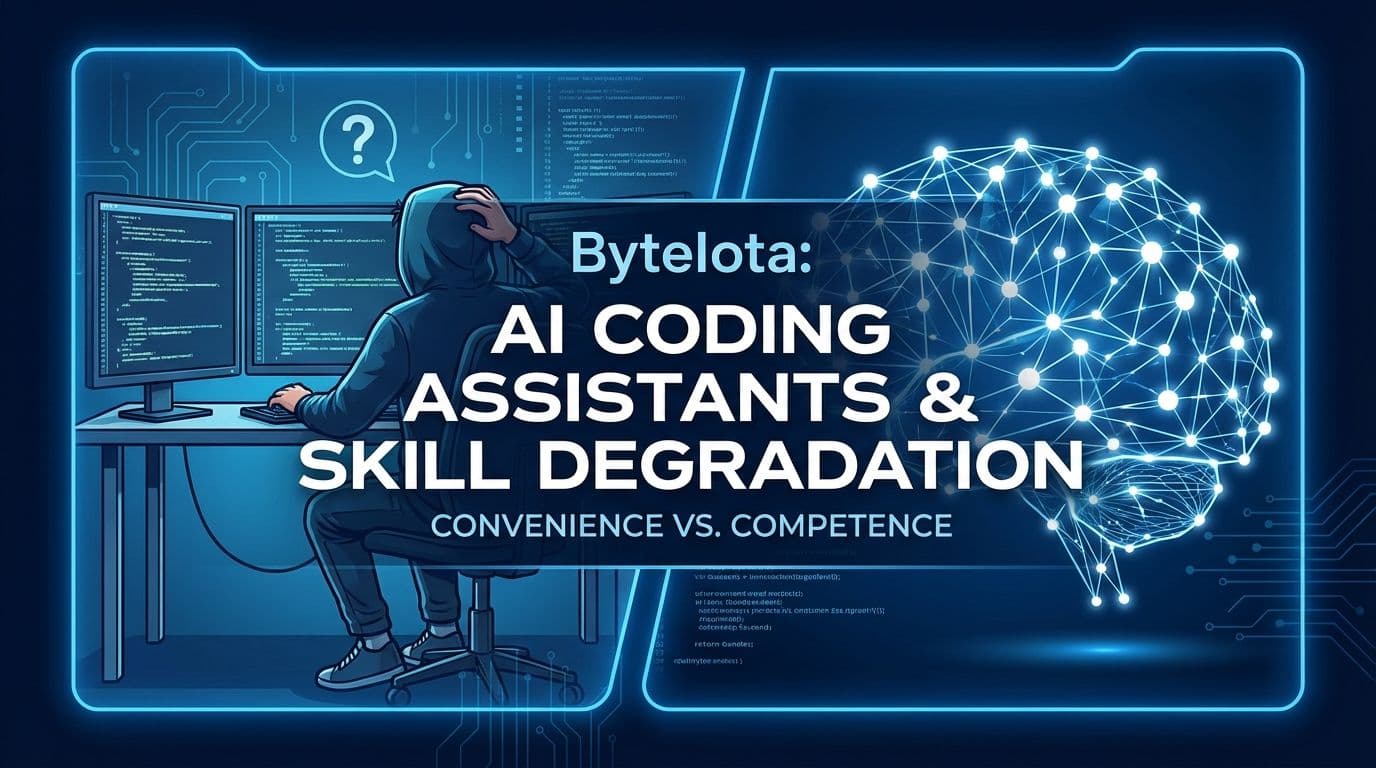
Anthropic published a study today showing senior engineers beat juniors by 31% when using Claude Code for agentic coding tasks. The finding challenges the narrative that AI coding tools will compress skill differences across experience levels.
Key facts
- Senior engineers beat juniors by 31% in verified success rate
- Study used Claude Code across 1,000+ agentic coding sessions
- Gap persisted after controlling for task difficulty
- Three factors: decomposition, prompt quality, error recovery
- Anthropic did not disclose raw success rates per tier
Anthropic published a study today titled "Agentic coding and persistent returns to expertise" that examined how software engineers of varying experience levels perform when using Claude Code for autonomous coding tasks. The study measured "verified success" — whether a commit passed all test suites — across more than 1,000 agentic coding sessions completed by engineers at Anthropic.
Senior engineers achieved a 31% higher verified success rate than junior engineers. This gap persisted even after controlling for task difficulty and domain familiarity. The finding contradicts the common narrative that AI coding tools will democratize software development by flattening skill differences.
What the study measured
Anthropic's researchers asked engineers at multiple seniority levels to use Claude Code — the company's agentic coding product launched in early 2026 — to implement features, fix bugs, and refactor code across internal repositories. Each session was logged, and success was determined by whether the resulting pull request passed continuous integration tests.
The study did not disclose raw success rates or exact sample sizes per experience tier. It controlled for task complexity by using a rubric that scored each task on difficulty, familiarity, and required domain knowledge. The 31% gap held across all difficulty levels.
Why the gap persists
Anthropic's analysis points to three factors driving the persistent expertise premium: task decomposition skill, prompt quality, and error recovery. Senior engineers were more effective at breaking ambiguous requirements into sub-tasks that Claude Code could execute sequentially. They also wrote more precise prompts and were faster to identify when the agent was going down an unproductive path.
"The agent is a tool, not a replacement for judgment," the study notes. "Expertise in software engineering translates to expertise in directing agents." This mirrors findings from prior research on human-AI collaboration — the value of the AI system is bounded by the operator's ability to guide it.
Implications for the industry
The result has direct implications for enterprise adoption of agentic coding tools. If expertise differentials persist — or widen — with AI assistance, companies cannot simply replace junior engineers with agents plus a small senior team. The study suggests that agentic coding may increase the marginal value of experienced engineers rather than reducing it.
This runs counter to recent market narratives. In June 2026, Cursor and other AI coding startups have been marketing their tools as leveling the playing field for junior developers. Anthropic's data suggests the opposite may be true, at least for the current generation of agentic coding systems.
The study is also notable for what it does not claim. Anthropic does not argue that agentic coding is useless for junior engineers — only that it does not eliminate the expertise gap. The absolute improvement for all skill levels was positive, the company said, though it did not disclose the magnitude.
A note on methodology
The study's definition of "verified success" — passing test suites — is a narrow measure. As noted on Hacker News, an engineer might use Claude Code to evaluate an approach and conclude it is not worth pursuing, which would register as a failure despite being the correct engineering decision. Anthropic acknowledged this limitation in the study.
Additionally, the study was conducted internally at Anthropic, where engineers are already familiar with Claude Code. The results may not generalize to organizations with different tooling stacks or engineering cultures. Anthropic did not share the raw data or replication code, citing competitive sensitivity.
What to watch
Watch for replication studies from OpenAI and Google DeepMind using their own agentic coding tools (Codex CLI, Gemini Code Assist). If they confirm Anthropic's finding, the enterprise coding assistant market — projected at $3B in 2026 — will need to reposition from 'replace juniors' to 'augment seniors.'
Source: news.google.com