What the Survey Found
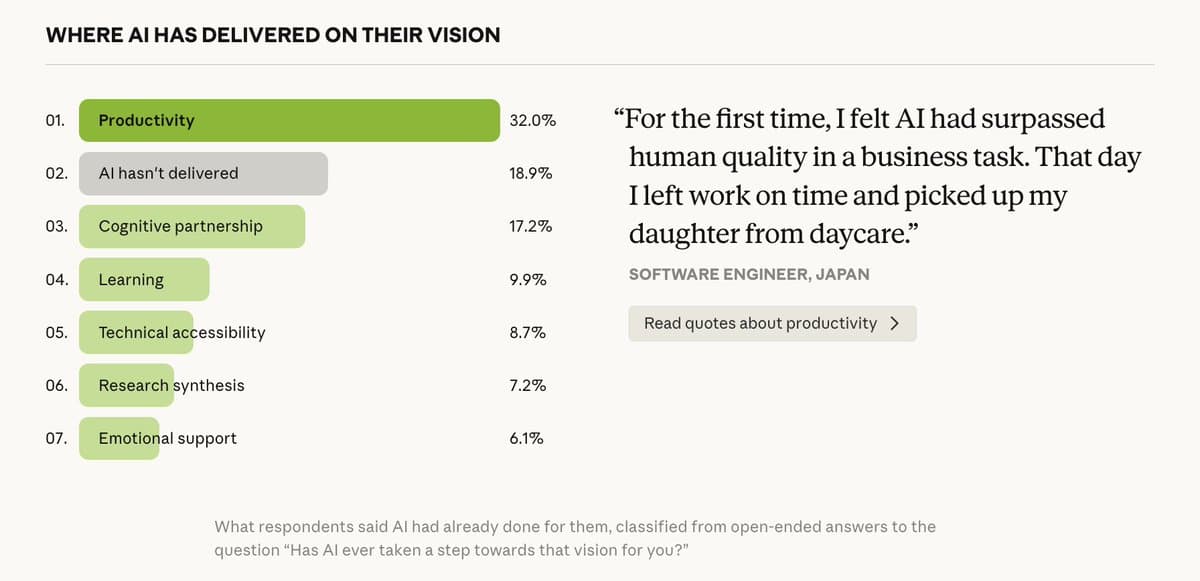
Anthropic has conducted a large-scale global survey of 80,508 users, revealing a nuanced public perception of artificial intelligence. The core finding is that people simultaneously hold both hope and fear about AI's development and deployment—a dual perception that suggests benefits and risks are deeply intertwined in the public consciousness.
According to the results, the top three hopes users have for AI are:
- Better work – Improvements in job performance, productivity, or work quality.
- Personal growth – Enhancement of skills, knowledge, or personal development.
- Life management – Assistance in organizing daily tasks, schedules, or personal affairs.
Conversely, the top three concerns are:
- Unreliability – Worries about AI systems being incorrect, inconsistent, or untrustworthy.
- Job loss – Anxiety about AI displacing human employment.
- Reduced autonomy – Fear that AI could diminish human control, decision-making, or independence.
Context & Significance
This survey represents one of the largest publicly noted user studies conducted by a major AI lab. While many AI companies release technical benchmarks, Anthropic's focus on broad user sentiment across 80,508 respondents provides a different kind of data point—one about societal reception rather than model capability.
The simultaneous presence of hope and fear indicates that public attitudes are not simply polarized between techno-optimism and techno-pessimism. Instead, individuals are weighing specific potential benefits against specific perceived risks. The concern about "unreliability" ranking above "job loss" is particularly notable, suggesting that immediate functional trust issues may be more pressing than longer-term economic displacement in current user perceptions.
For AI developers and policymakers, this data underscores that public acceptance may depend on addressing reliability concerns as much as or more than addressing economic impacts. The linkage between hopes for "better work" and fears of "job loss" also highlights the tension within the employment domain specifically.