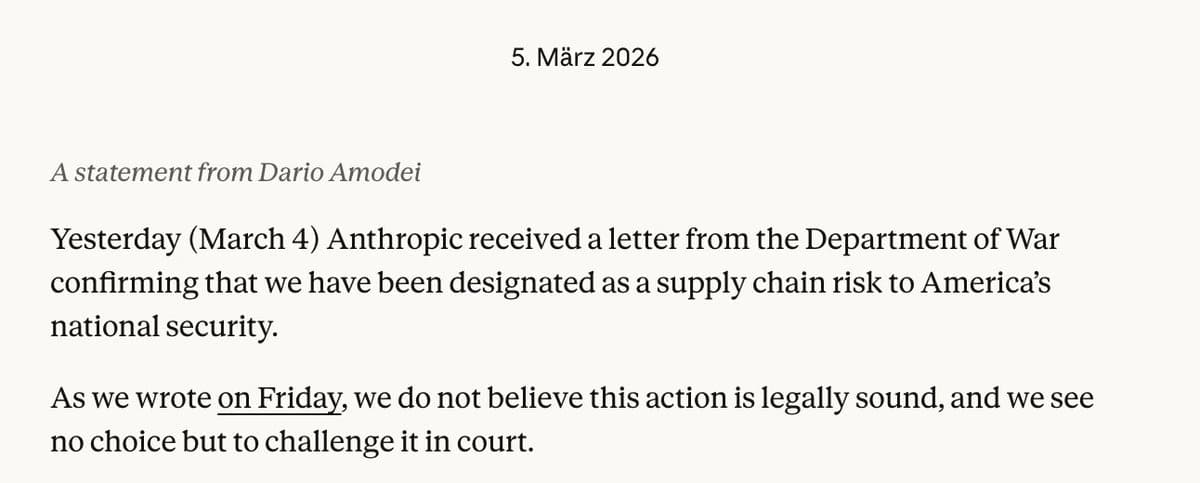
In a significant escalation of tensions between AI developers and government regulators, Anthropic has announced it will legally challenge the U.S. Department of Defense's recent designation of its Claude AI system as a supply chain risk. The controversy centers on a Defense Department decision that restricts Claude's direct use in certain military contracts, though the company maintains the actual scope is far narrower than initial reports suggested.
The Disputed Designation
According to Anthropic's public statements, the Defense Department's supply chain risk management (SCRM) designation applies specifically to Claude's direct integration into certain Department-linked contracts and procurement processes. The company emphasizes that this affects only a limited subset of potential military applications, with most commercial and government customers remaining unaffected by the restrictions.
"The actual scope of the designation is much more targeted than what early headlines implied," an Anthropic spokesperson explained. "This isn't a blanket ban on all military use, but rather specific restrictions on how Claude can be integrated into certain Defense Department procurement and contracting systems."
Legal Challenges and National Security Concerns
Anthropic CEO Dario Amodei has taken a particularly strong stance against the Defense Department's decision, calling it "legally shaky" and vowing to challenge the designation in court. Amodei's argument centers on both procedural concerns about how the designation was implemented and substantive questions about whether it represents appropriate regulatory action.
"We believe this designation lacks proper legal foundation and creates unnecessary barriers to innovation in national security," Amodei stated. "At the same time, we remain committed to supporting U.S. national security interests and have offered to provide our models at nominal cost during any transition period to ensure critical military operations aren't disrupted."
This dual approach—fighting the designation legally while offering transitional support—reflects Anthropic's nuanced position: challenging what it sees as regulatory overreach while maintaining its commitment to national security partnerships.
Broader Implications for AI Governance
The conflict emerges against a backdrop of increasing government scrutiny of AI systems, particularly those with potential national security applications. The Defense Department's supply chain risk designations typically address concerns about foreign ownership, control, or influence that might compromise the security of sensitive systems.
For Anthropic, which has positioned itself as a safety-focused AI developer with significant backing from Amazon and other major investors, the designation raises questions about how AI companies can navigate the complex landscape of national security regulations while continuing to innovate.
Industry analysts note that this case could establish important precedents for how AI systems are evaluated for security risks, particularly as language models like Claude become increasingly integrated into government and military workflows.
The Future of AI-Military Partnerships
Despite the legal challenge, Anthropic has emphasized its continued interest in supporting U.S. national security efforts. The company's offer to provide models at reduced cost during any transition period suggests a recognition of the practical realities facing military organizations that may have begun integrating Claude into their operations.
This situation highlights the growing tension between rapid AI advancement and established government procurement and security processes. As AI capabilities accelerate, regulatory frameworks designed for traditional software and hardware systems may struggle to keep pace with the unique characteristics of large language models and other advanced AI systems.
The outcome of Anthropic's legal challenge could influence how other AI companies approach government contracts and what safeguards they implement to address national security concerns. It may also prompt broader discussions about updating regulatory frameworks to better accommodate AI technologies while maintaining appropriate security standards.
Industry Reactions and Expert Perspectives
AI industry observers have noted that Anthropic's challenge represents one of the most direct confrontations between an AI developer and government security regulators to date. Some see it as a necessary test case for establishing clearer boundaries around AI regulation, while others worry it could create additional barriers to public-private partnerships in critical technology areas.
"This case will help define the playing field for AI companies working in national security spaces," said Dr. Elena Rodriguez, a technology policy researcher at Georgetown University. "We need clarity on what constitutes legitimate security concerns versus protectionism or bureaucratic inertia."
Other experts point to the international dimensions of the conflict, noting that similar debates are playing out in allied nations as they grapple with how to secure their AI supply chains while maintaining access to cutting-edge technology.
As the legal process unfolds, the AI industry will be watching closely to see how courts balance innovation concerns with national security imperatives—a balancing act that will only become more complex as AI capabilities continue to advance.