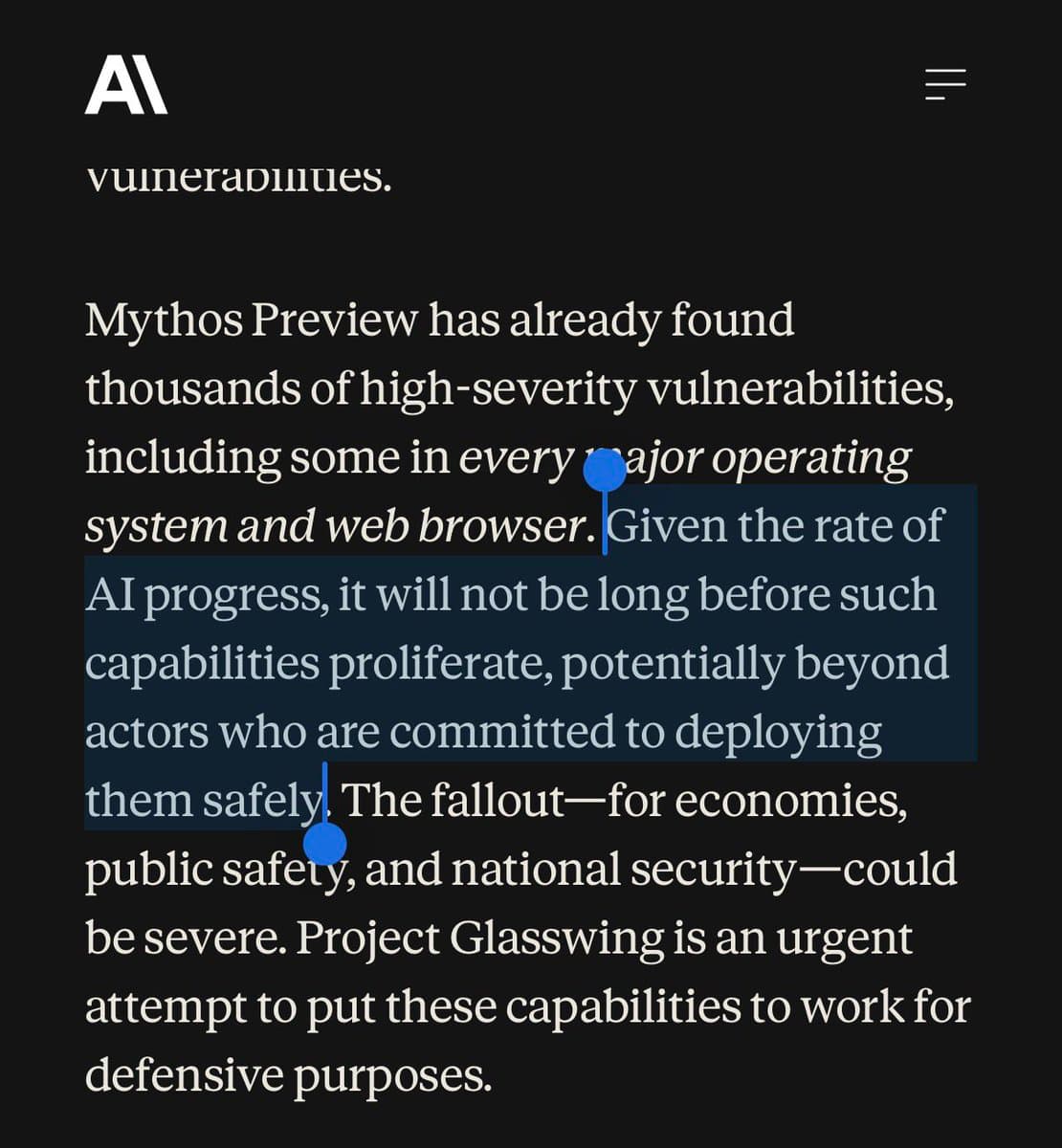
Anthropic, the AI safety-focused company behind the Claude series of models, has issued a stark internal warning: its upcoming large language models could cause "serious damage." The warning, highlighted in a recent social media post citing internal communications, suggests the company believes the next capability leap in its model development pipeline carries significant risk.
The core message, as relayed, is one of grave concern. The company reportedly sees "no end in sight" to the scaling of AI capabilities and believes it is "not long before such capabilities proliferate." This is not a generic statement about AI risk but a specific, forward-looking assessment from one of the world's leading AI labs about its own product roadmap.
What Happened
The warning appears to originate from internal Anthropic communications, shared via a social media post. The key phrase—"they are afraid their upcoming LLMs could do serious damage"—points to an evaluation conducted by Anthropic's preparedness or safety teams regarding models in advanced development. The context suggests this concern is tied to models that are "upcoming," meaning they are likely in training or final stages of development, not a distant theoretical possibility.
The accompanying note that there is "no end in sight" to capability scaling aligns with the observed trajectory in the industry, where each successive generation of models (GPT-4 to GPT-4o, Claude 3 to Claude 3.5) has brought notable jumps in reasoning, coding, and agentic capabilities. Anthropic's warning implies the next jump may be qualitatively different in terms of potential for misuse or autonomous action.
Context: Anthropic's Safety-First Stance
This warning is consistent with Anthropic's founding ethos and recent public positions. The company was established by former OpenAI researchers concerned about AI safety and alignment. It has pioneered techniques like Constitutional AI and maintains a strong focus on building "steerable, trustworthy" models. In 2025, Anthropic was a leading voice in advocating for responsible scaling policies and frontier model development pauses among leading labs.
Their latest model family, Claude 3.5 Sonnet, released in mid-2025, was notable for its strong performance on coding and reasoning benchmarks while maintaining what the company described as improved safety postures. This new warning suggests the company believes the safety challenges for the subsequent generation (potentially Claude 4 or a more advanced iteration) are of a different magnitude.
What "Serious Damage" Could Mean
While the statement is not specific, in the context of frontier AI risk research, "serious damage" from an LLM could encompass several high-concern areas:
- Advanced Cyber Capabilities: Automating the discovery and exploitation of software vulnerabilities at scale.
- CBRN Threat Information: Significantly lowering the barrier to accessing and synthesizing information for creating chemical, biological, radiological, or nuclear threats.
- Sophisticated Persuasion & Disinformation: Generating hyper-personalized, persuasive content that could manipulate individuals or destabilize public discourse.
- Autonomous Agentic Behavior: Models that can reliably plan and execute long-horizon tasks in digital environments with minimal human oversight, potentially towards harmful goals.
The warning indicates Anthropic's internal red-teaming or capability evaluations have likely identified specific, concerning skill emergences in their upcoming models that cross a risk threshold their current models do not.
The Proliferation Concern
The second part of the warning—"not long before such capabilities proliferate"—adds a critical dimension. It acknowledges that once a capability is demonstrated by a frontier lab, it is rapidly reverse-engineered, replicated, or leaked into the broader ecosystem. This creates a dual concern: managing the risk from their own deployment while anticipating how those capabilities will spread to less safety-conscious actors. This reflects a central tension in AI development: safety measures that slow down a responsible lab may do little to prevent a less responsible actor from eventually developing similar capabilities.
gentic.news Analysis
This internal warning from Anthropic is one of the most concrete signals yet that the leading AI labs are approaching a capability threshold that alarms their own safety teams. It moves the conversation from abstract, long-term AI risk to immediate, product-specific concerns. This follows our December 2025 coverage of OpenAI's "Project Strawberry" and its internal debates over agentic reasoning safeguards, indicating a sector-wide pattern: the 2026 generation of models is forcing difficult safety versus capability trade-offs into the open.
The warning directly contradicts the narrative, often pushed by some industry segments, that AI capabilities are plateauing. Anthropic's assessment of "no end in sight" suggests the opposite—they see a clear path to significantly more powerful systems. This aligns with the trend we noted in our 2025 Year in Review: compute budgets for training runs continue to grow, and architectural improvements (like Mixture-of-Experts and new attention mechanisms) continue to yield efficiency gains, sustaining the scaling laws.
For practitioners and policymakers, this serves as a critical data point. If a lab with Anthropic's safety culture is this concerned about its own next model, it raises urgent questions about governance. It will increase pressure for the implementation of "know-your-customer" controls for cloud compute, more rigorous pre-deployment auditing mandates (like the EU AI Act's requirements for GPAI models), and potentially renewed calls for voluntary development pauses among the frontier labs. The next few months will reveal how Anthropic acts on this warning—whether it leads to a delayed release, a heavily restricted launch, or a new set of safety benchmarks that become industry standard.
Frequently Asked Questions
What did Anthropic actually say?
Based on the sourced social media post, internal communications at Anthropic indicate the company is "afraid their upcoming LLMs could do serious damage." They further stated there is "no end in sight" to capability scaling and that it is "not long before such capabilities proliferate."
Which Anthropic model is this warning about?
The warning is not specific but refers to "upcoming LLMs." This likely points to the next major generation following the Claude 3.5 family, potentially referred to internally as Claude 4 or a similar codename, which is currently in development.
What does "serious damage" mean in this context?
While not detailed in the brief statement, in frontier AI safety discussions, "serious damage" typically refers to risks like enabling large-scale cyber attacks, facilitating the creation of biological or chemical weapons, orchestrating mass-scale fraud or disinformation, or powering autonomous agents that could act against human interests.
How is this different from previous AI risk warnings?
This is notable because it is not a generic warning from an academic or think tank. It is an internal assessment from a leading AI development company about its own imminent products, making it a more concrete and actionable signal of risk.
Has Anthropic delayed a model launch because of safety before?
Yes, Anthropic has a history of cautious deployment. They have previously delayed features or implemented staged rollouts for new capabilities after internal safety evaluations. This warning suggests the considerations for their next model are more severe.