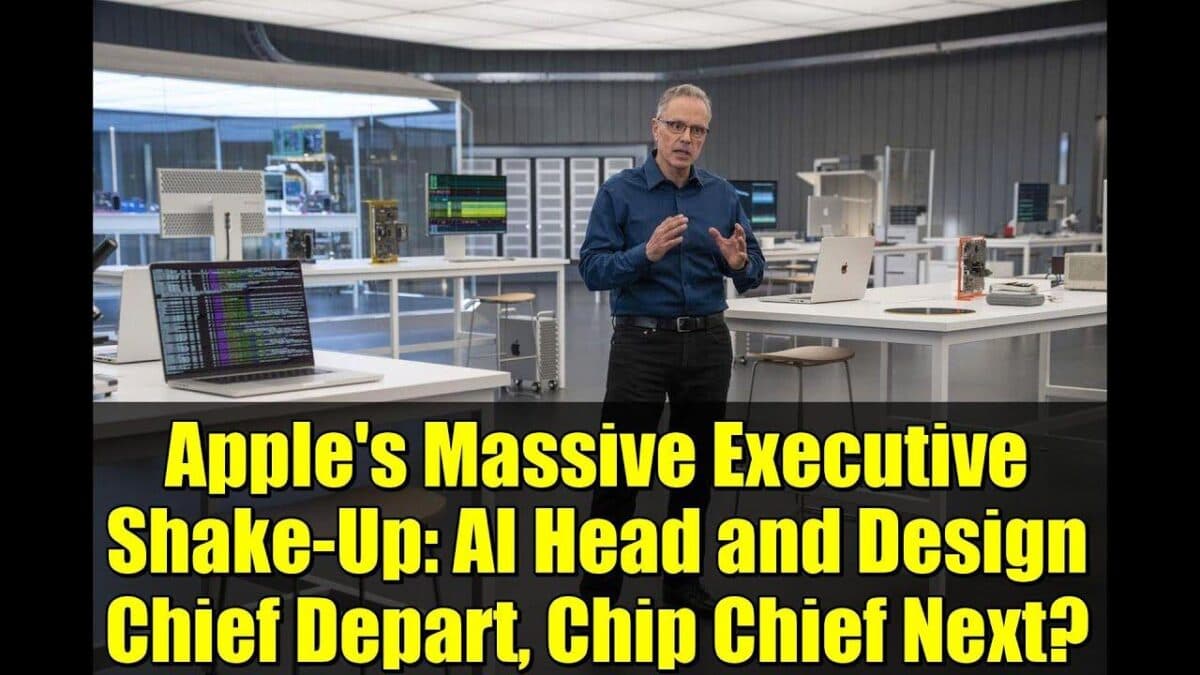
Apple has promoted Johny Srouji, its Senior Vice President of Hardware Technologies, to the newly created role of Chief Hardware Officer. The announcement, noted by industry observer Mark Gurman and commentator Mark Weinbach on X, consolidates leadership of Apple's core silicon and hardware engineering divisions under a single executive.
Srouji, who joined Apple in 2008, has led the company's custom silicon design efforts since their inception with the A4 chip in 2010. His team is responsible for the system-on-a-chip (SoC) designs—including the A-series for iPhones and iPads, the M-series for Macs, and specialized silicon like the S-series for Apple Watch and the H-series for headphones—that have become the performance and efficiency foundation for all Apple products.
Key Takeaways
- Apple has promoted Johny Srouji, its SVP of Hardware Technologies, to the role of Chief Hardware Officer.
- This move centralizes leadership over Apple's silicon design and hardware engineering groups during a critical AI hardware push.
What's New

The promotion to Chief Hardware Officer formalizes Srouji's oversight beyond silicon design to encompass broader hardware engineering groups. While specific reporting lines were not detailed in the initial report, the title suggests a unification of hardware leadership that was previously more distributed. This comes as Apple's hardware strategy is increasingly defined by vertical integration, where custom silicon, sensors, and system architecture are co-designed for specific software and AI features.
Technical & Strategic Context
Srouji's promotion occurs during Apple's most aggressive push into on-device AI. The company's latest chips, like the M4 and A18 Pro, feature significantly enhanced Neural Engines designed to run large language models and diffusion models locally. The architectural success of these chips—balancing CPU, GPU, and NPU performance within strict thermal and power envelopes—is directly credited to Srouji's organization.
This structural change follows a period of intense competition in AI hardware. Rivals like Qualcomm (with its Snapdragon X Elite platform for Windows PCs) and NVIDIA (dominant in data center AI accelerators) have raised the stakes. Apple's response has been to double down on its unique advantage: controlling the entire stack from silicon to software. Centralizing hardware leadership under Srouji is a logical step to accelerate this integrated approach.
What to Watch

The immediate question is how this reshapes the internal roadmap for Apple's next-generation AI silicon. With the role of Chief Hardware Officer, Srouji is positioned to more tightly align the development of application processors, connectivity chips (like Bluetooth and Ultra Wideband), and emerging sensor technologies (such as LiDAR and advanced camera modules) into a cohesive system. The goal is likely to create even more specialized hardware blocks for AI workloads anticipated in future versions of iOS, macOS, and visionOS.
gentic.news Analysis
This promotion is less a surprise and more a formal recognition of the strategic reality that has been building at Apple for nearly a decade. Johny Srouji has been the de facto most important hardware executive since the transition to Apple Silicon began. As we noted in our October 2025 analysis, "Apple's M4 Neural Engine: A Blueprint for On-Device AI," the company's AI strategy is fundamentally a hardware strategy. The Neural Engine's scaling—from 16 cores in the M1 to a reported 40+ in upcoming designs—is the enabling constraint for features like real-time language translation, advanced computational photography, and the rumored on-device AI assistant.
This move also follows a trend of consolidating technical leadership at major tech firms as the AI race intensifies. Similar centralization has occurred at Google with its Devices & Services division and at Microsoft with its Microsoft AI organization. For Apple, placing its most successful hardware architect in charge of the entire hardware portfolio signals that the post-Moore's Law era will be won by systems-level innovation, not just transistor density. Srouji's proven ability to deliver performance-per-watt breakthroughs is now the company's primary hardware moat.
Looking at the competitive timeline, this promotion arrives just as Qualcomm-powered "AI PCs" begin hitting the market and NVIDIA's Blackwell platform sets new data center benchmarks. Apple's counter-strategy remains focused on the edge. By giving Srouji broader authority, Apple is betting that deeper hardware-software co-design, orchestrated from the top, will yield AI capabilities that cloud-dependent competitors cannot match, particularly in areas like privacy, latency, and battery life. The success of this bet will be measured by the capabilities of the M5 and A19 chips, likely already deep in development under this new structure.
Frequently Asked Questions
Who is Johny Srouji?
Johny Srouji is an Israeli-American executive who joined Apple in 2008. He founded and led Apple's internal silicon design group, which created the A-series chips for iPhone and iPad and later engineered the Apple Silicon transition for the Mac with the M-series chips. He is widely regarded as one of the foremost silicon architects in the consumer technology industry.
What does Apple's Chief Hardware Officer do?
While Apple has not released an official job description, the Chief Hardware Officer role likely entails overarching responsibility for all of Apple's hardware engineering divisions. This includes Srouji's existing domain of silicon design (processors, modems, connectivity chips) and potentially expands to encompass hardware engineering for iPhone, iPad, Mac, Wearables, and accessories, ensuring a unified architecture and technology roadmap across all products.
Why is this promotion important for Apple's AI plans?
Apple's AI differentiation is based on powerful, efficient on-device processing via its custom Neural Engines. Srouji's team designs these cores. Promoting him to lead all hardware ensures that AI accelerator design is prioritized at the highest level and is deeply integrated with other system components (memory, sensors, displays). This systemic approach is critical for developing the complex, real-time AI features Apple is expected to unveil in the coming years.
Has Apple had a Chief Hardware Officer before?
No. This appears to be a newly created C-level position. Previously, hardware leadership was distributed among several Senior Vice Presidents reporting directly to the CEO. This consolidation under Srouji represents a significant reorganization of Apple's engineering leadership hierarchy.