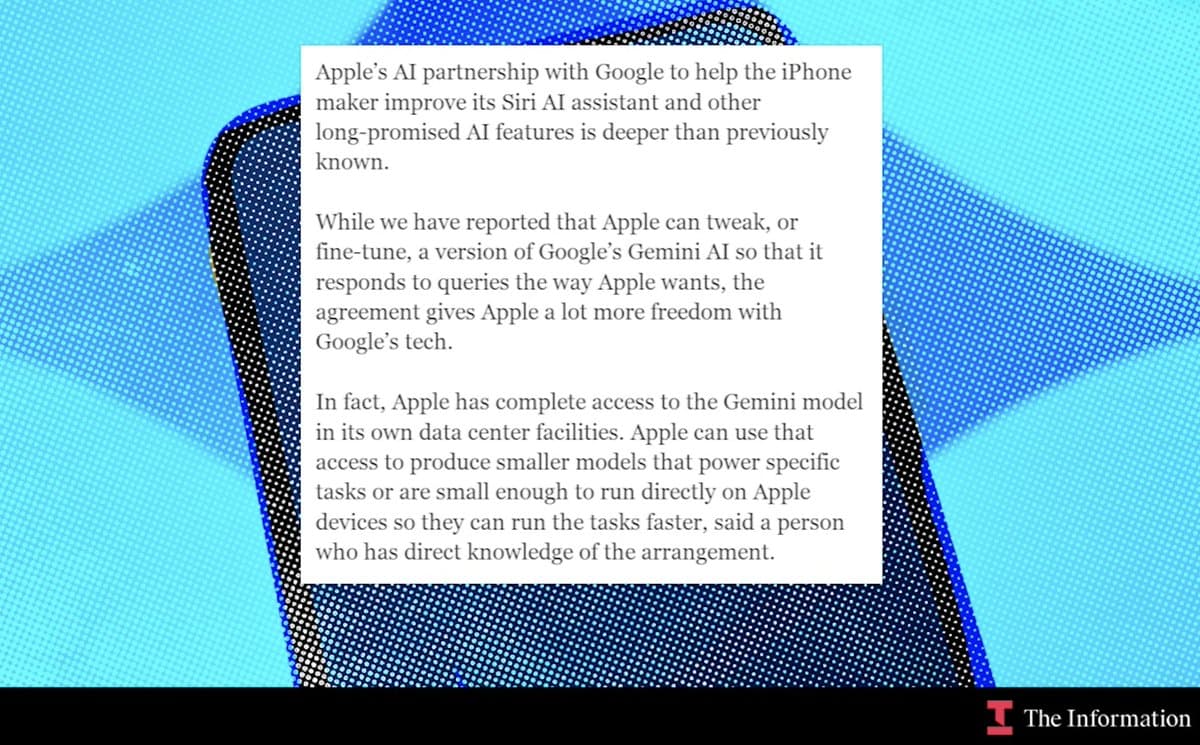
A new report from industry analyst @kimmonismus suggests the recently announced partnership between Apple and Google for Gemini integration is far more extensive than a simple API call. According to the report, Apple has secured "full access to the model inside their own data centers," granting them the ability to deeply analyze and distill Gemini's capabilities.
What the Report Claims
The core claim is that Apple's access goes beyond a standard API integration where queries are sent to Google's cloud and answers are returned. Instead, Apple reportedly has the ability to run Gemini within its own infrastructure. This level of access is said to enable two critical technical processes:
- Internal Reasoning Access: Apple can reportedly observe Gemini's "internal reasoning process, not just its outputs." This suggests access to intermediate activations, attention patterns, or chain-of-thought data within the model, which is far more valuable for training than just final text completions.
- Knowledge Distillation: With this internal access, Apple is reportedly distilling Gemini's knowledge and reasoning patterns "into smaller models purpose-built for specific tasks." The report states some of these distilled models are "small enough to run directly on your iPhone."
The stated goal is to create "compact models that punch way above their weight class" by learning not just what Gemini says, but how it thinks.
Technical Implications of Full Model Access
If accurate, this arrangement represents a significant departure from typical enterprise AI licensing. Standard API access provides a black-box service: input in, output out. Full internal access, especially within Apple's own data centers, implies a white-box or gray-box arrangement. This could allow Apple to:
- Perform Model Surgery: Analyze which model components (layers, attention heads) are responsible for specific capabilities.
- Extract Specialized Features: Create smaller models that excel at a narrow task (e.g., precise summarization, code generation for a specific framework) by focusing distillation on the relevant internal pathways.
- Optimize for Apple Silicon: The distilled models could be heavily optimized for the Neural Engine and GPU cores in Apple's A-series and M-series chips, maximizing on-device performance and power efficiency.
This strategy aligns with Apple's long-standing philosophy of vertical integration and on-device processing, but uses a competitor's state-of-the-art model as the training source.
Strategic Context: Apple's Hybrid AI Approach
This report, if confirmed, clarifies Apple's apparent hybrid AI strategy. The company is not simply outsourcing AI to Google or building everything from scratch. The strategy appears to be:
- Leverage Frontier Models for Training: Use deep access to a model like Gemini (and potentially others) as a "teacher" to rapidly bootstrap high-quality capabilities.
- Distill for On-Device Execution: Create a family of small, efficient, specialized models that run locally, ensuring privacy, low latency, and offline functionality.
- Offer Cloud Fallback: Use the standard Gemini API (or another cloud model) as a fallback for queries too complex for the on-device models, presenting a seamless experience to the user.
This approach would allow Apple to quickly close the perceived gap in generative AI features while maintaining its core differentiators: privacy, device integration, and power efficiency.
Unanswered Questions and Caveats
The report raises several immediate questions not addressed in the source:
- Scope of Access: Does "full access" include the raw model weights, or is it a hosted instance with introspection tools? The distinction is crucial for the depth of distillation possible.
- Which Gemini Model? Access to Gemini Ultra versus Gemini Pro or Nano would represent vastly different capability ceilings for the distillation process.
- Contractual Limits: Are there constraints on what Apple can do with the distilled models, especially regarding commercial competition with Google?
- Verification: This is a single-source report from an analyst. Neither Apple nor Google has commented on or confirmed these specific technical details of their partnership.
gentic.news Analysis
This report, if accurate, reveals a sophisticated and aggressive play by Apple that leverages partnership to fuel independence. It's not a surrender in the AI race, but a strategic bridge. Using Gemini as a high-quality knowledge source to train a fleet of proprietary, on-device models allows Apple to accelerate its roadmap while adhering to its architectural principles. This follows Apple's established pattern of leveraging external technology initially (Intel CPUs, PowerPC GPUs) before transitioning to fully in-house solutions over time.
The move also highlights the evolving value proposition of foundation model companies like Google. The premium product may shift from being API calls to being the model weights and training methodologies themselves, licensed for internal use to strategic partners. This aligns with trends we've noted in our coverage of other enterprise deals, where access depth is becoming a key differentiator. It stands in contrast to OpenAI's primarily API-driven partnership model, suggesting a bifurcation in how AI capabilities are commercialized.
For the broader ecosystem, this is a significant data point. It suggests the next battleground for edge AI won't just be about quantizing existing large models, but about using advanced distillation techniques from multiple teachers to create ultra-efficient specialist models. Apple's vast device footprint gives it a unique dataset for fine-tuning these distilled models to real-world user behavior, potentially creating a durable advantage even if the underlying "teacher" models come from partners.
Frequently Asked Questions
What does "distillation" mean in AI?
Knowledge distillation is a machine learning technique where a large, complex model (the "teacher") is used to train a smaller, simpler model (the "student"). The student model learns to mimic the teacher's outputs or, in more advanced cases, its internal patterns of reasoning. This allows the smaller model to achieve performance closer to the large model while being far more efficient to run.
Would Apple's distilled models still need an internet connection?
Based on this report, the primary goal of distillation is to create models that run on-device. Therefore, once deployed, these specialized models should not require an active internet connection to function, aligning with Apple's emphasis on privacy and offline functionality. A cloud connection would only be needed for tasks routed to the full Gemini model as a fallback.
Is Google helping its biggest competitor?
This is the central tension of the deal. Google gains massive distribution for the Gemini brand and likely significant licensing revenue. However, it is also providing the raw material (model access) that could allow Apple to build competing on-device AI capabilities that are less dependent on Google's cloud in the long term. The partnership is likely governed by strict contractual terms defining the scope of Apple's use.
How does this compare to Apple's rumored Ajax model?
This strategy does not necessarily replace Apple's reported internal large language model project, often referred to as "Ajax." A plausible scenario is that Apple uses Gemini (and potentially other models) to rapidly distill task-specific models for iOS 18, while continuing to develop its own foundational model for future generations. Ajax could eventually become the primary "teacher" model, reducing reliance on external partners.