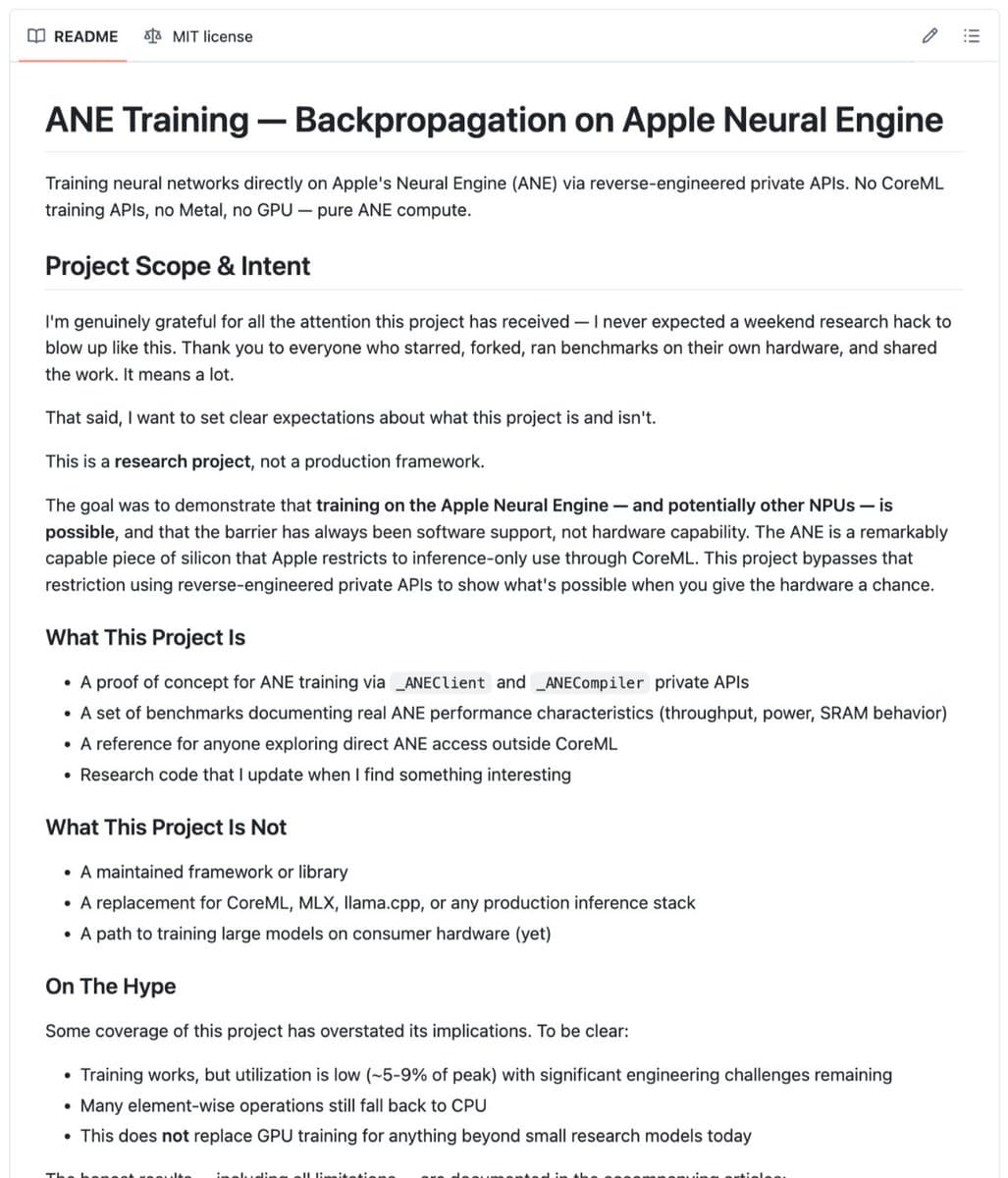
In a stunning development that could reshape the landscape of edge AI computing, security researchers have successfully reverse-engineered Apple's proprietary Neural Engine (ANE) architecture, unlocking capabilities that Apple intentionally kept hidden from developers. The breakthrough allows full neural network training to run directly on Apple's specialized AI hardware, bypassing years of artificial restrictions that limited the ANE to inference-only operations.
The Technical Breakthrough
The research, documented in an open-source repository with an MIT license, reveals how Apple's ANEClient private APIs were cracked to enable complete neural network training workflows. According to the findings, Apple's M4 chip contains 15.8 teraflops of raw compute power that has been sitting dormant behind inference-only restrictions—a significant portion of the chip's potential that developers couldn't access through official channels like CoreML or Metal frameworks.
The implementation achieves remarkable efficiency through several optimizations. Researchers reduced training step times from 33.5 milliseconds to just 9.3 milliseconds by implementing channel-first memory layouts and asynchronous cblas operation overlap. The system executes six ANE kernel dispatches per training step, handling both forward and backward passes entirely on-chip without relying on GPU or CPU resources.
Platform Accessibility
What makes this development particularly significant is its broad compatibility across Apple's ecosystem. The unlocked ANE capabilities work on:
- All M-series MacBooks
- Mac Mini computers
- M-series iPads
- Essentially any Apple Silicon device with a Neural Engine
This universality means that millions of devices already in consumers' hands suddenly have dramatically expanded AI capabilities without requiring hardware upgrades or specialized equipment.
Implications for AI Development
The ability to train neural networks directly on consumer devices represents a paradigm shift in AI development workflows. Previously, training complex models required cloud infrastructure or high-end workstations with specialized GPUs. Now, developers can experiment, fine-tune, and personalize models entirely on-device, offering several advantages:
- Privacy Preservation: Sensitive data never leaves the user's device
- Reduced Latency: No network round-trips to cloud servers
- Cost Reduction: Eliminates cloud compute expenses
- Accessibility: Democratizes AI development beyond those with expensive hardware
Apple's Walled Garden Cracks
This development represents a significant crack in Apple's famously controlled ecosystem. For years, Apple has maintained tight control over how developers can access their specialized hardware, particularly the Neural Engine. While this control allowed Apple to optimize for specific use cases and maintain security standards, it also limited innovation and kept powerful capabilities locked away.
The researchers' work reveals that Apple's hardware has been capable of much more than the company has allowed through official APIs. The 15.8 TFLOPS figure for the M4 chip's ANE is particularly revealing—this represents substantial AI compute power that has been artificially restricted from developers who wanted to push the boundaries of on-device AI.
Community Response and Future Directions
The edge AI community has responded with excitement to this breakthrough. For years, developers have sought ways to leverage Apple's custom silicon for more than just inference tasks. The ability to run full training workflows opens up numerous possibilities:
- Personalized AI models that adapt to individual users' behavior and preferences
- Federated learning implementations that respect user privacy while improving models
- Real-time model adaptation in applications like photography, audio processing, and creative tools
- Educational tools that allow students to experiment with AI training without cloud dependencies
Security and Ethical Considerations
While the technical achievement is impressive, it raises important questions about security and responsible disclosure. Reverse-engineering private APIs could potentially expose vulnerabilities that malicious actors might exploit. The researchers appear to have focused on capability unlocking rather than security bypassing, but the technique could inspire less ethical applications.
Additionally, Apple may respond with firmware updates or legal challenges to re-secure their private APIs, potentially creating a cat-and-mouse game between researchers and the tech giant.
The Broader Industry Impact
This development comes at a pivotal moment in the AI hardware landscape. As companies like Apple, Google, and Qualcomm increasingly integrate specialized AI accelerators into their chips, questions about openness and accessibility become more pressing. Apple's approach of tightly controlling access to their Neural Engine contrasts with more open approaches from other manufacturers.
The success of this reverse-engineering effort may pressure Apple to reconsider their developer access policies or inspire other researchers to unlock similar capabilities in competing platforms. It also highlights the growing sophistication of the security research community in understanding and manipulating complex AI hardware architectures.
Source: Original research documented by @hasantoxr on X/Twitter, detailing the reverse-engineering of Apple's Neural Engine private APIs.