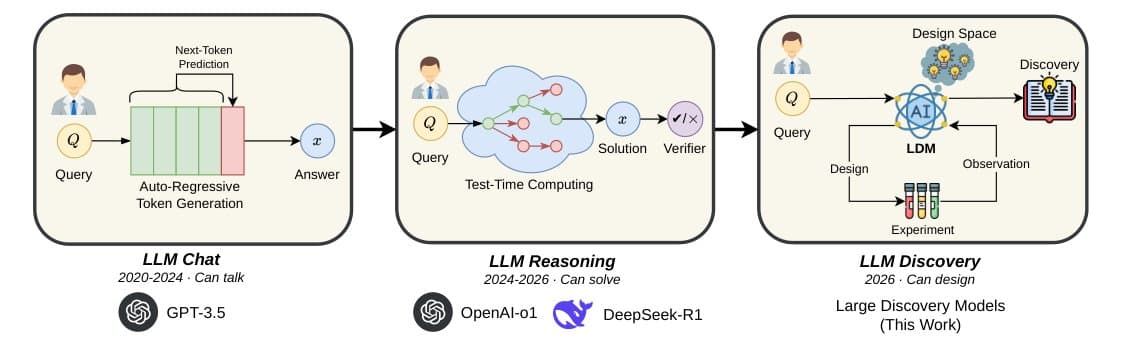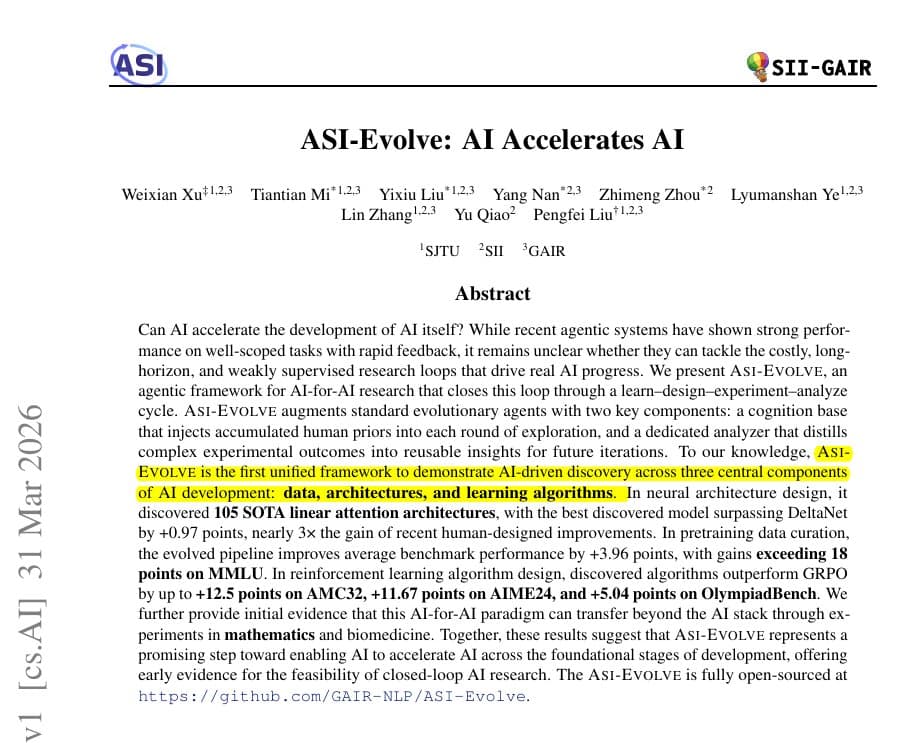
A new research paper introduces ASI-Evolve, an AI system designed to accelerate AI research itself by automating the experimental loop of proposing, testing, and learning from ideas. The system addresses the fundamental bottleneck in research: the slow, human-intensive process of navigating vast idea spaces, running expensive training jobs, and interpreting messy results.
What the System Does
ASI-Evolve operates as a persistent research assistant with memory. It doesn't start from scratch each time but maintains a structured memory of past trials. The process begins by ingesting human research notes or papers as initial hints. From this starting point, the system autonomously writes new code to implement experimental variations, executes task-specific evaluations (like training a model and running benchmarks), and then analyzes the resulting noisy logs to extract concise lessons. These lessons are fed back into its memory to inform the next round of experimentation.
Crucially, the paper emphasizes that this is not fully autonomous science. The loop remains dependent on human-provided components: the initial research literature, the choice of research tasks, the baseline systems to improve upon, and the evaluation procedures that define success. ASI-Evolve excels within this bounded search space, systematically exploring variations that humans might overlook or lack the bandwidth to test.
Key Results
The paper evaluates ASI-Evolve on three core AI research tasks, reporting concrete improvements over strong baselines.
Linear Attention Design Existing variants 105 better designs discovered N/A (Discovery Count) Reasoning Benchmark (AMC32) GRPO (Strong RL Baseline) Score increase up to 12.5 points Significant performance gain Data Curation Pipeline Standard curation Average score boost of 3.96 points Includes >18 point gain on MMLUIn a cross-domain test, the system was also applied to drug discovery, where it found a drug target prediction model that outperformed the seed design by 6.94 AUROC on an unseen test set. This suggests the automated search methodology may generalize beyond core AI tasks.
The core technical achievement is the system's ability to operate in a "long-horizon" research setting where feedback is weak, noisy, and expensive to obtain. In this context, efficient progress depends less on sporadic brilliance and more on consistent, systematic exploration that doesn't forget the lessons of past failures.
How It Works: The Automated Research Loop
ASI-Evolve's architecture is built around a continuous cycle of four stages:
- Memory & Hint Integration: The system stores a structured history of experiments (code, results, derived lessons). It can be seeded with insights from human-written papers or notes, framing the initial search direction.
- Proposal Generation: Using the memory context, it generates new experimental proposals. This involves writing executable code that implements architectural changes, new training configurations, or data processing pipelines.
- Execution & Evaluation: The proposed code is run, typically involving model training and evaluation on a target benchmark. This is the computationally expensive step that the system automates and manages.
- Analysis & Lesson Learning: Raw results (logs, metrics, loss curves) are analyzed to extract succinct, actionable lessons (e.g., "Adding LayerNorm after this module consistently degrades performance on this task"). These lessons are codified and added to memory.
This loop turns AI from a tool for executing single, human-specified jobs into a partner that can manage a sustained campaign of iterative improvement.
Why It Matters: Accelerating the Rate of Research
The significance of ASI-Evolve lies in its potential to increase the iteration speed of AI research. By automating the proposal-test-learn cycle, it allows researchers to explore a wider design space with the same human effort. The discovered linear attention variants and improved data curation pipelines are tangible outputs that would have required substantial manual experimentation to uncover.
The paper carefully positions the work not as a replacement for human researchers but as a force multiplier. Human creativity is still required to define meaningful problems, provide initial insights, and interpret high-level findings. ASI-Evolve handles the labor-intensive, computational heavy lifting of exploring the solution space around those ideas.
gentic.news Analysis
This work directly engages with a major trend in AI research: using AI to build better AI. It follows a trajectory from automated hyperparameter tuning (e.g., Google's Vizier) and neural architecture search (NAS) toward more open-ended, code-writing research assistants. It aligns with but meaningfully advances beyond projects like OpenAI's earlier work on using LLMs to generate and evaluate code, or Meta's previous experiments in self-improving AI systems. The key differentiator here is the explicit focus on the long-horizon, weak-feedback loop characteristic of fundamental research, coupled with a persistent memory system—a critical component often missing from one-off automation scripts.
The reported success in drug discovery (a 6.94 AUROC gain) is a notable data point. It suggests the underlying methodology of automated experimental loops may be a general-purpose paradigm for computational science, not just AI-for-AI. This connects to broader industry efforts in computational biology and materials science, where companies like Isomorphic Labs (backed by Alphabet) and Recursion Pharmaceuticals are leveraging AI for high-throughput in-silico experimentation. ASI-Evolve provides a blueprint for how such loops can be structured when the "experiment" is training a model or running a simulation.
For practitioners, the immediate implication is the validation of a tool-assisted research workflow. The most impactful near-term use of systems like ASI-Evolve may not be fully autonomous discovery, but in augmenting research teams to rigorously test more hypotheses derived from human intuition. It formalizes and automates the often-ad-hoc process of running ablation studies and tracking experimental lineages.
Frequently Asked Questions
What is ASI-Evolve?
ASI-Evolve is an AI research acceleration system described in the paper "ASI-Evolve: AI Accelerates AI." It automates the experimental loop in AI research by maintaining a memory of past trials, generating new code-based experiments, running evaluations, and extracting lessons to guide future rounds. It is designed to be a force multiplier for human researchers, not a replacement.
What concrete results did ASI-Evolve achieve?
The system produced three primary results: it discovered 105 improved variants of linear attention mechanisms; it created agents that surpassed a strong reinforcement learning baseline (GRPO) by up to 12.5 points on the AMC32 reasoning benchmark; and it built a data curation pipeline that raised average benchmark scores by 3.96 points, including an improvement of over 18 points on the MMLU knowledge benchmark.
Can ASI-Evolve do research without any human input?
No. The authors explicitly state the system is not fully human-free. It depends on human-provided research papers for initial hints, human-chosen tasks and objectives, pre-defined baseline systems to improve upon, and user-specified evaluation procedures. It operates within a bounded search space defined by human researchers.
How is this different from Neural Architecture Search (NAS)?
While related, ASI-Evolve aims for a broader scope. Traditional NAS typically searches within a constrained space of neural network layer types and connections for a single task like image classification. ASI-Evolve is designed for more open-ended research tasks (like improving attention mechanisms or data curation pipelines), writes its own code for experiments, and uses a persistent memory to learn general lessons across a long sequence of trials, making it suitable for long-horizon research problems.