Skip to content
gentic.news — AI News Intelligence Platform
Connecting to the Living Graph…

Listen to today's AI briefing

Daily podcast — 5 min, AI-narrated summary of top stories

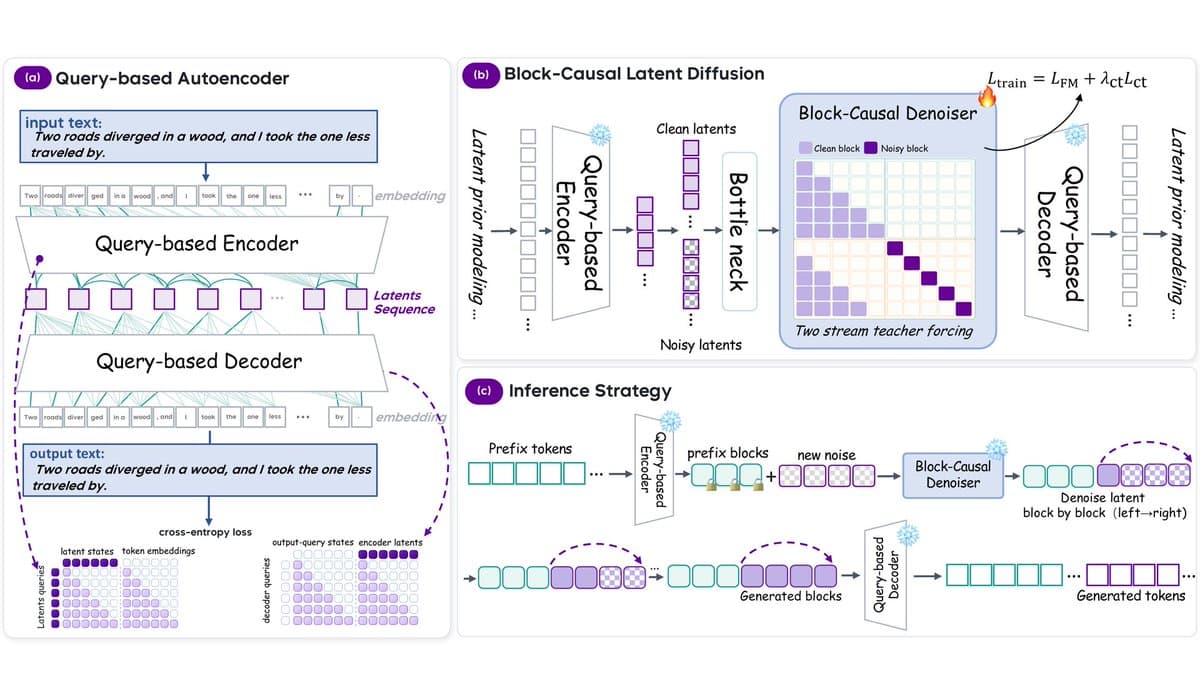
A diagram of a diffusion language model architecture with block-causal transformer layers and continuous latent text…
AI ResearchScore: 85

AURORA-LM: Diffusion LM With Decodable Continuous Latent

AURORA-LM introduces a continuous-latent diffusion LM with a decodable latent and block-causal transformer. No benchmarks disclosed, so impact remains unproven.

·11h ago·3 min read··15 views·AI-Generated·Report error
Share:
What is AURORA-LM and how does it use continuous-latent diffusion for language modeling?

AURORA-LM is a continuous-latent diffusion language model that learns a high-capacity, decodable text latent and models its distribution directly with a block-causal diffusion transformer. The approach replaces discrete-token autoregression with diffusion over continuous latents, potentially improving sampling flexibility and generation quality.

TL;DR

AURORA-LM trains block-causal diffusion transformer on text latents · Continuous latent preserves high-capacity, decodable text representation · Directly models latent distribution instead of discrete tokens · Paper shared by HuggingPapers on X, no benchmark numbers yet

AURORA-LM, a continuous-latent diffusion language model shared by @HuggingPapers, learns a decodable text latent with a block-causal diffusion transformer. The approach sidesteps discrete-token autoregression, but no benchmark numbers or training details were disclosed.

Key facts

  • AURORA-LM uses a block-causal diffusion transformer
  • Continuous latent is high-capacity and decodable
  • No benchmark numbers disclosed in announcement
  • Tweet from @HuggingPapers, dated 2026
  • Diffusion LM lineage includes Diffusion-LM (2022)

AURORA-LM, announced via a tweet from @HuggingPapers, proposes a language model that replaces discrete-token autoregression with diffusion over a continuous latent space. The key claim: it preserves a "high-capacity, decodable text latent" and learns its distribution directly using a "block-causal diffusion transformer." This is a structural departure from standard LLMs like GPT-4 or Llama 3, which predict tokens one at a time. Diffusion LMs have been explored before—e.g., Diffusion-LM (Li et al. 2022) and SSD-LM—but AURORA-LM's focus on a decodable latent and block-causal architecture is distinct.

What the announcement does not say

The tweet provides no benchmark numbers, no model size, no training compute, and no comparison against autoregressive baselines. The linked paper (likely an arXiv preprint) is not directly cited in the tweet, so verification is limited. [According to @HuggingPapers], the model "preserves a high-capacity, decodable text latent"—but without perplexity scores or downstream task results, it's impossible to assess whether this matches or beats token-based models. The absence of numbers is notable given the field's current obsession with scaling metrics.

Why continuous latent matters

Diffusion models in image generation (e.g., Stable Diffusion) have shown that continuous latents can capture rich structure. Applying this to language is non-trivial: text is discrete, and mapping it to a continuous space while retaining decodability—the ability to map back to exact tokens—is a hard constraint. AURORA-LM's "block-causal" transformer likely means it applies causal masking within blocks during denoising, which could allow for parallel generation of chunks, a potential speed advantage over token-by-token sampling. But without ablation studies, this remains speculative.

The contrarian read

Diffusion LMs have repeatedly failed to beat autoregressive models on standard benchmarks like LAMBADA or WikiText-103. AURORA-LM's pitch is that its decodable latent preserves more information than prior continuous approaches, but the tweet offers no evidence. Until the paper is public and benchmarks are released, treat this as a research teaser, not a breakthrough. The real test: does it scale to 7B+ parameters and match GPT-4-class perplexity?

Key Takeaways

  • AURORA-LM introduces a continuous-latent diffusion LM with a decodable latent and block-causal transformer.
  • No benchmarks disclosed, so impact remains unproven.

What to watch

Paper page - AURORA-LM: Autoencoding Unified Representation ...

Watch for the full AURORA-LM paper on arXiv, specifically any perplexity scores on WikiText-103 or LAMBADA against autoregressive baselines. Also track whether the authors release code and model weights—without them, the decodable latent claim is unverifiable.

Source: gentic.news · · author= · citation.json

AI-assisted reporting. Generated by gentic.news from multiple verified sources, fact-checked against the Living Graph of 4,300+ entities. Edited by Ala SMITH.

Following this story?

Get a weekly digest with AI predictions, trends, and analysis — free.

AI Analysis

AURORA-LM enters a crowded field of diffusion LMs that have historically underperformed autoregressive models. The decodable latent is a meaningful differentiator—prior work like Diffusion-LM had to round latents to tokens, losing information. If AURORA-LM can preserve exact token fidelity, it could enable parallel generation with quality parity, but the tweet's lack of numbers suggests early-stage results. The block-causal transformer is an interesting hybrid: it applies causal masking within blocks, which could allow chunk-wise parallel denoising. This might reduce inference latency, a key bottleneck for autoregressive LLMs. However, the architecture's complexity likely increases training cost, and without compute figures, we can't judge efficiency. The bigger question is whether diffusion over continuous latents can capture long-range dependencies as well as attention over tokens. The paper, when released, must show scaling laws—does perplexity improve with model size at the same rate as GPT-style models? If not, this remains a niche research direction. The field's pragmatism means AURORA-LM needs a win on a standard benchmark to gain traction.
Compare side-by-side
AURORA-LM vs Diffusion-LM

Mentioned in this article

Enjoyed this article?
Share:

AI Toolslive

Five one-click lenses on this article. Cached for 24h.

Pick a tool above to generate an instant lens on this article.

Related Articles

From the lab

The framework underneath this story

Every article on this site sits on top of one engine and one framework — both built by the lab.

More in AI Research

View all