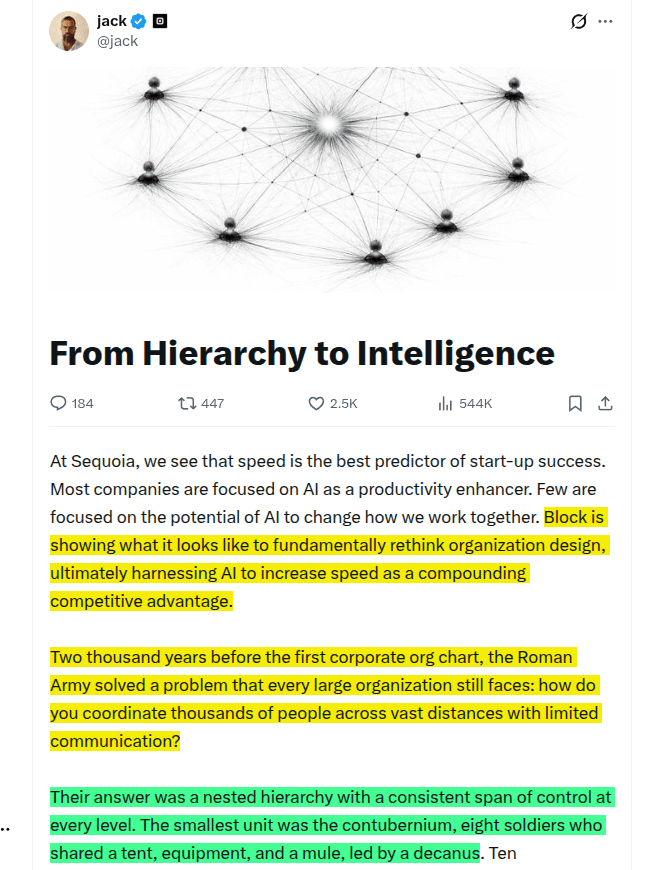
Jack Dorsey's financial technology company Block has detailed a radical organizational vision: replacing much of traditional corporate hierarchy with AI-driven coordination systems. According to a plan outlined by the company, middle management—which historically exists to coordinate work and pass information through organizational layers—could be supplanted by artificial intelligence that handles these functions instantly.
What Block Is Proposing
Block's core argument centers on the inefficiency of human-based organizational structures. In traditional corporations, managers serve as "slow, narrow-band routers of context," requiring information to move up and down multiple layers before decisions can be made. Block claims this creates coordination bottlenecks that limit organizational agility.
The company proposes replacing this hierarchical model with two interconnected AI systems:
- A Company World Model: Continuously tracks work, projects, bottlenecks, resources, and outcomes across the organization
- A Customer World Model: Built from transaction data to understand what customers and merchants actually need in real-time
In a remote-first company where work already leaves digital traces, Block argues that AI can maintain a live picture of organizational activity, eliminating the need for status meetings and hierarchical reporting structures.
How the System Would Work
The technical implementation centers on what Block calls an "intelligence layer" that sits atop the company's financial capabilities. Instead of building products through traditional roadmap processes, this AI system would detect customer needs through transaction data and automatically assemble modular capabilities:
- Payments processing
- Lending services
- Card issuance
- Payroll systems
When the customer world model identifies a pattern suggesting demand for a particular financial solution, the intelligence layer would compose the necessary capabilities in real-time. For example, if transaction data shows a merchant experiencing cash flow issues during seasonal downturns, the system might automatically offer a short-term lending product with customized terms.
The Changing Role of Human Workers
Under this model, human roles would shift dramatically:
- From relaying status to building capabilities
- From managing reports to owning cross-team problems as Directly Responsible Individuals (DRIs)
- From hierarchical supervision to acting as player-coaches who improve craft and judgment
The company emphasizes that the real bottleneck in large organizations isn't individual effort but coordination overhead. By targeting coordination itself with AI systems, Block believes it can achieve greater organizational efficiency and responsiveness.
The Data Advantage
Block's approach leverages its unique position as a financial services company with extensive transaction data. As the company notes: "Money is behavior with fewer illusions attached. If you can see how customers and merchants actually spend, borrow, save, and repay, you are no longer guessing from survey answers or product roadmaps."
This data-driven approach allows the company to move from product-centric thinking to capability-centric thinking. Financial services become modular components that can be dynamically assembled based on real-time understanding of customer behavior.
Implementation Challenges
While Block has outlined the theoretical framework, significant implementation challenges remain:
- Technical complexity: Building accurate world models that can track both internal operations and external customer needs requires sophisticated AI systems
- Data integration: Creating a unified view from disparate data sources across the organization
- Organizational change management: Transitioning from hierarchical structures to AI-coordinated teams represents a fundamental cultural shift
- Decision-making accountability: Determining how AI-driven coordination interacts with human judgment and responsibility
Block has not provided a specific timeline for implementing this vision or detailed what specific AI technologies would power these coordination systems.
gentic.news Analysis
Block's proposal represents one of the most ambitious applications of AI to organizational structure we've seen from a major technology company. This follows Jack Dorsey's longstanding interest in organizational efficiency and decentralization, evident in his leadership of both Block and previously Twitter. The timing is particularly notable given the broader industry trend toward AI-driven productivity tools, but Block is taking this several steps further by targeting the fundamental architecture of corporate management.
This announcement aligns with several trends we've been tracking in enterprise AI. First, it represents a natural extension of the AI agent frameworks that have gained prominence in 2025-2026, where multiple specialized AI systems coordinate to complete complex tasks. Second, it connects to the growing interest in "AI-native" organizational design, where companies structure themselves around AI capabilities rather than retrofitting AI into existing hierarchies. We covered early experiments in this direction with Autonomous AI Teams at Scale last November, but Block's vision appears more comprehensive.
However, significant questions remain about implementation. The most successful AI applications in enterprise settings have typically augmented human decision-making rather than replacing entire management layers. Block's approach assumes that AI can handle the nuanced social and political dimensions of organizational coordination—a claim that remains unproven at scale. Additionally, the company hasn't addressed how this system would handle strategic direction setting, cultural development, or ethical oversight—functions that typically involve human judgment beyond mere coordination.
From a competitive standpoint, this move could give Block significant operational advantages if successfully implemented. Financial services is particularly suited to this approach because transaction data provides unusually clear signals about customer needs. If Block can indeed assemble financial products in real-time based on detected demand, it could dramatically outpace traditional banks and even fintech competitors who still rely on human-driven product development cycles.
Frequently Asked Questions
What exactly is Block proposing to replace with AI?
Block is proposing to replace much of the traditional corporate hierarchy, particularly middle management layers whose primary function is coordinating work and passing information up and down the organization. The company argues that AI systems can handle these coordination functions more efficiently by maintaining real-time models of both internal work and external customer needs.
How would Block's AI coordination system actually work?
The system would consist of two interconnected AI models: a company world model that tracks all internal work, projects, resources, and bottlenecks, and a customer world model built from transaction data that understands what customers and merchants need. An intelligence layer would use these models to automatically assemble Block's financial capabilities (payments, lending, cards, payroll) into customized solutions when customer demand is detected.
What would happen to human managers under this system?
Human roles would shift from coordination and status reporting to building capabilities, owning cross-team problems as Directly Responsible Individuals (DRIs), and acting as player-coaches who focus on improving craft and judgment. Rather than eliminating human workers, the system would redefine their responsibilities toward higher-value activities that leverage human strengths like creativity and strategic thinking.
Has any company successfully implemented AI-driven organizational structures like this?
While many companies use AI for specific coordination tasks (scheduling, resource allocation, project management), no major corporation has successfully replaced entire management layers with AI coordination systems at scale. Some startups and tech companies have experimented with flatter, more automated structures, but Block's proposal appears to be one of the most comprehensive visions from an established public company.
What are the biggest challenges Block will face in implementing this vision?
The main challenges include: (1) technical complexity in building accurate world models that can track both internal operations and external customer needs, (2) data integration across disparate systems, (3) organizational change management in transitioning from hierarchical structures, and (4) establishing clear accountability frameworks for AI-driven decision-making. Additionally, the system must handle the nuanced social and strategic dimensions of management that go beyond mere coordination.