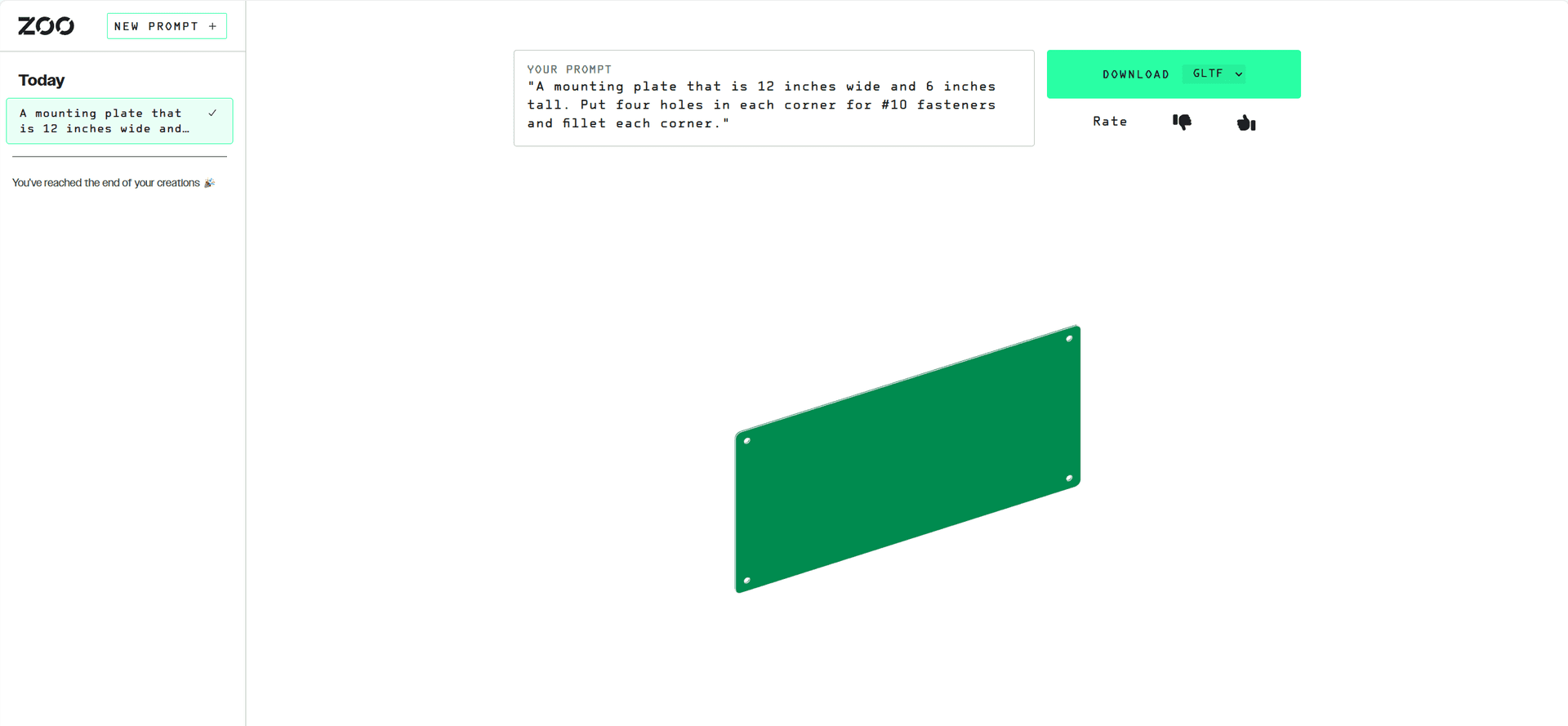
A developer has created a text-to-computer-aided design (CAD) application that runs completely within a web browser, bypassing the need for cloud servers or external APIs. The tool, highlighted in a social media post, allows users to describe a 3D object in natural language and generate a corresponding CAD model directly in their browser. The interface also reportedly includes controls for editing the generated model.
What Happened
The tool was showcased in a post by AI educator and developer Jainam Desai (@aiwithjainam), who expressed surprise at its existence, stating, "Genuinely didn't expect this to exist yet." The key technical claim is that the entire pipeline—from processing the text prompt to generating and rendering the 3D geometry—executes locally on the user's device using client-side JavaScript and WebGL. This is a significant departure from most generative AI for 3D, which relies on sending prompts to remote servers for processing.
Technical Context
Text-to-3D and text-to-CAD are challenging domains that have typically required substantial cloud compute. Major approaches include:
- NeRF-based methods: Generate neural radiance fields from text, which are computationally intensive to train and render.
- Diffusion models for 3D: Such as OpenAI's Shap-E or Stability AI's offerings, which usually run on servers.
- Procedural generation: Some tools convert text to parameters for procedural modelers, but these are often limited to specific domains.
A fully browser-based implementation suggests the developer may be using one of several techniques:
- A small, distilled neural network (likely a diffusion model or a specialized transformer) that has been converted to run via TensorFlow.js or ONNX Runtime for Web.
- A hybrid approach where a lightweight model generates a intermediate representation (like a set of primitives or parameters), which is then turned into a mesh by a deterministic, client-side geometry kernel.
- Leveraging WebGPU, the emerging successor to WebGL, to accelerate model inference directly on the GPU.
The ability to "edit" the generated model in-browser further suggests the tool may output a structured scene graph or parametric model, not just a static mesh, allowing for post-generation adjustments.
Why It Matters
If the tool performs as described, it has several immediate implications:
- Privacy & Data Control: Prompts and models never leave the user's machine, which is critical for proprietary designs.
- Cost & Accessibility: Eliminates per-query API costs and subscription fees associated with cloud-based 3D generation services.
- Speed & Latency: Avoids network round-trips, potentially offering faster iteration for simple models.
- Offline Functionality: In principle, the tool could work offline after the initial page load, enabling use in low-connectivity environments.
This development lowers the barrier to entry for rapid 3D prototyping, making it accessible to designers, engineers, educators, and hobbyists who need quick concept models without investing in complex CAD software or cloud credits.
Limitations & Unknowns
The social media post does not provide details on:
- Model Capabilities: The complexity and fidelity of models it can generate (e.g., simple geometric assemblies vs. organic shapes).
- Underlying Technology: The specific AI model or architecture powering the generation.
- Performance: Generation time and hardware requirements (CPU/GPU/RAM).
- Output Formats: Whether it exports standard CAD files (STEP, IGES) or common 3D formats (OBJ, GLB).
- Availability: Whether the tool is publicly accessible or still in a demo/private stage.
gentic.news Analysis
This development is a logical, incremental step in the ongoing trend of bringing generative AI inference to the edge. It follows the broader industry movement, exemplified by companies like Replicate (which offers client-side models via Cog) and Mozilla's LLaMA.cpp, to decentralize AI compute. The specific application to CAD is notable because the 3D design space has been dominated by cloud-based solutions from players like Autodesk (with its Fusion 360 AI features) and Adobe (Substance 3D Sampler). A client-side tool directly challenges the SaaS model that has become standard in this sector.
Technically, the feasibility hinges on the recent maturation of WebGPU and efficient model formats. As we covered in our October 2025 analysis, WebGPU adoption is accelerating, providing near-native GPU access for ML workloads in the browser. This tool likely leverages these advancements. Its emergence also aligns with increased activity (📈) in the open-source 3D generation space, where projects like Three.js and Open3D have lowered the barrier for building 3D web applications.
For practitioners, the key takeaway is the validation of a client-side path for specialized generative tasks. While text-to-image diffusion models have seen successful browser ports (e.g., Stable Diffusion WebUI), 3D generation is more computationally demanding. This proof-of-concept suggests that for certain use-cases—particularly parametric or primitive-based CAD—the model size and compute requirements can be tamed for local execution. The next frontier will be whether similar techniques can be applied to more complex, organic text-to-3D generation without sacrificing too much quality.
Frequently Asked Questions
What is a text-to-CAD tool?
A text-to-CAD tool is an application that uses artificial intelligence to interpret a natural language description (e.g., "a hexagonal nut with a 10mm diameter") and automatically generates a corresponding 3D computer-aided design model. This model can typically be edited, measured, and exported for use in manufacturing, 3D printing, or simulation.
How does a browser-based AI tool work without the cloud?
It works by loading a pre-trained, optimized AI model directly into the webpage. This model is then executed using JavaScript APIs that access your computer's GPU (via WebGL or WebGPU) to perform the necessary calculations. All data processing happens locally in your browser's sandbox, so no information is sent to a remote server.
What are the advantages of a local, browser-based AI tool?
The primary advantages are privacy, cost, and latency. Your design prompts and generated models never leave your computer, protecting intellectual property. There are no API fees or subscription costs for the AI processing. Finally, eliminating network requests can lead to faster generation times, especially for simple models, as you're not waiting for a server queue.
Is this tool as powerful as cloud-based 3D AI generators?
It is unlikely to be as powerful in terms of the complexity and photorealism of the 3D models it can generate. Cloud-based services like OpenAI's Shap-E or NVIDIA's GET3D have access to vast computational resources (multiple high-end GPUs) and can run much larger, more complex models. A browser-based tool must use a highly optimized, smaller model to run efficiently on consumer hardware, which may limit its detail and scope to simpler, more parametric objects suitable for CAD, rather than highly detailed organic shapes.