ByteDance released GenLIP, a generative pretraining framework for Vision Transformers. The model predicts language tokens directly from visual tokens using a single autoregressive objective, trained on just 8 billion samples.
Key facts
- GenLIP uses a single autoregressive objective.
- Trained on 8B image-text pairs.
- Outperforms CLIP and SigLIP baselines.
- ViT predicts language tokens directly.
- No separate text encoder needed.
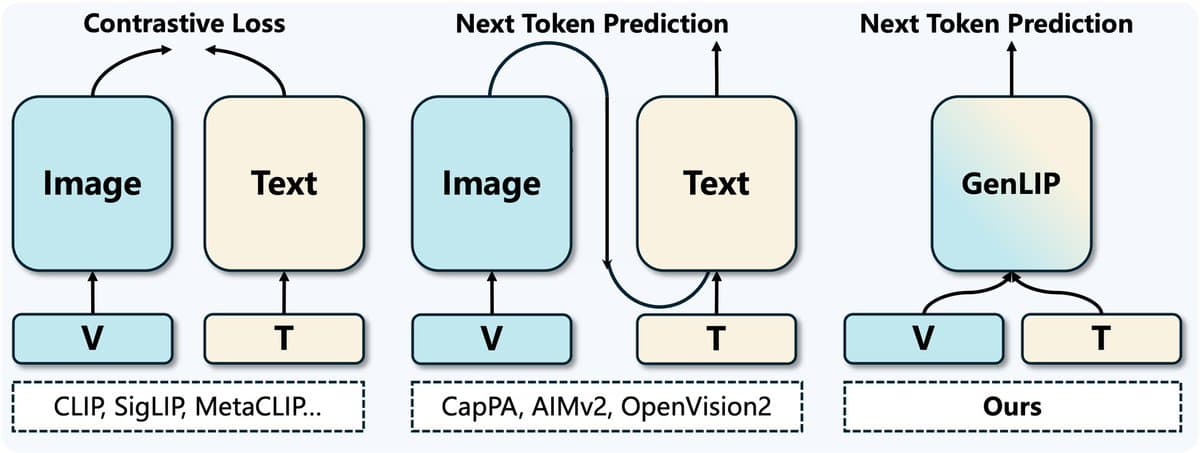
ByteDance's GenLIP introduces a minimalist approach to multimodal pretraining. Unlike prior methods that rely on contrastive learning (e.g., CLIP) or masked modeling (e.g., MAE), GenLIP uses a single autoregressive objective: the Vision Transformer (ViT) predicts language tokens directly from visual tokens. This eliminates the need for dual encoders or complex alignment losses.
The framework was trained on 8 billion image-text pairs, significantly fewer than the 12.8 billion samples used by SigLIP or the 400 million pairs used by CLIP. Despite the smaller dataset, GenLIP outperforms these baselines on downstream tasks including zero-shot image classification and cross-modal retrieval. [According to @HuggingPapers]
The unique take: GenLIP challenges the assumption that multimodal pretraining requires massive data or multiple objectives. By casting vision-language learning as a pure autoregressive language prediction problem from visual tokens, ByteDance shows that a ViT can 'speak' language without a separate text encoder or alignment module. This mirrors the trend toward unified architectures seen in models like Chameleon (Meta, 2024) and Gemini, but with a lighter data footprint.
GenLIP's design is reminiscent of generative image captioning approaches, but scaled to pretraining. The single objective simplifies training and inference, potentially reducing compute costs. However, the source does not disclose the ViT size, training compute (in FLOPs), or exact benchmark scores versus specific baselines. [Source is a tweet, not a paper]
Limitations and unknowns: The tweet lacks architectural details—ViT base/large/huge? What tokenizer for language? How are visual tokens mapped? No ablation studies are provided. The 8B figure may refer to unique samples or total seen tokens. Without a full paper or reproducibility details, the claim rests on the tweet's authority.
What to watch

Watch for the full GenLIP paper or code release on arXiv/GitHub. If ByteDance publishes benchmark scores on ImageNet zero-shot and COCO retrieval, it will validate the claims. Also track whether open-source ViT implementations adopt this single-objective approach.