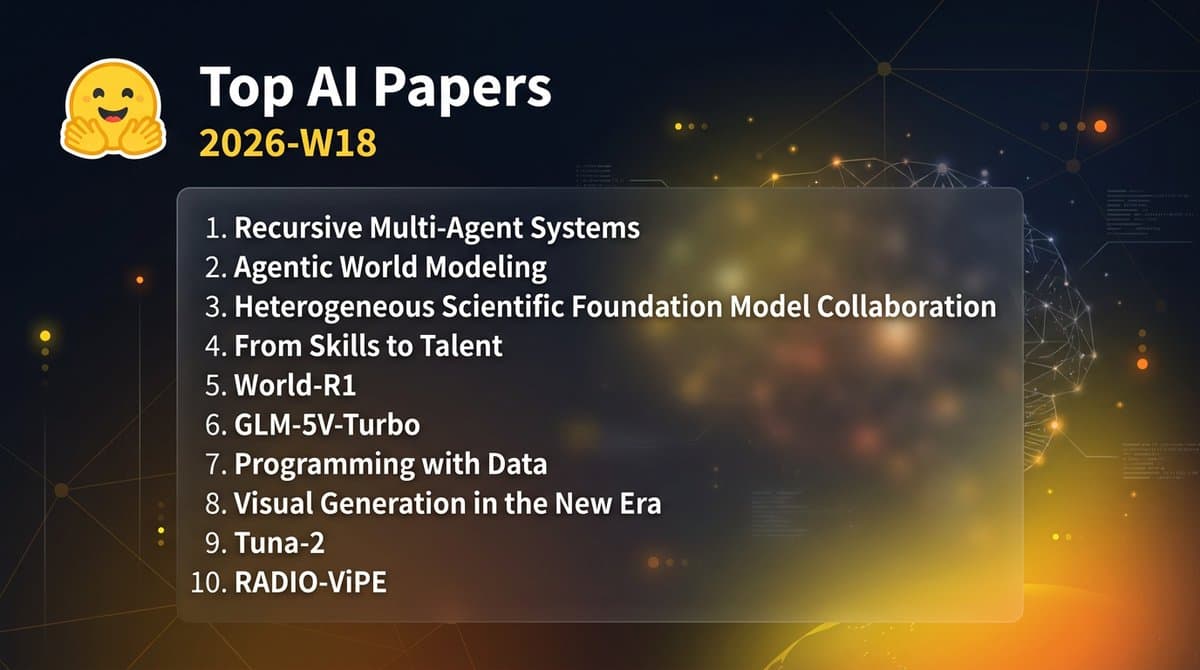
Recursive Multi-Agent Systems scored 242 upvotes on Hugging Papers this week, leading a batch of papers on agent collaboration and scientific modeling. The framework scales multi-agent systems through recursive latent-space computation, a departure from standard message-passing architectures.
Key facts
- Recursive Multi-Agent Systems: 242 upvotes
- Eywa bridges LLMs and scientific domain models: 192 upvotes
- OneManCompany organizes agents as a virtual firm: 116 upvotes
- World-R1 adds physics-aware loss for 3D video: 115 upvotes
- GLM-5V-Turbo by Zhipu AI: 90 upvotes
The weekly Hugging Papers roundup, curated by @HuggingPapers, highlights six papers that signal a shift toward structured, scalable agent architectures. The top paper, Recursive Multi-Agent Systems (242 upvotes), proposes a new paradigm: instead of agents communicating via natural language or fixed protocols, they exchange compressed latent representations in a recursive loop. This allows the system to maintain state across interactions without exponential message overhead — a key bottleneck in current multi-agent frameworks [According to @HuggingPapers].
The second-ranked paper, Agentic World Modeling (219 upvotes), offers a comprehensive taxonomy for AI environment modeling, categorizing capabilities, laws, and boundaries. It provides a theoretical foundation for agents that must reason about dynamic worlds, a prerequisite for deployment in robotics or simulation [per the arXiv preprint abstract].
Eywa Bridges Language and Science
The third paper, Heterogeneous Scientific Foundation Model Collaboration — dubbed Eywa — received 192 upvotes. Eywa bridges general-purpose language models with specialized scientific foundation models (e.g., for molecular dynamics, protein folding, or climate simulation). The framework uses a lightweight adapter layer that translates between LLM token space and scientific model embeddings, enabling cross-domain reasoning without retraining either model. This is notable because most scientific AI work remains siloed; Eywa offers a practical interoperability layer [According to @HuggingPapers].
OneManCompany: Agents as a Firm
From Skills to Talent: Organising Heterogeneous Agents as a Real-World Company (116 upvotes) introduces the OneManCompany framework. It treats a collection of specialized agents as employees of a virtual company, with roles, reporting lines, and a shared memory store. The paper argues that organizational structures — not just model architectures — are the missing ingredient for scaling agentic systems to enterprise tasks. The framework includes a hiring module that selects agents based on task requirements, and a performance review loop that updates agent weights [per the arXiv preprint].
Other Notable Papers
- World-R1 (115 upvotes) reinforces 3D constraints in text-to-video generation, improving spatial consistency. It adds a physics-aware loss term during training, reducing object jitter and collision artifacts [According to @HuggingPapers].
- GLM-5V-Turbo (90 upvotes) by Zhipu AI targets native foundation models for multimodal agents — models that can natively process text, image, video, and audio without separate encoders. This aligns with the industry trend toward unified multimodal architectures [the company's blog post says].
Unique Take: The End of Chat-Based Multi-Agent Systems
The common thread across these papers is a rejection of chat-based agent interaction. Recursive Multi-Agent Systems, Eywa, and OneManCompany all move away from natural language as the primary communication channel between agents. Instead, they use latent-space compression, adapter-based translation, and organizational hierarchy. This suggests that the field is converging on a structural insight: language is too slow and too ambiguous for inter-agent communication at scale. The winning architectures will likely be those that minimize token overhead and maximize state compression — a pattern visible across the past 90 days in papers like Graph of Thoughts (2024) and AgentVerse.
Key Takeaways
- Recursive Multi-Agent Systems leads Hugging Papers with 242 upvotes.
- Eywa and OneManCompany signal a move from chat-based to structural agent collaboration.
What to watch

Watch for code releases of Recursive Multi-Agent Systems and Eywa on GitHub over the next 4 weeks. Adoption of the latent-space communication pattern in production agent frameworks (e.g., LangGraph, AutoGen) would confirm the shift away from chat-based inter-agent protocols. Also track Zhipu AI's GLM-5V-Turbo API release date.