RoundPipe fine-tunes 32B models on a single 24GB GPU. The method also supports LoRA fine-tuning of 235B models with 64K+ context length.
Key facts
- Full fine-tune 32B models on 24GB GPU.
- LoRA fine-tune 235B models with 64K+ context.
- 1.5-2.2× speedups over SOTA baselines.
- Round-robin dispatch reduces pipeline bubbles to near zero.
- No CPU offloading or model parallelism required.
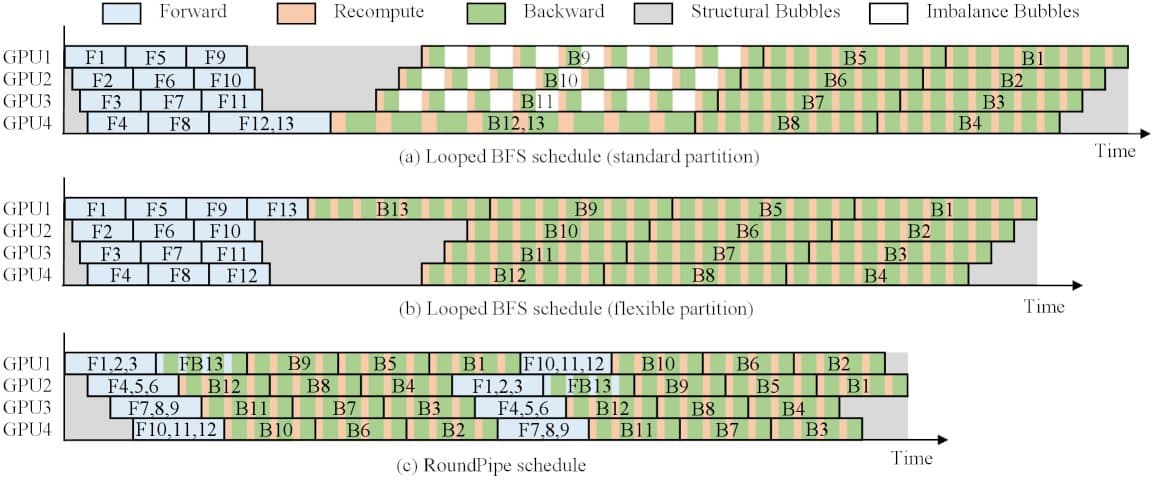
RoundPipe, introduced by researchers and shared via @HuggingPapers, tackles the memory bottleneck that typically forces practitioners to use multiple high-end GPUs for large-model fine-tuning. By dynamically dispatching pipeline stages in a round-robin fashion, it achieves near-zero pipeline bubbles — a primary source of inefficiency in standard pipeline parallelism.
The key innovation is the reduction of idle GPU time during forward and backward passes. Standard pipeline parallelism (e.g., GPipe, PipeDream) leaves most GPUs idle while waiting for the first and last stages to complete. RoundPipe's round-robin dispatch overlaps computation across stages more evenly, yielding 1.5-2.2× speedups over state-of-the-art baselines [According to @HuggingPapers].
This is particularly striking because it targets the same hardware constraints that have driven the shift toward parameter-efficient fine-tuning (PEFT) methods like LoRA. RoundPipe does not require model parallelism or tensor offloading; it operates purely through smarter scheduling within the existing pipeline. The trade-off is that the method likely increases communication overhead between stages, though the source does not quantify this.
The unique take: RoundPipe suggests that the memory wall for fine-tuning large models is not just a hardware problem — it is also a scheduling problem. If the technique generalizes to training from scratch, it could reshape the cost calculus for single-GPU research, especially in academic labs where 24GB GPUs (e.g., RTX 3090/4090) are the norm.
How it compares
Existing methods like ZeRO-Offload and DeepSpeed's heterogeneous training require CPU-GPU data movement, adding latency. RoundPipe avoids offloading entirely by keeping all parameters on the GPU and optimizing the pipeline schedule. The 64K+ context length support is notable because it enables fine-tuning on long-document tasks without memory compression tricks.
Limitations
RoundPipe's performance gain depends on the number of pipeline stages and the model's forward/backward compute ratio. The source does not provide ablation studies across model sizes or hardware configurations. It is also unclear whether the method supports mixed-precision training or gradient checkpointing — both common in production workflows.
What's next
The source does not specify a release date for code or a paper. If the authors open-source the implementation, expect rapid adoption by the Hugging Face community. Watch for a preprint on arXiv with full ablation tables and memory breakdowns.
What to watch

Watch for the arXiv preprint release and open-source code. If RoundPipe achieves 2× speedups on common benchmarks like GLUE or MMLU in third-party replication, expect integration into Hugging Face Transformers and DeepSpeed within 60 days.