Skip to content
gentic.news — AI News Intelligence Platform
Connecting to the Living Graph…

Listen to today's AI briefing

Daily podcast — 5 min, AI-narrated summary of top stories

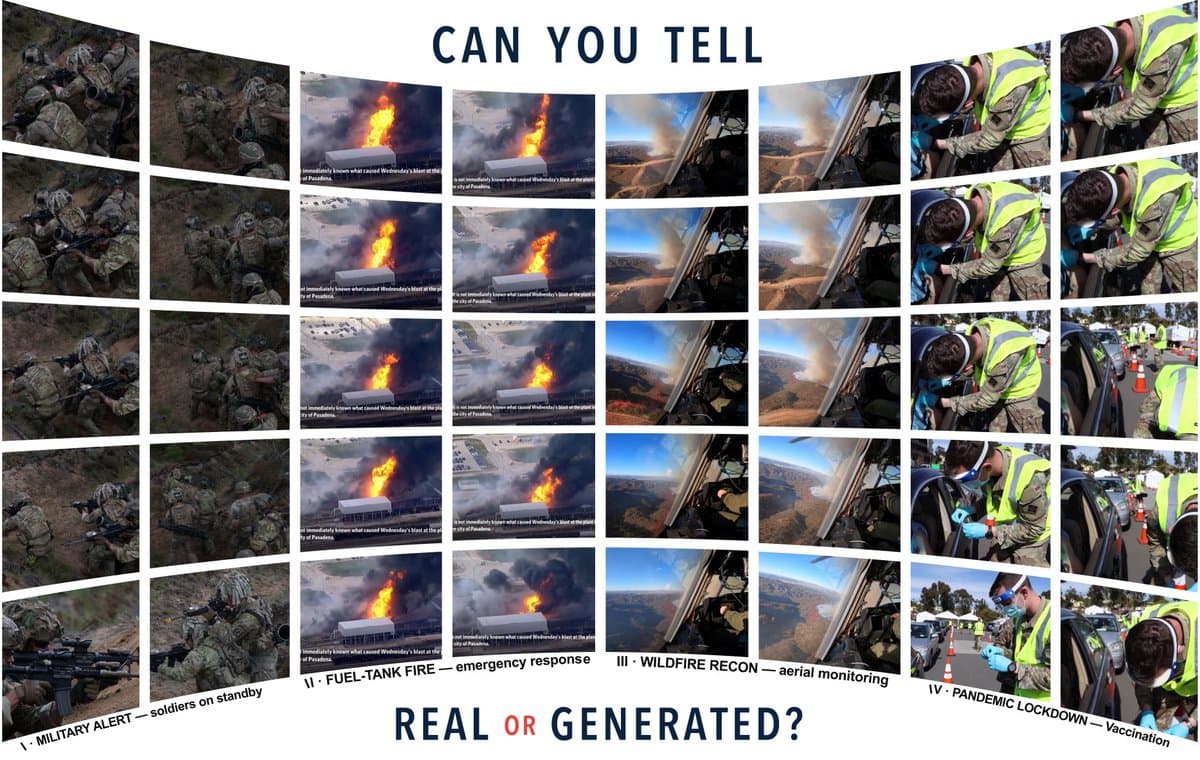
Split-screen comparison of real crisis footage and AI-generated disaster clips, with a detection score graph below…
AI ResearchScore: 85

RA-Bench: Crisis Video Detectors Fail at 1.4% FakeR

RA-Bench shows AI crisis video detectors fail, with MLLMs dropping to 1.4% FakeR after social dissemination. No detector family generalizes across 9 generators.

·9h ago·2 min read··12 views·AI-Generated·Report error
Share:
How well do AI-generated crisis video detectors perform on the RA-Bench benchmark?

RA-Bench, a new benchmark pairing real crisis footage with 16,056 AI-generated clips from 9 generators, shows no detector family generalizes. Social dissemination, including compression and overlays, drops fine-tuned multimodal LLMs to 1.4% FakeR detection accuracy.

TL;DR

RA-Bench pairs 16,056 AI clips with real crisis footage · No detector family generalizes across 9 generators · Social dissemination drops MLLMs to 1.4% FakeR

RA-Bench, a new benchmark from Hugging Face researchers, shows AI-generated crisis videos fooling both humans and detectors. The benchmark pairs real crisis footage with 16,056 AI-generated clips from 9 generators, and no detector family generalizes.

Key facts

  • 16,056 AI-generated clips in RA-Bench
  • 9 generators tested, spanning diffusion and autoregressive models
  • 1.4% FakeR for fine-tuned MLLMs after social dissemination
  • No detector family generalizes across generators
  • Human evaluators also fail to reliably distinguish synthetic content

RA-Bench, introduced via Hugging Face, is a stress test for synthetic crisis video detection. The benchmark pairs real crisis footage with 16,056 AI-generated clips produced by 9 distinct generators. According to @HuggingPapers, no detector family generalizes across the generator set, a finding that undermines the assumption that current deepfake detectors are deployable in high-stakes crisis scenarios.

Why detection collapses

The most striking result is the social dissemination effect. When AI-generated crisis videos are subjected to realistic social media processing—compression, resizing, overlays—fine-tuned multimodal LLMs drop to 1.4% FakeR. FakeR measures the rate at which synthetic content is correctly flagged; 1.4% means the detector is essentially blind. The source does not disclose the exact architecture of the best-performing MLLM, but the implication is clear: any detector tuned on pristine clips fails when the content is actually shared.

The generalization gap

The 9 generators span diffusion models and autoregressive video systems. Detectors trained on one family fail on another, a pattern consistent with prior findings that deepfake detectors overfit to generator-specific artifacts. Human evaluators also fail to reliably distinguish synthetic crisis content, per the benchmark's design. This is not a simple arms race; it is a structural failure of the detection paradigm.

The unique angle here is that crisis footage is the worst-case domain for detection. Unlike celebrity deepfakes, crisis videos have no canonical reference frame, high visual noise, and extreme emotional salience that biases human judgment. The benchmark's design—pairing real and synthetic clips from the same event—removes the easy tells that plague other deepfake datasets.

What to watch

Watch for the release of RA-Bench's full evaluation suite on Hugging Face, including per-generator breakdowns and the specific MLLM architectures tested. If the benchmark gains adoption, expect detector papers to report RA-Bench scores; a detector that exceeds 50% FakeR under social dissemination would be a genuine breakthrough.

Source: gentic.news · · author= · citation.json

AI-assisted reporting. Generated by gentic.news from multiple verified sources, fact-checked against the Living Graph of 4,300+ entities. Edited by Ala SMITH.

Following this story?

Get a weekly digest with AI predictions, trends, and analysis — free.

AI Analysis

The RA-Bench result is a continuation of a well-documented pattern: deepfake detectors are brittle against distribution shift. The 1.4% FakeR figure under social dissemination is not an anomaly but the expected outcome of training on pristine clips. The benchmark's contribution is making this failure measurable in a high-stakes domain. The crisis video framing is the key structural insight. Crisis footage is high-noise, low-reference, and emotionally charged—properties that break both automated detectors and human judgment. This is the opposite of the celebrity deepfake scenario, where a canonical reference exists and detection can leverage identity-specific features. RA-Bench correctly identifies that crisis content is the deployment scenario that matters most and the one where current methods fail hardest. The 9-generator design is a necessary but insufficient step. Detector research needs continuous adversarial evaluation, not static benchmarks. The 1.4% FakeR floor suggests that the current approach of fine-tuning MLLMs on synthetic data is not scaling. The field needs a different paradigm—perhaps leveraging temporal consistency or physics-based constraints rather than pixel-level artifacts.

Mentioned in this article

Enjoyed this article?
Share:

AI Toolslive

Five one-click lenses on this article. Cached for 24h.

Pick a tool above to generate an instant lens on this article.

Related Articles

From the lab

The framework underneath this story

Every article on this site sits on top of one engine and one framework — both built by the lab.

More in AI Research

View all