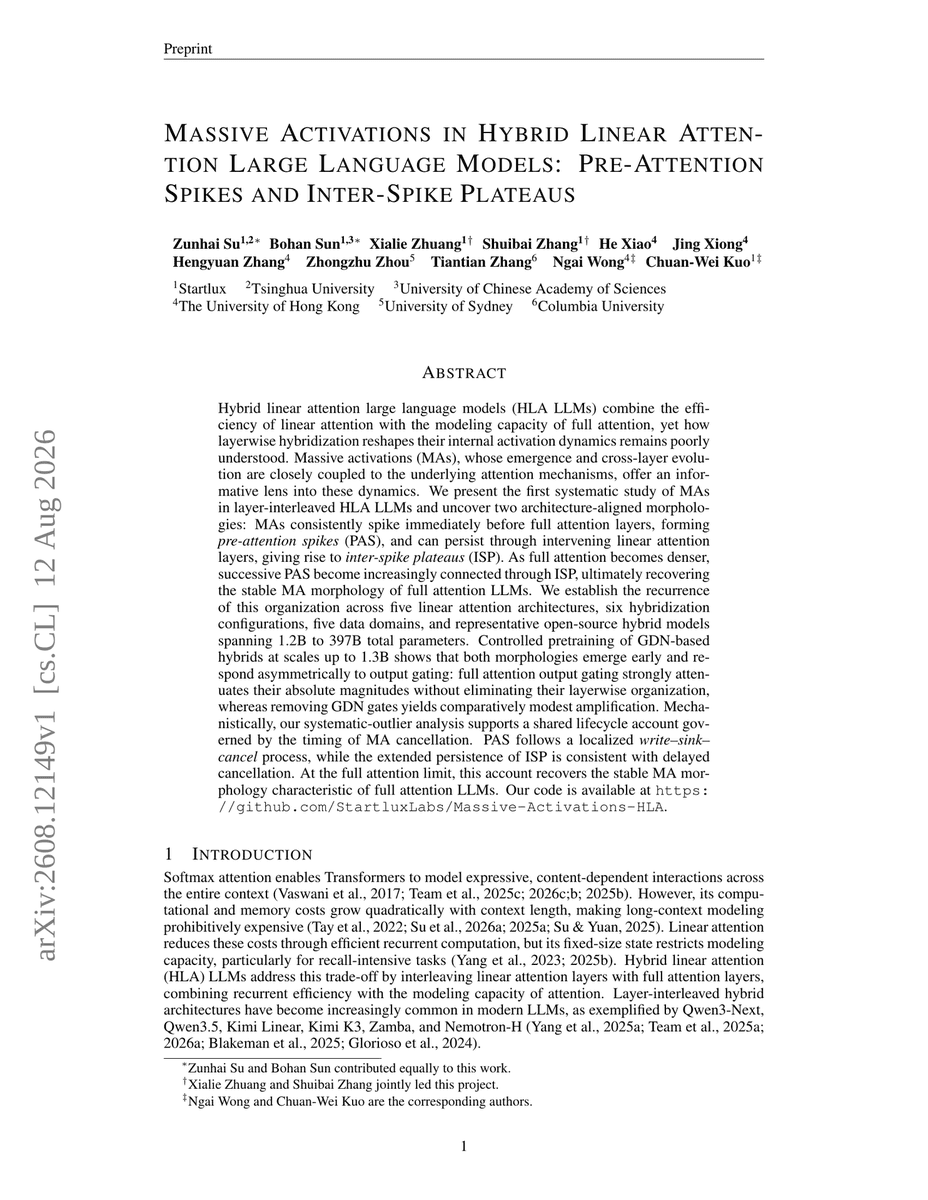
A new paper from Hugging Papers reveals massive activations in hybrid linear attention LLMs, forming pre-attention spikes and inter-spike plateaus. The finding challenges assumptions that hybrid architectures avoid the instability seen in dense transformers.
Key facts
- Massive activations form pre-attention spikes and inter-spike plateaus
- Code and checkpoints released on Hugging Face
- Hybrid linear attention combines linear and softmax attention
- Linear attention offers O(n) complexity vs O(n²) for softmax
- Outliers can degrade INT8/FP8 quantization precision
Massive activations—large-magnitude outlier values in hidden states—have been documented in dense transformer LLMs, but a new paper extends that phenomenon to hybrid linear attention models. The work, shared by @HuggingPapers, identifies two distinct patterns: pre-attention spikes that occur just before attention layers, and inter-spike plateaus that persist between those spikes. The authors released code and checkpoints on Hugging Face, allowing researchers to reproduce and explore the behavior.
Why hybrid models are vulnerable
Hybrid linear attention architectures, which mix linear attention with softmax attention, are prized for their efficiency gains—linear attention offers O(n) complexity versus O(n²) for standard attention. However, the paper shows that massive activations emerge specifically at the junction where linear attention hands off to softmax attention. This is a structural vulnerability: the linear attention's unbounded state can produce outlier values that the subsequent softmax layer amplifies, creating spikes that dominate the activation distribution.
The inter-spike plateaus are equally problematic. Between spikes, activations remain elevated, which can saturate nonlinearities and distort gradient flow during training. The paper's analysis suggests these plateaus are not random but correlate with token frequency and position, hinting at a learned behavior rather than pure numerical noise.
Implications for quantization and deployment
Massive activations are not just an academic curiosity—they directly impact practical deployment. Quantization schemes, such as INT8 or FP8, rely on activation ranges to set scaling factors. When outliers exist, they force a wide range, reducing precision for the majority of values. The paper's findings imply that hybrid models may require specialized quantization-aware training or outlier-aware clipping, similar to techniques developed for dense models like LLM.int8().
The release of checkpoints is significant because it lets the community test mitigation strategies. Prior work on dense transformers, such as the 2022 paper by Dettmers et al., showed that outlier features can be isolated and processed in higher precision. Whether that approach transfers to hybrid models remains an open question, but the new checkpoints provide a testbed.
What the paper doesn't say
The source, a tweet from @HuggingPapers, provides limited detail: it names the phenomenon, the patterns, and the release. It does not specify which hybrid architectures were tested, the model sizes, or the magnitude of the activation spikes relative to normal values. The paper itself, linked in the tweet, presumably contains those details, but the tweet alone is insufficient for a full technical assessment. Readers should treat the claims as preliminary until the full paper is reviewed.
Still, the finding is timely. Hybrid linear attention models, such as those used in recent efficient LLMs like Jamba and Griffin, are gaining adoption for their long-context capabilities. If massive activations are systemic, it could affect the next wave of efficient model deployments.
Key Takeaways
- New paper finds massive activations in hybrid linear attention LLMs, forming pre-attention spikes and inter-spike plateaus.
- Code and checkpoints released on Hugging Face; implications for quantization and deployment.
What to watch

Watch for the full paper's release on arXiv, which should specify the hybrid architectures tested and the magnitude of activation spikes. Also track whether quantization-aware training methods, like those from LLM.int8(), are adapted for hybrid models in the coming months.