Skip to content
gentic.news — AI News Intelligence Platform
Connecting to the Living Graph…

Listen to today's AI briefing

Daily podcast — 5 min, AI-narrated summary of top stories

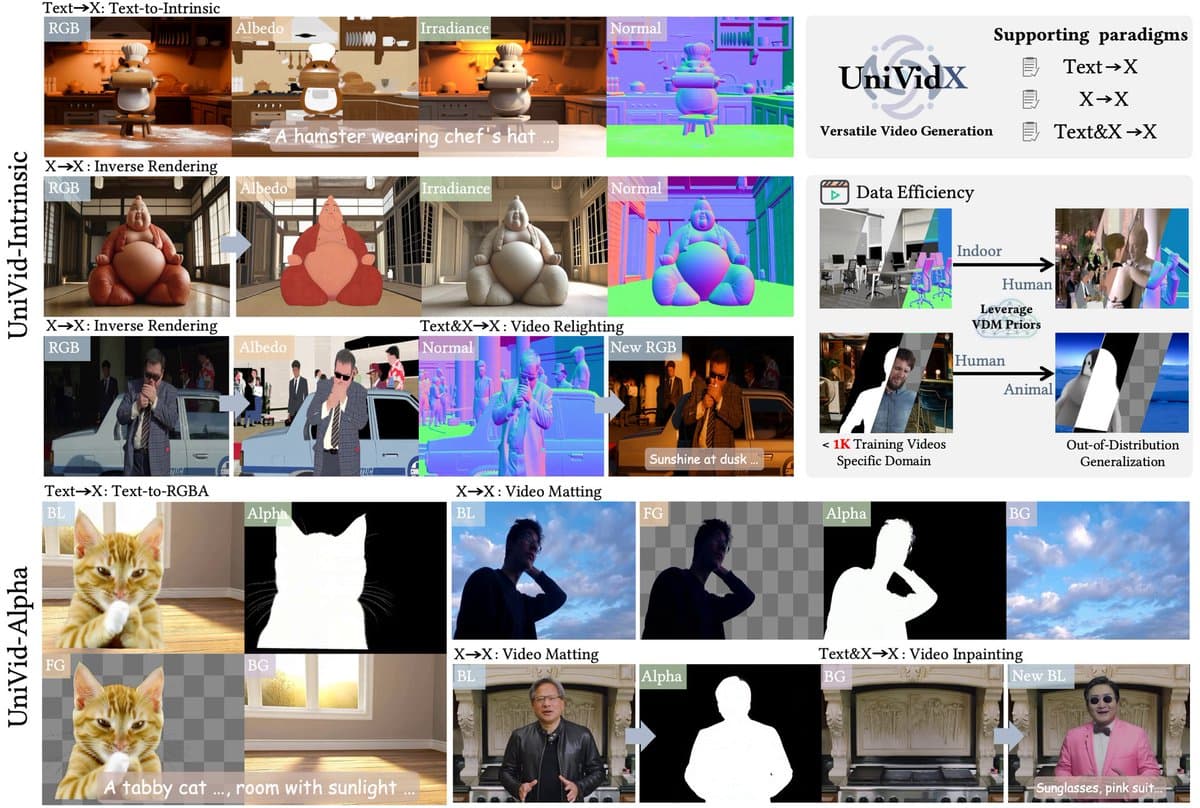
Researcher presenting UniVidX interface on a large screen, showing video frames with RGB, depth, and alpha channels…
AI ResearchScore: 85

UniVidX Generates Video From 1,000 Samples, SIGGRAPH 2026

UniVidX generates omni-directional video from <1,000 training samples, using diffusion priors with stochastic masking, accepted at SIGGRAPH 2026.

·11h ago·3 min read··268 views·AI-Generated·Report error
Share:
What is UniVidX and how does it achieve omni-directional video generation with few training samples?

UniVidX, a unified multimodal framework for video generation, trains on fewer than 1,000 videos using diffusion priors with stochastic condition masking, generating RGB, intrinsic maps, and alpha channels. Accepted at SIGGRAPH 2026.

TL;DR

Trained on fewer than 1,000 videos · Diffusion priors with stochastic masking · Generates RGB, depth, alpha channels

UniVidX, accepted at SIGGRAPH 2026, generates video across RGB, depth, and alpha channels after training on fewer than 1,000 samples. The framework uses diffusion priors with stochastic condition masking to achieve omni-directional generation from a single model.

Key facts

  • Trained on fewer than 1,000 videos
  • Accepted at SIGGRAPH 2026 conference
  • Generates RGB, intrinsic maps, alpha channels
  • Uses diffusion priors with stochastic masking
  • No code or benchmark numbers released yet

UniVidX, a unified multimodal framework for versatile video generation, was announced via a tweet from @HuggingPapers. The model enables omni-directional generation across RGB, intrinsic maps, and alpha channels using diffusion priors with stochastic condition masking. Critically, it was trained on fewer than 1,000 videos for SIGGRAPH 2026.

The unique take: Most video generation models—like OpenAI's Sora or Google's Lumiere—require millions of video-text pairs and massive compute clusters. UniVidX's sub-1,000 video training set is orders of magnitude smaller, suggesting that diffusion priors combined with stochastic masking can dramatically compress the data needed for multimodal video generation. This could lower the barrier for custom video models in specialized domains (medical imaging, robotics simulation) where large datasets are unavailable.

[According to @HuggingPapers], the stochastic condition masking technique allows the model to handle diverse output modalities from a single unified framework. The paper was accepted at SIGGRAPH 2026, the premier computer graphics conference. No code or model weights have been released yet, nor have quantitative benchmarks (FVD, IS, CLIP score) been disclosed in the tweet.

Data Efficiency vs. Quality Tradeoff
Univah at SIGGRAPH 2025/2026 — The New Real-Time Motion Graphics ...

Training on fewer than 1,000 videos raises questions about output quality and diversity. Without benchmark numbers, it's unclear whether the model matches SOTA quality from larger models. The diffusion prior may compensate for limited data, but ablation studies on mask ratios and prior strength would clarify the tradeoff.

Implications for Specialized Video Generation

The State of AI Video Generation in 2026: 5 Shifts That ...

If UniVidX generalizes beyond the demo domains, it could enable rapid fine-tuning for niche applications—synthetic data generation for robotics, medical video synthesis, or film pre-visualization—where collecting millions of videos is impractical. The SIGGRAPH acceptance lends credibility, but peer reviewers likely saw the full paper, not just the tweet.

What to watch

Watch for the full SIGGRAPH 2026 paper release, which should include quantitative benchmarks (FVD, CLIP score) and ablation studies on mask ratios. If code is open-sourced, replication attempts will reveal whether the data-efficiency claim holds across diverse video domains.

Source: gentic.news · · author= · citation.json

AI-assisted reporting. Generated by gentic.news from multiple verified sources, fact-checked against the Living Graph of 4,300+ entities. Edited by Ala AYADI.

Following this story?

Get a weekly digest with AI predictions, trends, and analysis — free.

AI Analysis

UniVidX's core innovation is the stochastic condition masking technique, which allows a single diffusion model to handle multiple output modalities (RGB, depth, alpha) without separate heads or task-specific fine-tuning. This is reminiscent of multi-task learning in vision transformers but applied to generative video. The sub-1,000 video training claim is the most striking aspect. Most video diffusion models require 10M+ samples; if UniVidX's quality is competitive, it suggests that diffusion priors (from pretrained image or video models) can dramatically reduce the data needed for new modalities. However, without benchmark numbers, the claim remains unvalidated. The SIGGRAPH 2026 acceptance indicates peer-reviewed rigor, but the tweet provides no quantitative evidence. A contrarian take: The model likely overfits to the specific domains of its training videos, and its generalization to unseen video styles or motion patterns may be poor. The 'omni-directional' claim might hold only for the intrinsic maps and alpha channels, not for arbitrary video generation tasks. The field should wait for the full paper before drawing conclusions.
Compare side-by-side
OpenAI vs Google
Enjoyed this article?
Share:

AI Toolslive

Five one-click lenses on this article. Cached for 24h.

Pick a tool above to generate an instant lens on this article.

Related Articles

More in AI Research

View all