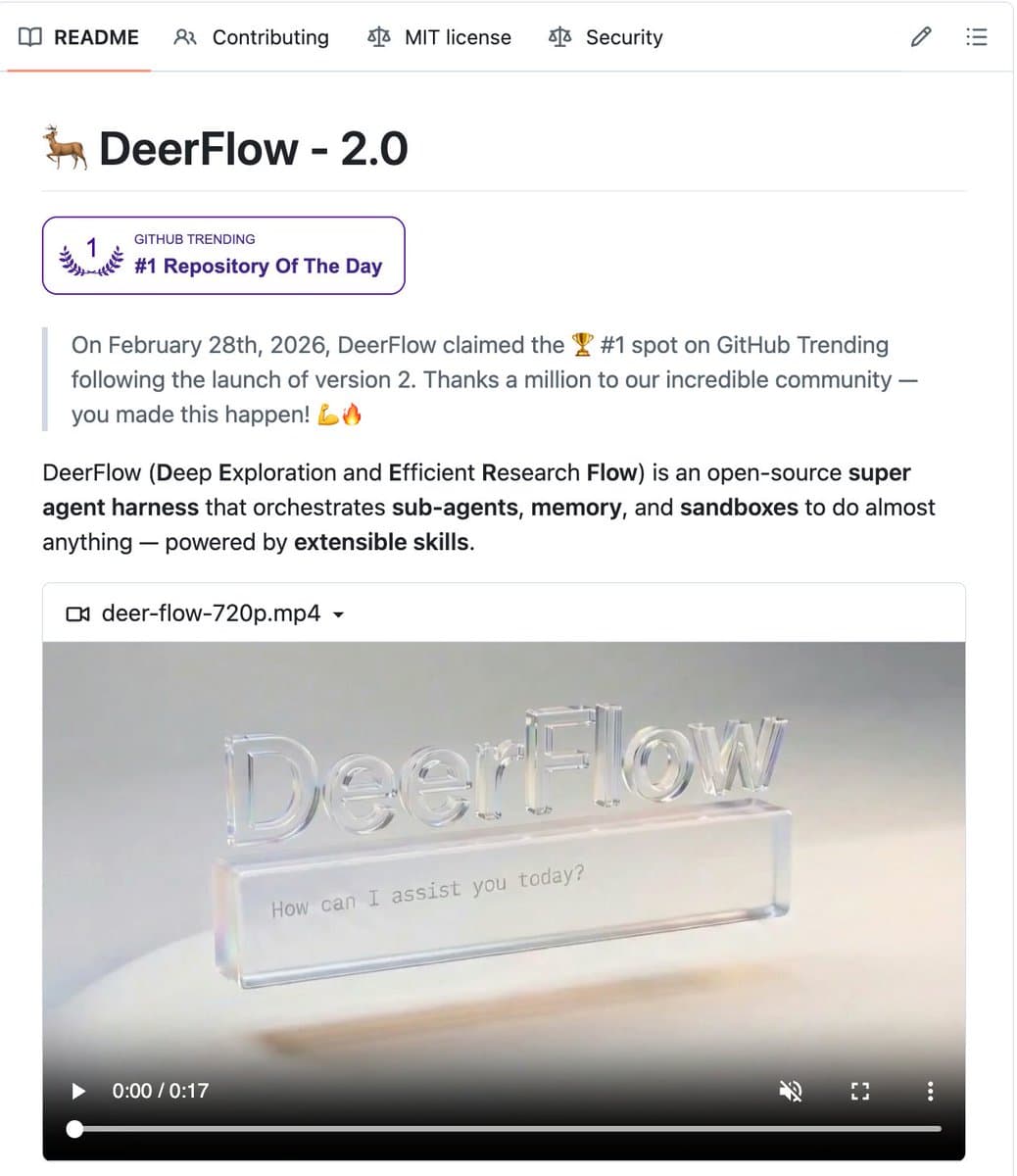
In a significant move within the AI development landscape, ByteDance—the Chinese tech giant behind TikTok—has open-sourced DeerFlow, an advanced AI agent system described as a "SuperAgent." According to an announcement by AI researcher Jainam, DeerFlow is designed to autonomously handle complex, multi-step tasks that traditionally require human intervention, such as conducting research, writing code, building websites, creating presentation decks, and even generating videos.
What Makes DeerFlow Different?
Unlike conventional AI chatbots or copilot tools that assist users step-by-step, DeerFlow operates as what the announcement calls "an AI employee with its own computer, filesystem, and memory." This distinction is crucial: instead of merely responding to prompts, DeerFlow can take a high-level task, break it down into subtasks, spawn specialized sub-agents to handle each component, and deliver a finished product—all without continuous human guidance.
For example, if tasked with creating a marketing website for a new product, DeerFlow could autonomously research the product domain, draft copy, generate relevant graphics or videos, write the necessary HTML/CSS/JavaScript code, and assemble the site into a functional package. This end-to-end automation capability positions DeerFlow closer to a general-purpose digital worker than a conversational assistant.
Technical Architecture and Capabilities
While the source announcement does not delve into granular technical specifics, it highlights several key features that define DeerFlow's architecture:
- Task Decomposition and Sub-Agent Spawning: DeerFlow can analyze a complex objective, decompose it into logical subtasks, and deploy specialized AI sub-agents to handle each segment. This mirrors a project manager delegating work to a team.
- Integrated Virtual Environment: The agent operates with its own simulated computer environment, complete with a filesystem and persistent memory. This allows it to manage files, maintain context across sessions, and execute computational tasks in a controlled workspace.
- Multi-Modal Outputs: DeerFlow is reportedly capable of generating diverse outputs—from code and documents to slide decks and videos—suggesting integration with or access to various AI models for text, image, and video synthesis.
The Open-Source Advantage
Perhaps the most impactful aspect of ByteDance's release is that DeerFlow is 100% open-source and released under the MIT License. This permissive licensing allows developers and researchers worldwide to use, modify, and distribute the software freely, even for commercial purposes.
Open-sourcing a system of this caliber could accelerate innovation in autonomous AI agents. Developers can examine DeerFlow's architecture to understand how to orchestrate multiple AI models, manage state and memory, and create reliable multi-step workflows. It also lowers the barrier to entry for organizations that lack the resources to build such systems from scratch.
Implications for Developers and Businesses
The release of DeerFlow signals a growing trend toward autonomous, agentic AI systems that go beyond text generation. For developers, it provides a blueprint for building AI that can execute complex, non-trivial tasks independently. For businesses, it hints at a future where AI can shoulder more substantive operational workloads—potentially automating roles that involve research, content creation, or basic software development.
However, this also raises important questions about oversight, reliability, and safety. Fully autonomous agents could produce unintended outputs, make errors in critical tasks, or operate in ways that are difficult to audit. The open-source nature of DeerFlow means the community will play a vital role in testing, hardening, and establishing best practices for such systems.
Looking Ahead: The Future of AI Agents
DeerFlow enters a competitive space that includes other AI agent frameworks (like AutoGPT, LangChain, and CrewAI) and commercial offerings from major tech firms. ByteDance's decision to open-source its technology may be a strategic move to attract developer mindshare, foster ecosystem growth, and position itself as a leader in the next wave of AI—shifting from models that "think" to systems that "do."
As these agents become more capable, we can expect them to take on increasingly sophisticated responsibilities, from managing digital marketing campaigns to conducting data analysis and generating reports. The key challenges will be ensuring they act reliably, ethically, and transparently—especially as they gain access to more tools and data.
Source: Jainam (@aiwithjainam) on X (formerly Twitter), announcing ByteDance's open-source release of the DeerFlow AI SuperAgent.