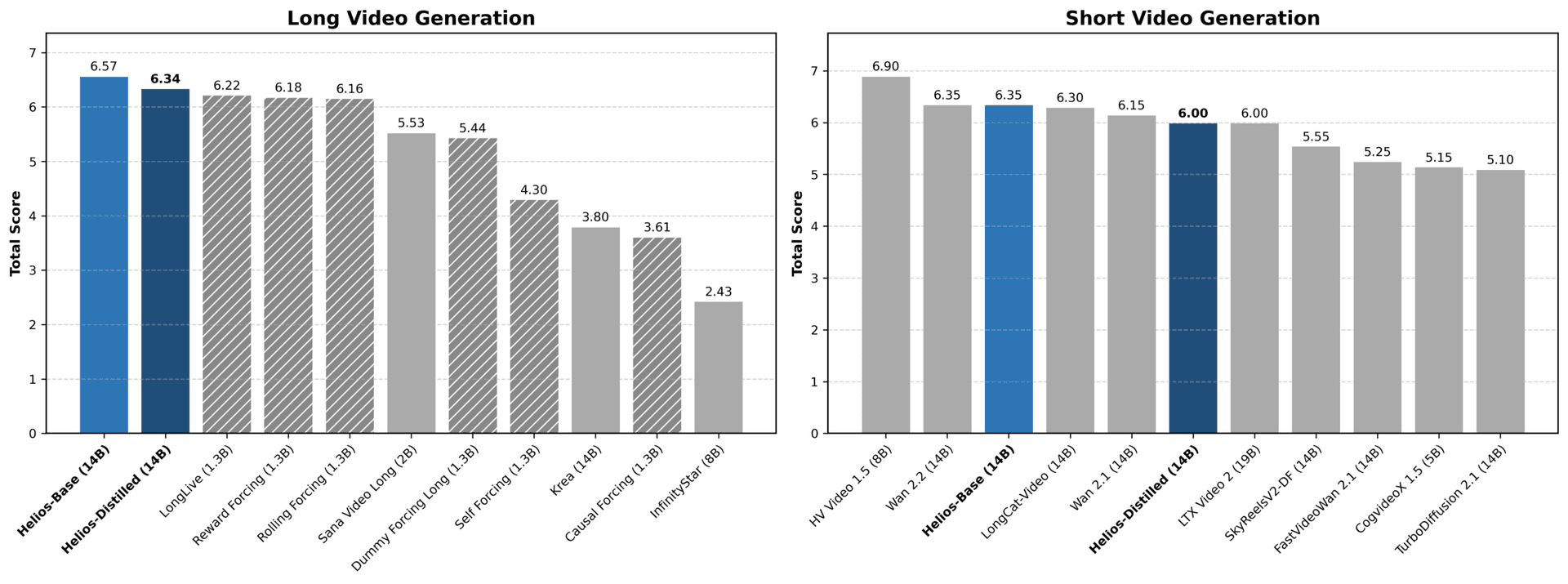
ByteDance, the Chinese technology giant behind TikTok, has introduced a new video generation model named Helios, according to an announcement shared by AI researcher Rohan Paul. The model is notable for its combination of scale and inference speed, positioning it as a potentially practical tool for real-time video synthesis.
What Happened
Based on the available information, ByteDance has developed and introduced Helios. The core technical claim is that it is a 14-billion parameter model capable of generating video at 19.5 frames per second (FPS) when running on a single NVIDIA H100 GPU. The announcement did not specify the exact resolution, duration, or frame count of the generated videos for this benchmark, nor did it provide comparative quality metrics against other models like Sora, Stable Video Diffusion, or Lumiere.
Context
The field of AI video generation is currently dominated by a few key players. OpenAI's Sora has set a high bar for quality and long-form coherence but remains a closed research preview with no public API or detailed technical specifications. Meanwhile, open-source and more accessible models like Stable Video Diffusion from Stability AI and Google's Lumiere have pushed the boundaries of what's possible with publicly available code and weights, though they often require significant computational resources for training and inference.
A primary bottleneck for widespread adoption and experimentation with video generation models is their immense computational cost, both for training and, critically, for inference. Models that can produce high-quality results but take minutes to generate a few seconds of video are impractical for many interactive or real-time applications. Helios's reported 19.5 FPS inference speed on a single high-end GPU (the H100) directly addresses this challenge, suggesting ByteDance has prioritized inference efficiency in its architecture.
The 14-billion parameter size is also a strategic midpoint. It is large enough to potentially capture complex visual and temporal dynamics (far larger than many diffusion-based video models) but is an order of magnitude smaller than the rumored scale of models like Sora, which is speculated to be in the hundreds of billions of parameters. This smaller scale is a key enabler of the reported inference speed.
What We Don't Know
The announcement is brief and leaves several critical questions unanswered:
- Video Quality: No samples, benchmarks (e.g., FVD, IS), or qualitative comparisons were provided.
- Capabilities: The resolution, aspect ratio, maximum duration, and controllability (e.g., via text, image, or video prompts) of the model are unspecified.
- Architecture: The technical underpinnings (e.g., diffusion, transformer, latent space design) are not disclosed.
- Availability: There is no information on whether Helios will be released publicly, integrated into ByteDance products (like TikTok or CapCut), or offered via an API.
- Training Data: The scale and composition of the training dataset are unknown.
gentic.news Analysis
The introduction of Helios, as described, signals ByteDance's serious entry into the foundational video generation race, but with a distinct engineering-focused angle. While OpenAI's Sora seems to prioritize maximum quality and narrative coherence, and others focus on open-source accessibility, ByteDance appears to be optimizing for a crucial metric for productization: inference latency per quality unit. A 19.5 FPS throughput on a single H100 is not just a benchmark; it's a statement about feasible serving cost. If the quality is competitive, this could transition video generation from a batch-processing, offline task to a near-real-time feature capable of powering interactive applications, live editing, or personalized content creation at scale.
The choice of a 14B parameter model is particularly interesting. It suggests ByteDance's researchers may have found a more efficient architecture or training paradigm that avoids the need for a 100B+ parameter count to achieve strong performance. This could involve innovations in latent video representations, more efficient temporal attention mechanisms, or superior data curation. It challenges the prevailing assumption in large language models that scale is the primary driver of capability, pointing toward a future where video model efficiency is as important as raw performance.
Practically, this move should be seen through the lens of ByteDance's core business: short-form video. A highly efficient, capable video generation model is a natural strategic asset. It could be integrated into CapCut for AI-powered editing, used internally to create marketing or training content, or even form the backbone of new TikTok features for creators. The speed claim makes these product integrations technically plausible, not just research fantasies.
Frequently Asked Questions
What is the Helios AI model?
Helios is a 14-billion parameter AI model developed by ByteDance for generating video from prompts. Its most highlighted feature is its inference speed, reportedly running at 19.5 frames per second on a single NVIDIA H100 GPU, which is significantly faster than many current video generation models.
How does Helios compare to OpenAI's Sora?
A direct comparison is not possible with the information released. Sora is known for producing high-quality, long-duration videos with strong narrative coherence but has no public benchmarks or API. Helios, based on the announcement, emphasizes inference speed (19.5 FPS on an H100) with a 14B parameter size, suggesting a focus on efficiency. The quality and capabilities of Helios relative to Sora remain unknown until ByteDance releases samples or evaluations.
Is the Helios model available to use?
As of this announcement, ByteDance has not released any details regarding the public or commercial availability of the Helios model. It is unclear if it will be released as open-source, made available through an API, or kept internal for use within ByteDance's products like TikTok or CapCut.
Why is the inference speed of Helios important?
Inference speed, measured in frames per second (FPS), determines how quickly an AI model can generate video. Many state-of-the-art models are slow, taking minutes to produce short clips. A speed of 19.5 FPS on a single GPU makes Helios fast enough for near-real-time applications, such as interactive editing tools, live preview generation, or scalable content creation, lowering the computational barrier and cost for using advanced video AI.