Researchers from ByteDance Seed have introduced Mixture-of-Depths Attention (MoDA), a novel attention mechanism designed to combat signal degradation in deep large language models. According to the announcement, MoDA enables attention heads to attend to both the current sequence's key-value (KV) pairs and depth KV pairs from previous layers, addressing a fundamental limitation in training very deep transformer architectures.
What the Researchers Built
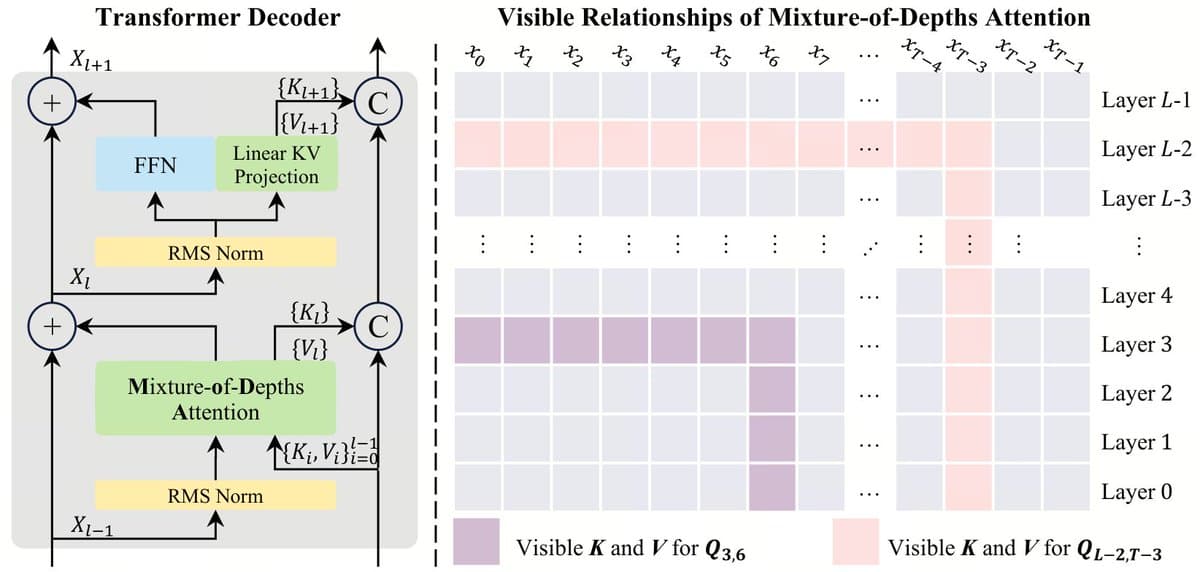
MoDA modifies the standard transformer attention mechanism to incorporate information from previous layers alongside the current layer's computations. In traditional transformers, each attention head operates only on the KV pairs generated within its own layer. This can lead to signal degradation as information propagates through dozens or hundreds of layers in deep models.
The core innovation of MoDA is allowing attention heads to selectively attend to KV pairs from previous layers—what the researchers term "depth KV pairs." This creates a mixture-of-depths approach where attention computations draw from both the current layer and historical representations, potentially preserving important signals that might otherwise be lost in deep architectures.
Key Results
The researchers report two significant performance metrics:
Training Efficiency 97.3% of FlashAttention-2 Near state-of-the-art efficiency despite additional computations Downstream Performance Improvement +2.11% Measured on unspecified downstream tasks Computational Overhead +3.7% FLOPs Minimal additional computation requiredThese results suggest MoDA provides meaningful performance benefits with minimal efficiency trade-offs. The 97.3% efficiency relative to FlashAttention-2 is particularly notable given FlashAttention-2's status as one of the most optimized attention implementations available.
How It Works
While the source material doesn't provide architectural details, the core mechanism appears to involve:
- Depth KV Storage: Storing KV pairs from previous layers alongside current layer KV pairs
- Selective Attention: Allowing attention heads to attend to both current and historical KV representations
- Mixture Mechanism: Some form of gating or weighting to determine how much attention to allocate to depth versus current KV pairs
The approach addresses signal degradation—a known problem in deep transformers where important information can be lost or diluted through successive layers. By providing direct access to earlier representations, MoDA potentially allows models to preserve critical signals throughout the forward pass.
The 3.7% FLOPs overhead suggests the implementation is highly optimized, likely through selective application of depth attention rather than applying it uniformly across all heads and layers.
Why It Matters
Deep LLMs (those with hundreds of layers) face fundamental challenges with signal propagation. Techniques like residual connections help but don't fully solve the problem. MoDA offers a computationally efficient way to maintain signal integrity throughout deep architectures.
The near-parity with FlashAttention-2 efficiency (97.3%) makes this approach practical for real-world training scenarios. Many proposed architectural improvements come with significant efficiency penalties that limit adoption; MoDA's minimal 3.7% FLOPs overhead makes it potentially viable for production-scale training.
For practitioners training deep transformers, MoDA represents a promising direction for improving model quality without dramatically increasing training costs. The 2.11% downstream performance improvement, while modest, comes at minimal computational expense—an attractive trade-off for many applications.
Note: The source material doesn't specify the exact downstream tasks used for evaluation, model sizes tested, or comparison baselines beyond FlashAttention-2 efficiency metrics.