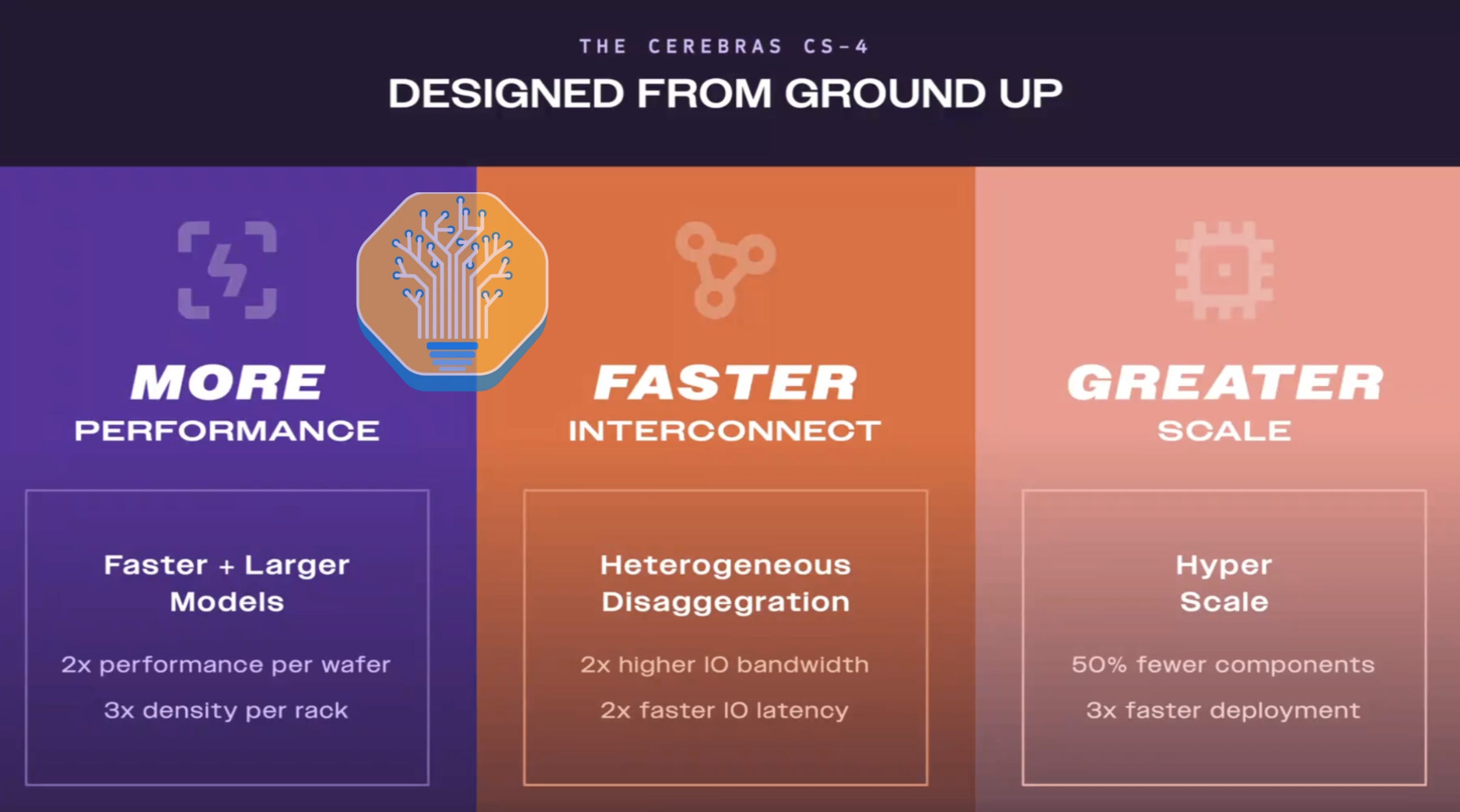
Cerebras unveiled the CS-4 wafer-scale chip, doubling performance and power draw. The announcement, reported by @SemiAnalysis_, challenges Nvidia's data-center GPU dominance with a radically different architecture.
Key facts
- CS-4 doubles performance vs prior generation
- Power consumption doubles per chip
- Wafer-scale architecture maintained
- Announced via @SemiAnalysis_ on X
- No benchmark or pricing disclosed
Cerebras's next-generation CS-4 wafer-scale engine doubles performance and power consumption per chip, according to @SemiAnalysis_. The announcement, which carries the tagline "Fast Just Got Faster," signals that the company is doubling down on its wafer-scale approach rather than pivoting toward more conventional packaging.
The CS-4 continues Cerebras's strategy of building a single enormous silicon wafer as a processor, bypassing the interconnect bottlenecks that plague multi-chip GPU systems. While the company did not disclose specific teraflops or memory bandwidth figures in the announcement, the doubling of performance suggests the CS-4 roughly matches the generational leap seen in Nvidia's transitions between data-center GPU architectures.
The power trade-off
Doubling power consumption alongside performance is a notable engineering choice. For hyperscale operators, power density is becoming the binding constraint in data-center design — a 2x power draw per chip means either fewer chips per rack or significantly upgraded cooling infrastructure. Cerebras's wafer-scale design already requires custom liquid cooling; the CS-4 will likely push that requirement further.
The company appears to be betting that the raw performance-per-wafer advantage justifies the power cost. For training runs spanning weeks, the reduced communication overhead of a single wafer could still yield a total-cost-of-ownership advantage over multi-GPU clusters that spend cycles on data movement.
Competitive positioning
Cerebras's announcement arrives as Nvidia continues to dominate the AI accelerator market with its GPU platforms and CUDA ecosystem. The CS-4's wafer-scale approach offers an architectural alternative that eliminates the need for high-bandwidth interconnects like NVLink or InfiniBand, but it requires customers to adopt Cerebras's programming model and software stack.
The company did not disclose pricing, availability windows, or benchmark results in the announcement. The lack of third-party benchmarks leaves open questions about real-world performance on standard workloads like LLM training and inference.
Key Takeaways
- Cerebras CS-4 doubles performance and power, challenging Nvidia.
- Wafer-scale architecture continues; specifics on benchmarks and pricing remain undisclosed.
What to watch
Watch for Cerebras's next earnings or technical disclosure, which should include specific teraflops, memory bandwidth, and power figures for the CS-4. Also track whether any hyperscaler announces a CS-4 deployment — that would signal real market traction against Nvidia.