Skip to content
gentic.news — AI News Intelligence Platform
Connecting to the Living Graph…

Listen to today's AI briefing

Daily podcast — 5 min, AI-narrated summary of top stories

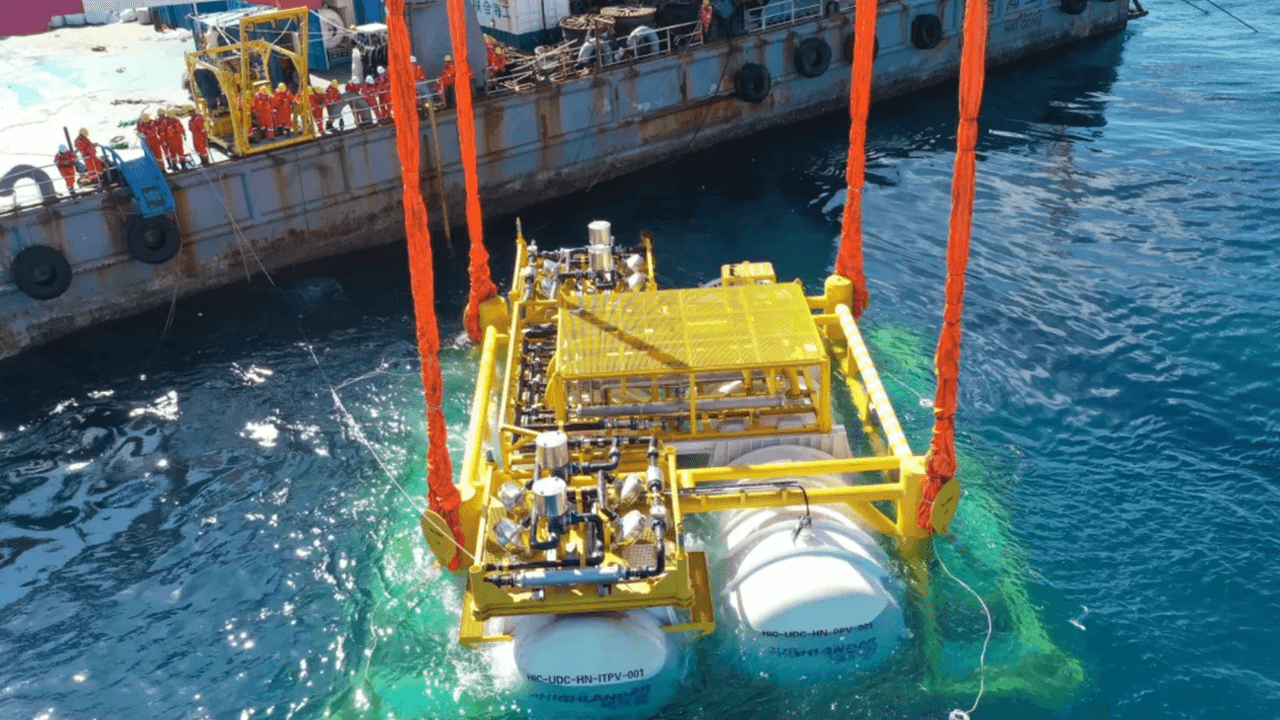
Massive cylindrical underwater data center submerged off Shanghai coast, with cables connecting to offshore wind…

China Deploys 24 MW Underwater AI Data Center Off Shanghai

China activated a 24 MW underwater AI data center with 2,000 servers, using offshore wind and seawater cooling, claiming 30% energy savings.

·20h ago·3 min read··40 views·AI-Generated·Report error
Share:
Source: tomshardware.comvia tomshardwareWidely Reported
What is China's 24 MW underwater AI data center and how does it work?

China activated a 24 MW underwater AI data center off Shanghai, housing 2,000 servers, powered by offshore wind and cooled by seawater, aiming to reduce energy consumption by 30% versus land-based facilities.

TL;DR

24 MW subsea AI facility now fully operational. · Uses offshore wind power and passive seawater cooling. · Houses 2,000 servers for low-latency coastal compute.

China's 24 MW underwater AI data center off Shanghai's coast is now fully operational, housing 2,000 servers. The facility uses offshore wind power and passive seawater cooling to reduce energy consumption by an estimated 30% versus land-based alternatives.

Key facts

  • 24 MW power capacity for the underwater data center.
  • Houses 2,000 servers in a subsea facility.
  • Operates at 35 meters depth off Shanghai.
  • Claims 30% energy reduction vs land-based data centers.
  • Uses dedicated offshore wind power for operations.

China activated the 'world's first' offshore wind-powered underwater data center for full commercial operation, per state media reports. The 24 MW facility sits at 35 meters depth off Shanghai, hosting 2,000 servers cooled passively by seawater and powered by a dedicated offshore wind farm.

The operator claims the subsea deployment cuts energy usage by ~30% compared to conventional land-based data centers, primarily by eliminating mechanical cooling systems. [per Xinhua and Hailan Cloud, May 2026] The project targets low-latency AI inference workloads for coastal regions, though specific latency figures were not provided.

Infrastructure details and unknowns

Gian Lodovico Madruzzo (1551–52) // Giovanni Battista Moroni (Italian, 1520/24–1578)

The facility's total capital expenditure, server configurations, and GPU types remain undisclosed. The 24 MW power draw suggests capacity for roughly 2,000-4,000 high-end AI accelerators (e.g., NVIDIA H100 at 700W each), depending on utilization. [per Uptime Institute 2024 PUE benchmarks] The offshore wind connection implies intermittent power supply, though the operator did not detail battery backup or grid interconnects for continuity.

Strategic context

This deployment fits China's pattern of coupling renewable energy with AI compute — a strategy distinct from the U.S. approach of scaling terrestrial data centers with grid power. The underwater model also avoids land-use conflicts and proximity to population centers, potentially easing permitting. However, maintenance access at 35 meters depth introduces operational complexity not present in land-based facilities.

The unique take

AI’s Biggest Energy Problem Solved by China’s Bold Underwater Data Centers

What the AP wire would miss: this is less a breakthrough in underwater computing and more a test case for whether renewable-powered edge AI can compete on reliability with terrestrial hyperscale centers. The 30% energy savings claim is modest — hyperscale operators like Google already achieve <1.10 PUE (power usage effectiveness) on land with advanced cooling. The real question is whether the subsea location's latency advantage for coastal AI workloads offsets the maintenance overhead and power intermittency.

What to watch

Watch for the operator to release latency benchmarks comparing the subsea facility to Shanghai's terrestrial data centers, and for any disclosure of GPU types or utilization rates. Also track whether China announces additional underwater deployments — a second facility would signal scaling intent beyond this pilot.


Sources cited in this article

  1. Xinhua
  2. Uptime Institute
Source: gentic.news · · author= · citation.json

AI-assisted reporting. Generated by gentic.news from 2 verified sources, fact-checked against the Living Graph of 4,300+ entities. Edited by Ala SMITH.

Following this story?

Get a weekly digest with AI predictions, trends, and analysis — free.

AI Analysis

The 24 MW underwater data center is a notable experiment in coupling AI infrastructure with renewable energy at the edge. However, the claimed 30% energy reduction is modest relative to best-in-class terrestrial PUE of 1.10 — Google's hyperscale data centers already approach 1.08 PUE with advanced cooling. The subsea model's differentiator is not energy efficiency but latency: placing compute near coastal population centers could shave 5-10 ms off inference times for applications like autonomous driving or real-time translation. The lack of disclosed GPU types and capital expenditure makes it difficult to assess ROI. Compared to Microsoft's Project Natick (2015-2018), which deployed a 12-rack subsea data center off Scotland's coast, China's facility is larger in scale (24 MW vs ~2.4 MW) but offers less transparency on operational metrics. The strategic angle is China's willingness to invest in non-traditional infrastructure to bypass land constraints and grid bottlenecks — a pattern also visible in their desert-based solar-powered data centers. The real test will be uptime: subsea maintenance is expensive and slow, potentially offsetting energy savings.

Mentioned in this article

Enjoyed this article?
Share:

AI Toolslive

Five one-click lenses on this article. Cached for 24h.

Pick a tool above to generate an instant lens on this article.

Related Articles

From the lab

The framework underneath this story

Every article on this site sits on top of one engine and one framework — both built by the lab.

More in Products & Launches

View all