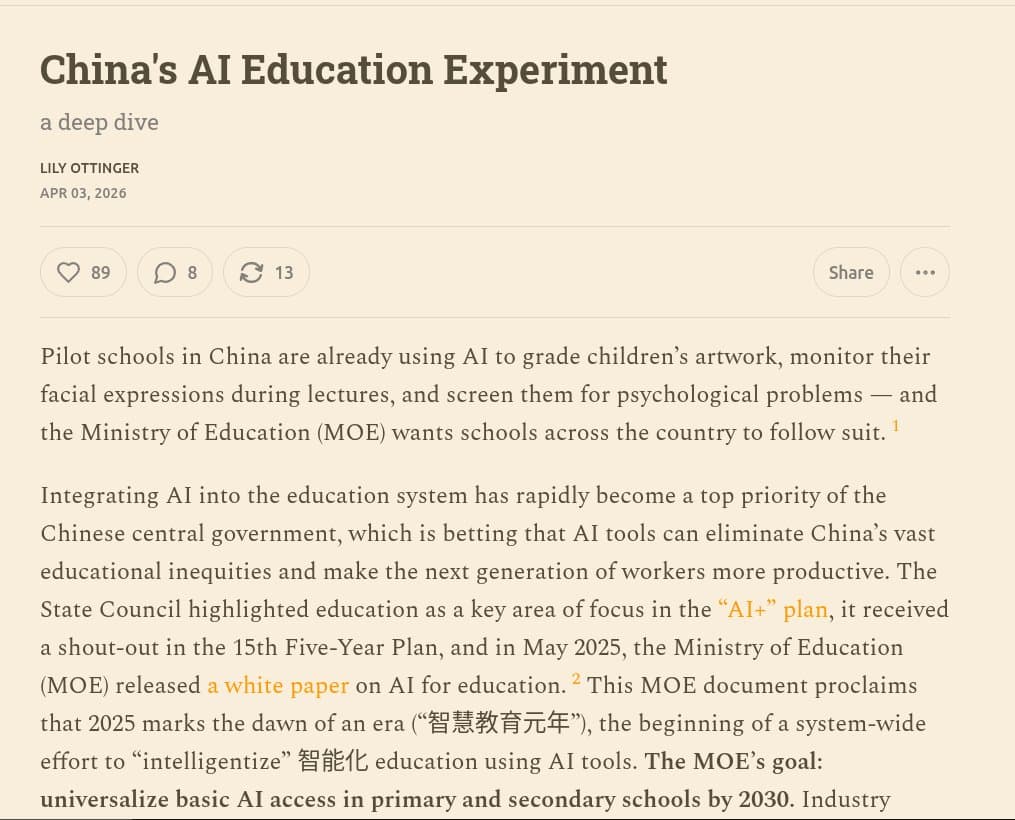
China is initiating a large-scale, decentralized integration of artificial intelligence into its national K-12 education system. According to a report, the central government has signaled for local schools and counties to procure and deploy commercial AI tools to handle core educational tasks. This is not a centrally funded, uniform rollout, but a directive for local experimentation using existing budgets and infrastructure.
The Four-Pillar AI Mandate
The initiative focuses on four primary applications for AI in schools:
- Teacher Assistance & Lesson Planning: AI systems are to aid teachers in creating and preparing lessons.
- Automated Grading: The use of AI to assess student work, potentially including essays and exams.
- Rural Education Support: Leveraging AI to "beam" higher-quality educational content and teaching support into remote and rural schools, aiming to bridge resource gaps.
- Student Performance & Behavior Monitoring: Deploying AI to track academic performance and monitor student behavior and mental health indicators.
The model is described as "decentralized and mostly unfunded." Beijing sets the policy goals and provides the regulatory signal, domestic technology companies supply the AI tools, and local educational officials are tasked with implementing them and demonstrating results using their current financial and technological resources.
A National Experiment with Local Execution
This approach creates a vast, real-world testing ground for educational AI. Instead of a top-down, ministry-led software deployment, it encourages a fragmented ecosystem where different regions, schools, and companies experiment with various solutions. Success or failure will likely be determined at the local level, with results presumably reported upward. The strategy effectively outsources the development and refinement of AI education tools to the market and local governments, while the central authority maintains control over the overarching framework and objectives.
The scale is significant: China's K-12 system serves hundreds of millions of students. A widespread adoption of AI for grading and monitoring would represent one of the largest deployments of such technology in education globally, generating immense datasets on student learning and behavior.
Implications and Immediate Questions
The report raises immediate practical and ethical questions:
- Algorithmic Bias & Fairness: How will consistency and fairness be ensured across thousands of different AI systems used for high-stakes tasks like grading?
- Data Privacy & Security: The plan involves extensive collection of student performance and behavior data. The safeguards governing this data are unclear.
- Teacher Roles: While framed as assistance, the long-term impact on the teaching profession—whether AI augments or replaces certain functions—remains to be seen.
- Vendor Landscape: This policy will create a major market for Chinese edtech and AI companies, potentially accelerating domestic AI development in the education sector.
gentic.news Analysis
This move is a classic example of China's "whole-of-nation" approach to strategic technology sectors, now applied to the social domain of education. It follows a pattern seen in other areas like smart cities and surveillance, where central direction catalyzes local implementation and market competition, rapidly generating scale and data. The directive to use AI for student behavior and mental health monitoring directly extends the country's existing social governance frameworks into the classroom, aligning educational tools with broader social stability objectives.
For the global AI community, this represents a critical case study in the large-scale, real-world application of AI in education. The "decentralized experiment" model will likely produce a wide array of results—some showcasing effective adaptive learning, others potentially highlighting risks of bias or over-surveillance. The data generated will be unparalleled but largely inaccessible to international researchers. Technically, watch for Chinese AI firms to rapidly develop and refine multimodal models capable of processing student essays, classroom audio, and behavioral cues. This policy isn't just about education; it's a state-sponsored driver for specific, applied AI capabilities.
Frequently Asked Questions
What AI models will Chinese schools use?
The report indicates schools will purchase "commercial AI systems" from technology companies. This suggests a variety of models from different domestic vendors (e.g., companies like Baidu, Alibaba, or specialized edtech firms), not a single, government-provided model. The performance and features will vary.
Is this AI rollout mandatory for all Chinese schools?
The reporting describes a national project where Beijing "gives the signal and the goals" and local officials are "expected to experiment and show results." This language strongly implies a top-down directive with compliance expectations, though the specific implementation timeline and penalties are not detailed.
How will AI grade subjective assignments like essays?
This is a major open technical question. The directive includes grading, but the accuracy and fairness of automated essay scoring, especially in Chinese, remain challenging. Schools will likely rely on vendors claiming to have solved this, leading to potential inconsistencies. The rollout itself will be a massive test of these systems' capabilities.
What are the privacy concerns for students?
Substantial. The plan involves AI tracking student performance and monitoring behavior/mental health. This creates detailed, long-term profiles of minors. China's data security laws (like the PIPL) apply, but the specific protocols for handling this sensitive educational data within thousands of local systems are untested and a key area of concern.