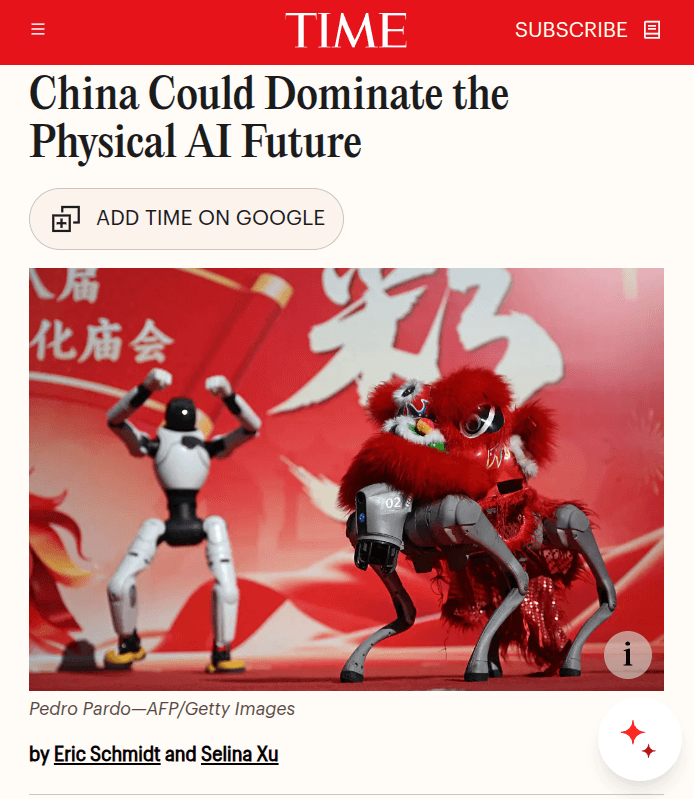
In a striking new analysis for Time magazine, former Google CEO Eric Schmidt issues a stark warning about the shifting landscape of artificial intelligence. According to Schmidt, while American AI labs remain preoccupied with software advancements and language model leaderboards, China has quietly established dominance in what he calls "physical AI"—the integration of artificial intelligence into tangible hardware systems that interact directly with the physical world.
The Hardware Revolution
Schmidt describes a fundamental shift in technological evolution: "We've lived through over a decade of 'software eating the world.' Now, metal and mathematics have converged: hardware is eating the world." This transition from purely digital AI to embodied intelligence represents what Schmidt calls "the next great frontier" of artificial intelligence.
The implications are profound. Rather than AI remaining confined to screens and servers, China is successfully embedding intelligence into robots, manufacturing systems, and physical infrastructure. This represents a departure from the current Western focus, where major investments continue to flow toward large language models and software-based AI systems.
China's Strategic Advantages
China's dominance in physical AI isn't accidental—it's built on specific strategic advantages that Schmidt outlines in detail. Most notably, China controls approximately 70% of the global market for lidar sensors, the critical components that enable autonomous vehicles and robots to perceive their surroundings. This near-monopoly gives Chinese manufacturers unprecedented control over a key enabling technology for physical AI systems.
Additionally, China has achieved remarkable scale in manufacturing the mechanical components required for robotic movement. Factories across China mass-produce harmonic reducers—specialized mechanical gears essential for precise robotic motion—at volumes that have dramatically reduced costs. This manufacturing scale has enabled Chinese companies to produce home companion robots for as little as $1,400, making them accessible to mass markets in ways Western competitors cannot match.
The Supply Chain Imperative
Schmidt's analysis reveals a critical vulnerability in America's AI strategy: software dominance cannot overcome physical supply chain monopolies. While U.S. companies excel at developing sophisticated AI algorithms, they remain dependent on Chinese-controlled supply chains for the hardware components needed to bring those algorithms into the physical world.
This dependency creates what Schmidt describes as an "asymmetric competition" where China holds structural advantages that go beyond mere technological innovation. The ability to manufacture at scale, control key components, and integrate AI into physical products creates a competitive moat that software alone cannot breach.
The Geopolitical Implications
The shift toward physical AI has significant geopolitical implications. Schmidt notes that "much of it is currently driven by China," suggesting that the balance of technological power may be shifting in ways that traditional software-focused analyses have missed. As AI becomes increasingly embedded in critical infrastructure, manufacturing, and defense systems, control over physical AI technologies translates directly into economic and strategic advantage.
This development challenges conventional wisdom about technological competition. While Western analysts have focused on China's perceived lag in foundational AI models, Schmidt argues they've missed China's parallel advancement in applied, physical AI systems—advancements that may prove more immediately consequential for economic competitiveness and national security.
The Path Forward for the West
Schmidt concludes with a clear prescription: "The US must rebuild its supply chains to compete in embodied intelligence." This requires more than just increased investment in AI research—it demands a comprehensive strategy to rebuild manufacturing capabilities, secure supply chains for critical components, and foster closer collaboration between software innovators and hardware manufacturers.
The challenge is both technical and structural. Competing in physical AI requires capabilities that extend beyond Silicon Valley's traditional strengths, including advanced manufacturing, materials science, and mechanical engineering. Success will depend on creating ecosystems that can translate software innovations into physical products at competitive scale and cost.
Source: Eric Schmidt's analysis in Time magazine, as referenced by @rohanpaul_ai on X/Twitter and available at time.com/7382151/china-dominates-the-physical-ai-race/