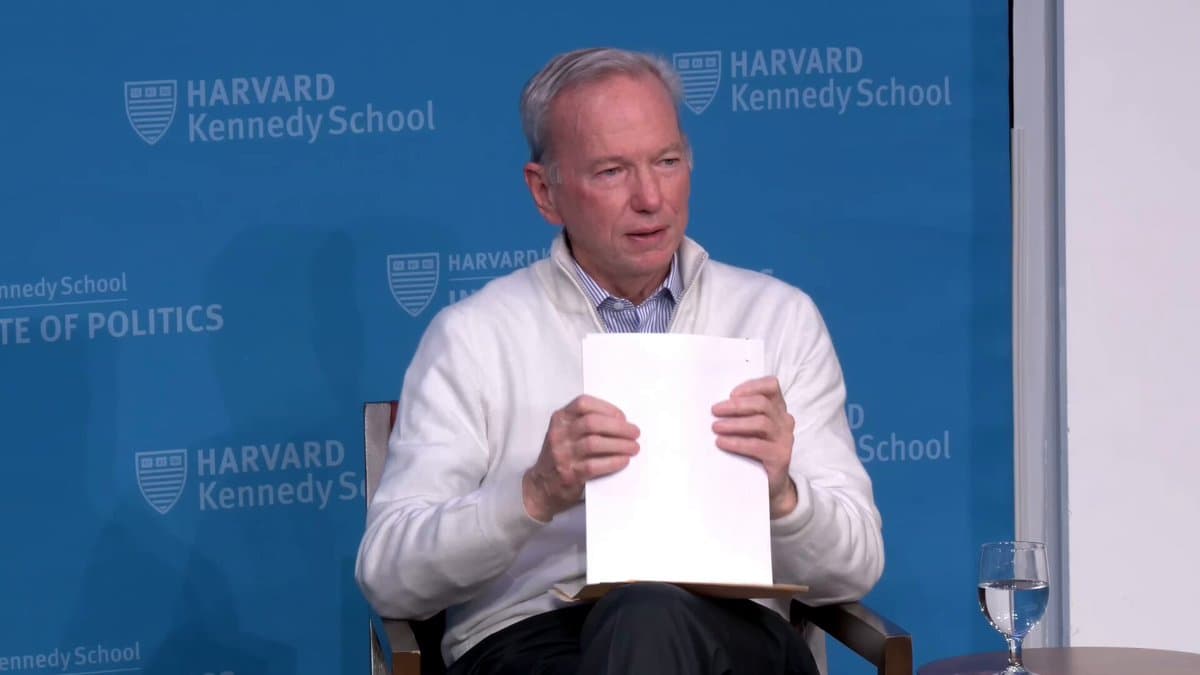
Former Google CEO Eric Schmidt recently shared a poignant reflection at Harvard Kennedy School's Institute of Politics that captures one of the most profound transformations in modern technology. The executive who helped shepherd Google through its most explosive growth years revealed that "my whole early life was basically coding, and AI just wiped it out." This admission from one of Silicon Valley's most influential figures signals more than personal nostalgia—it marks a fundamental shift in how we create, interact with, and think about technology.
The Programmer's Journey: Then and Now
Schmidt described his early career trajectory as singularly focused: "In my 20s all I wanted to do was write programs, all the way through college and grad school, and that's what built my career." This path was typical for technology leaders of his generation—years of dedicated study mastering programming languages, algorithms, and system architectures. The skills Schmidt and his contemporaries developed through countless hours of debugging and optimization formed the foundation of the digital revolution that created companies like Google, Microsoft, and Apple.
Today, Schmidt observes that "every single thing I learned back then can be done by AI." The specialized knowledge that once required years of focused study is now accessible through natural language prompts. Where programmers once needed to understand memory allocation, pointer arithmetic, or specific syntax rules, AI systems can now generate functional code from simple descriptions of desired outcomes.
The Pocket-Sized Revolution
Perhaps Schmidt's most striking observation is that "each and every one of you has a supercomputer and superprogrammer in your pocket." This statement encapsulates the democratization occurring across the technology landscape. The smartphone—already a camera, communication device, and entertainment center—has now become a development platform accessible to anyone with an idea.
This transformation represents more than just convenience. It fundamentally alters who can participate in creating technology. Where programming was once a specialized skill requiring specific education and temperament, AI-assisted development tools are lowering barriers dramatically. Students, entrepreneurs, artists, and professionals from non-technical backgrounds can now prototype applications, automate tasks, and solve computational problems without traditional coding expertise.
Educational Implications: Rethinking Technology Training
The implications for education are particularly significant. Computer science programs that have traditionally focused on syntax mastery and algorithmic thinking must now evolve. Schmidt's experience suggests that curriculum designers should emphasize:
- Problem formulation over syntax memorization: Teaching students how to clearly articulate problems for AI systems
- System architecture and design: Higher-level thinking about how components interact
- AI collaboration skills: Working effectively with AI tools while maintaining critical oversight
- Ethical implementation: Understanding the societal impacts of rapidly developed applications
This shift doesn't render programming knowledge obsolete but rather changes its nature from foundational requirement to specialized expertise for certain advanced applications.
Professional Transformation: The Evolving Developer Role
For current and aspiring developers, Schmidt's observations signal both disruption and opportunity. While AI can handle routine coding tasks, human developers are increasingly valuable for:
- Complex system design and integration
- Understanding user needs and translating them into specifications
- Quality assurance and testing in context
- Ethical considerations and bias mitigation
- Creative problem-solving at architectural levels
The programmer's role is evolving from code writer to solution architect, from syntax expert to problem definer, from implementer to innovator.
The Broader Societal Impact
Schmidt's personal reflection points to larger societal transformations. As AI democratizes technical creation, we're likely to see:
- Increased innovation velocity: More people can prototype and test ideas
- Diversified technology creation: People from varied backgrounds bringing different perspectives
- New economic opportunities: Lower barriers to creating technology-based businesses
- Accelerated digital transformation: Organizations can adapt more quickly with AI-assisted development
However, this democratization also raises important questions about quality control, security, and the potential for rapid proliferation of poorly conceived applications.
Looking Forward: The Human-AI Partnership
Schmidt's experience suggests we're entering an era of human-AI collaboration rather than AI replacement. The most effective technologists will be those who can leverage AI capabilities while bringing human judgment, creativity, and ethical consideration to the process.
This partnership model extends beyond programming to nearly every knowledge work domain. Just as Schmidt's generation mastered programming languages, today's professionals must master collaboration with AI systems—understanding their capabilities, limitations, and appropriate applications.
Conclusion: Beyond Nostalgia to New Frontiers
Eric Schmidt's reflection on his coding journey being "wiped out" by AI isn't a lament but an observation about technological progress. The specialized skills of one generation become the automated processes of the next, freeing human attention for new challenges and opportunities.
As AI handles more routine technical work, human creativity, strategic thinking, and ethical judgment become increasingly valuable. The "supercomputer and superprogrammer in your pocket" that Schmidt describes isn't replacing human ingenuity but amplifying it, creating possibilities for innovation at scales and speeds previously unimaginable.
The true significance of Schmidt's observation may be this: We're not witnessing the end of programming but its evolution into something more accessible, more powerful, and ultimately more human-centered than ever before.
Source: Remarks by Eric Schmidt at Harvard Kennedy School's Institute of Politics, shared via @rohanpaul_ai on X/Twitter