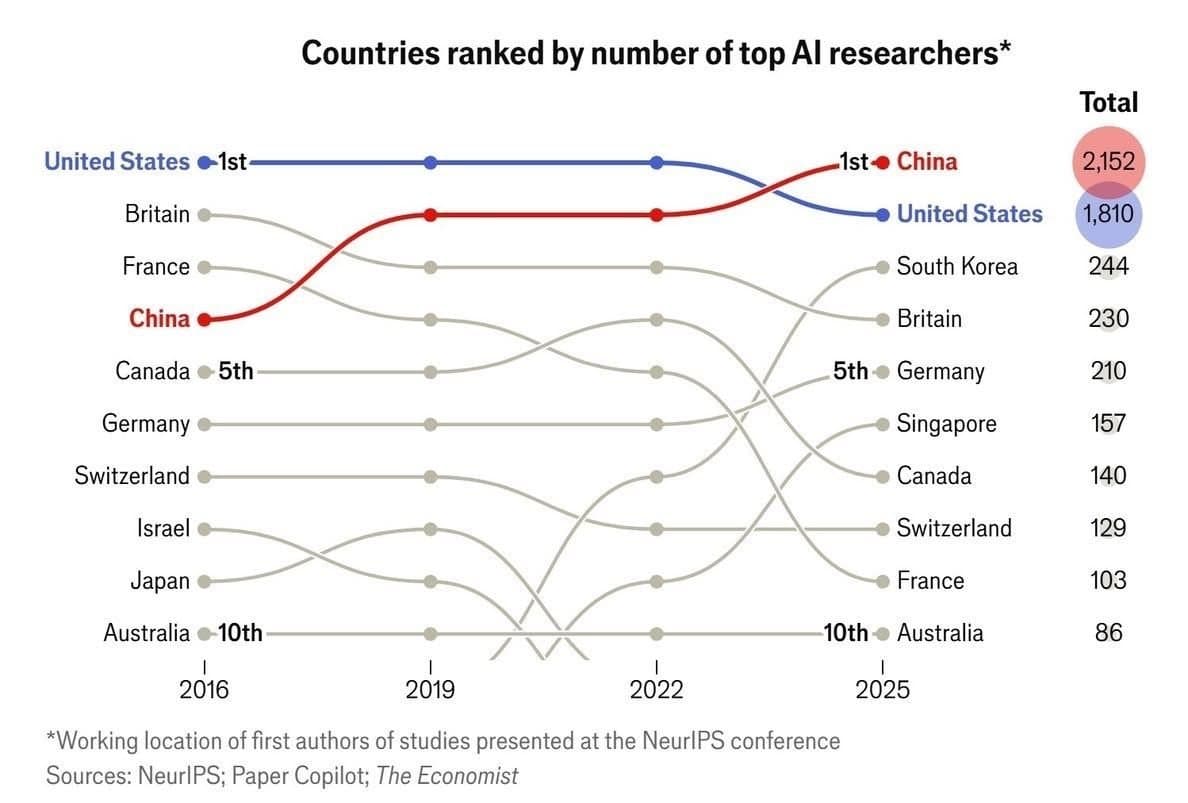
A new analysis of AI research authorship reveals a significant shift in the global research landscape. For the first time, China has surpassed the United States in the number of first-author researchers contributing to top-tier AI conferences and publications. According to data cited by AI analyst Rohan Paul, China now counts 2,152 first-author researchers, compared to 1,810 in the United States.
What the Data Shows
The metric of "first-author researchers" is a critical indicator of research leadership and bench depth. The first author on an academic paper is typically the researcher who has done the primary work of conducting experiments, writing the manuscript, and driving the project's intellectual direction. Counting unique individuals (rather than paper counts) who hold this position provides a view into the size of the active, leading-edge research workforce.
The data, which appears to track contributions to major venues like NeurIPS, ICML, and ICLR, shows China's lead of 342 researchers. This represents a tangible numerical advantage in the human capital driving the foundational research that fuels AI advancement.
Context and Implications of the Shift
This shift did not happen overnight. It is the result of over a decade of strategic national investment in AI education, research funding, and industrial policy. China's State Council issued the "Next Generation Artificial Intelligence Development Plan" in 2017, aiming to make China the world's primary AI innovation center by 2030. A key pillar of that plan was massive investment in talent cultivation.
While the United States remains a powerhouse in AI, with dominant companies like OpenAI, Anthropic, Google DeepMind, and Meta AI driving both research and productization, the research authorship data suggests a change in where the raw volume of novel research ideas is being generated. As Rohan Paul notes: "Chips help, but researchers choose the direction. The side producing more first authors is building the deeper bench."
This has practical implications. A larger pool of first-author researchers suggests a broader exploration of technical avenues, more competition within China's research ecosystem, and a greater capacity for parallel innovation. It strengthens China's position in setting research agendas and increases the probability of breakthroughs originating from its institutions.
The Broader Competitive Landscape
The research authorship lead is one facet of the broader US-China AI competition. The United States maintains significant advantages in other areas:
- Foundational Model Development: US-based organizations (OpenAI, Anthropic, Google, Meta) are widely seen as leaders in developing the most capable large language models (LLMs) and frontier AI systems.
- AI Chip Design & Software Ecosystem: US companies (Nvidia, AMD, Intel, along with software frameworks) dominate the hardware and core software stack for AI training and inference.
- Private Capital & Commercialization: The US venture capital ecosystem for AI is deeper and more mature, rapidly turning research into global products.
China's strengths lie in its massive scale of talent production, strong government-led coordination, and rapid industrial application in sectors like surveillance, fintech, and manufacturing. Chinese tech giants (Alibaba, Tencent, Baidu) and specialized AI firms (SenseTime, Megvii) have produced capable models, though they often trail the US frontier.
The research authorship milestone indicates China is successfully executing on the "talent" portion of its strategy, potentially addressing a historical dependency on ideas and training originating from the West.
gentic.news Analysis
This data point is a concrete milestone in a long-anticipated trend. For years, analysts have pointed to China's graduation of more STEM PhDs and its increasing share of AI publications. Overtaking the US in first-authorship moves the narrative from volume of papers to leadership of projects. This aligns with our previous coverage of China's strategic pushes, such as the rise of domestic AI frameworks and the government's focus on achieving self-reliance in critical technologies.
The trend connects directly to the entity relationship between research output and long-term technological competitiveness. While the US currently leads in translating research into commercially dominant frontier models (like OpenAI's GPT-4 and o1, Anthropic's Claude 3.5 Sonnet, and Google's Gemini), China is systematically building the foundational human infrastructure to compete over the next decade. This is not just about publishing more papers; it's about cultivating a generation of research leaders who will define future paradigms.
However, raw researcher count is not the sole determinant of breakthrough innovation. The US ecosystem benefits from unparalleled concentration of talent in key hubs, a culture that often rewards high-risk, high-reward exploration, and deep integration between academia and industry. The true test will be whether China's expanded research bench can produce the kind of paradigm-shifting architectural advances (like the transformer, diffusion models, or Mixture of Experts) that have historically defined AI epochs. The next few years will reveal if quantity translates into a commensurate share of qualitative, field-defining contributions.
Frequently Asked Questions
What does "first-author researcher" mean?
In academic publishing, the first author listed on a paper is typically the researcher who contributed the most work—conducting experiments, analyzing data, and writing the initial manuscript. Counting unique individuals who are first authors measures the size of the active, lead researcher population driving new projects, rather than just total paper output.
Does this mean China's AI is now better than the US's?
Not necessarily. This metric measures research leadership volume, not the quality or impact of individual breakthroughs. The US still leads in developing the most capable frontier AI models (like GPT-4 and Claude 3.5) and dominates the underlying hardware (Nvidia chips) and software ecosystems. China leads in the scale of its research workforce, which is a crucial long-term input for innovation.
Where does this data come from?
The cited figures (2,152 for China, 1,810 for the US) are attributed to analyst Rohan Paul, who likely compiled them from an analysis of authorship at top-tier AI conferences such as NeurIPS, ICML, and ICLR. These venues are considered the premier stages for publishing cutting-edge machine learning research.
Why is this shift happening now?
This is the result of sustained, strategic investment. Following its 2017 AI Development Plan, China significantly increased funding for AI research centers and university programs. This has led to a growing pipeline of PhD graduates specializing in AI, who are now reaching seniority and leading their own research projects, reflected in the first-author count.