What Changed — The Specific Update

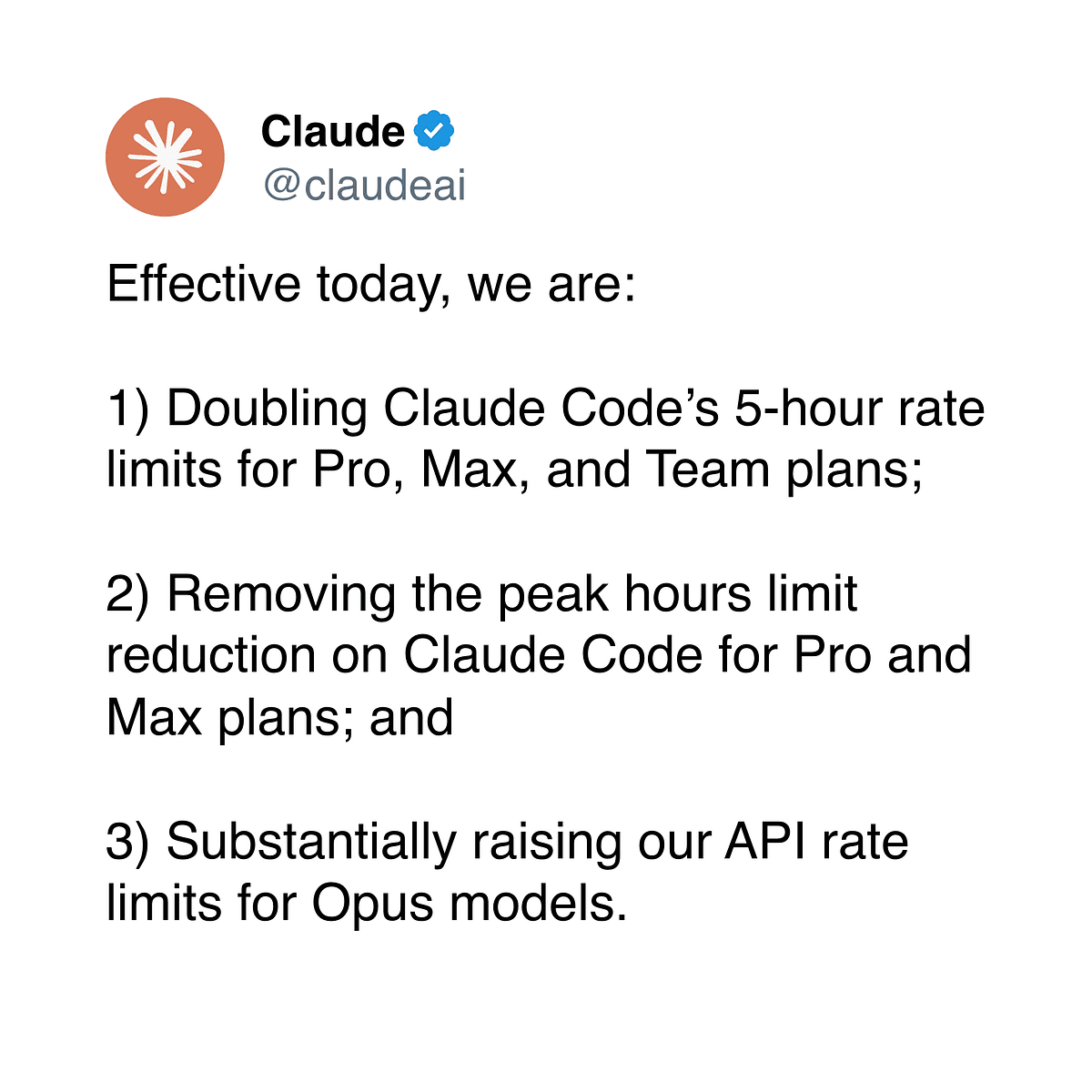
On May 6, 2026, Anthropic doubled rate limits across every paid Claude Code plan and removed peak-hour throttling entirely. This isn't a gradual rollout—it's live now.
Plan-by-plan breakdown:
- Pro ($20/month): Five-hour rolling limits doubled. Peak-hour throttling that previously dropped you to Sonnet during busy periods is gone. You now get consistent Opus 4.7 access throughout the full window.
- Max ($100/month): Limits doubled from the previous Max ceiling, now at 10x the original Pro baseline. Peak-hour caps also removed.
- Team ($30/user/month): Same five-hour limit doubling, with usage pooled across the team. Multi-agent workflows that previously hit shared ceilings now have room to breathe.
- Enterprise (seat-based): Same rate limit increases as Team, plus higher request volume for Claude Opus API calls.
These limits operate on a five-hour rolling window, not a daily reset. Early-session usage ages out while you're still working, so effective capacity is higher than a simple "double the daily cap" reading suggests.
What It Means For You — Concrete Impact
The infrastructure bottleneck that forced Anthropic to tier usage and throttle Opus access is now structurally addressed. The SpaceX Colossus 1 deal adds 220,000 NVIDIA H100-class GPUs within a month—operational inference capacity that lets Anthropic serve Opus to a materially larger share of users without the dynamic throttling that made rate limits unpredictable.
For developers, this means:
- No more mid-session model fallback. Previously, hitting throttling limits would silently drop you from Opus to Sonnet mid-refactor. That's gone.
- Predictable capacity. You can plan intensive coding sessions without guessing when limits will engage.
- True value at $20/month. The main objection to Claude Code Pro—metered Opus access vs. competitors' effectively unlimited Sonnet access—is substantially weaker.
Try It Now — How to Adapt Your Workflow
1. Stop conserving Opus quota. If you've been manually selecting Sonnet for "lighter" tasks like writing tests or generating boilerplate to save Opus for complex work, stop. Let Claude Code run Opus as the default across all tasks. The doubled limits with rolling expiration make conservation unnecessary for typical single-developer use.
2. Run parallel agent sessions. Claude Code supports multiple simultaneous agent windows. Try this workflow:
# Terminal 1: Feature implementation
claude code "Implement the user authentication module"

# Terminal 2: Test generation
claude code "Generate unit tests for the auth module"

# Terminal 3: Documentation
claude code "Write API docs for the auth endpoints"
Previously, three parallel Pro sessions would burn through your ceiling by mid-morning. Now the rolling window keeps them viable throughout the day.
3. Stop checking limits mid-session. The peak-hour throttling was opaque—you couldn't predict when it would engage. With it removed entirely, you no longer need to monitor usage or adjust workflow mid-task. Just work.
4. Reconsider your plan tier. If you were on Max primarily for higher Opus limits, check whether Pro now covers your usage. At $20 vs $100/month, the gap has narrowed significantly.
Source: news.google.com
[Updated 05 Jul via devto_claudecode]
Anthropic's partnership with SpaceX covers all of the Colossus 1 facility's capacity, not a partial allocation, and xAI confirmed the deal as part of a strategy to monetize the data center between major Grok training cycles [per dev.to]. The deal arrives as Anthropic surpassed $30 billion in annualized recurring revenue in April 2026, exceeding OpenAI's $24 billion for the first time, with Claude Code as a primary revenue driver.