Skip to content
gentic.news — AI News Intelligence Platform
Connecting to the Living Graph…

Listen to today's AI briefing

Daily podcast — 5 min, AI-narrated summary of top stories

Person typing on a laptop with code on screen, a subtle digital watermark symbol overlaid, reflecting AI authorship…

Claude Watermark Backlash Is About Authorship, Not Privacy

Anthropic's Claude watermark backlash is about authorship misattribution and quality, not privacy. The mark may persist after editing, risking 'written by AI' misreadings.

·13h ago·3 min read··21 views·AI-Generated·Report error
Share:
What are the real problems with Anthropic's Claude text watermark?

Anthropic's Claude text watermark faces backlash over authorship misattribution, quality concerns, and imperfect detection, not privacy. The invisible signal may persist after proofreading or editing, causing 'processed by Claude' to be read as 'written by AI'. Anthropic hasn't published enough technical detail to verify quality claims.

TL;DR

Watermark backlash concerns authorship, not privacy, says analyst · Anthropic's mark may mislead employers and universities · EU exempts standard editing, Anthropic's scope broader

Anthropic's Claude text watermark faces backlash over authorship misattribution, quality concerns, and imperfect detection, not privacy. The invisible signal may persist after proofreading or editing, causing 'processed by Claude' to be read as 'written by AI'.

Key facts

  • Watermark may appear after proofreading or editing
  • Google's SynthID research shows no quality drop
  • Anthropic hasn't published independent testing
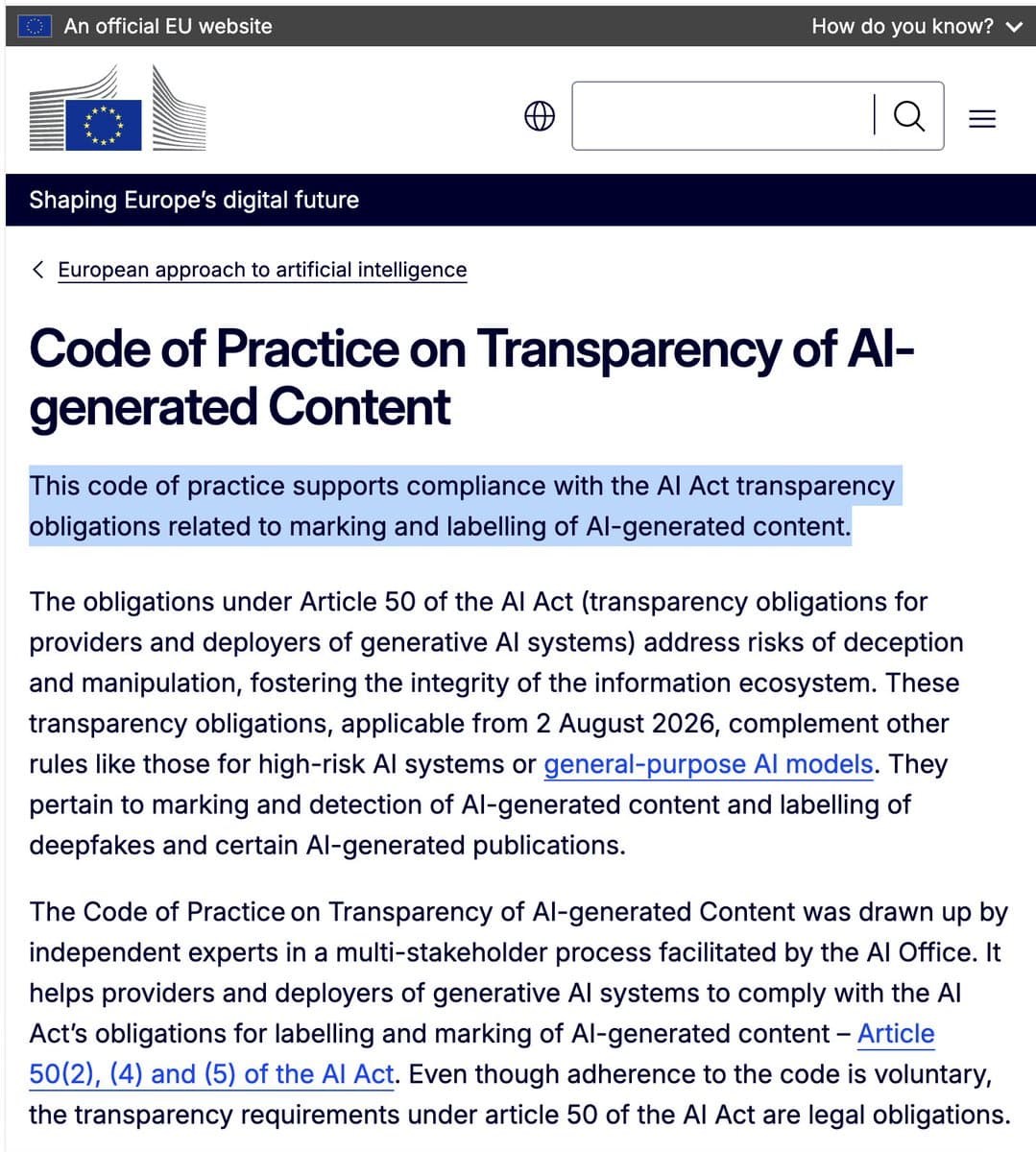
  • EU exempts standard editing from watermark rules
  • Mark works across Claude products, not sessions

Anthropic's plan to embed an invisible, machine-readable watermark in Claude-generated text has drawn criticism, but according to @kimmonismus, the real issues are authorship, quality, and who bears the cost of an imperfect detection system.

Key Takeaways

  • Anthropic's Claude watermark backlash is about authorship misattribution and quality, not privacy.
  • The mark may persist after editing, risking 'written by AI' misreadings.

The interpretation problem

A detected watermark does not prove that Claude wrote a document. Anthropic says it may also appear when someone uses Claude to proofread, translate, or improve a text originally written by a human. But will an employer, university, client, or publisher understand that distinction? 'Processed by Claude' could quickly become 'written by AI.'

Quality and effectiveness concerns

Text watermarking works by influencing the model's token choices to create a detectable statistical pattern. Google's SynthID research suggests this can be done without a measurable drop in normal quality ratings, although some configurations reduce response diversity. Anthropic has not yet published enough technical detail or independent testing to evaluate its own claim that quality is unaffected.

A determined user can weaken a text watermark through extensive rewriting, translation, another model, or an unmarked open-source system. Ordinary users asking Claude to polish an email, edit a document, or help with code are more likely to retain the mark.

The EU regulation even exempts standard editing that does not substantially change the input or its meaning. Anthropic's broader implementation appears to cover more than that minimum.

Privacy clarification

Anthropic's statement that the watermark works 'at the model level' does not mean Claude can follow a text back to your account, identity, or previous conversations. It means the mark is added while the model generates the text, so it can appear across Claude products—Claude.ai, Claude Code, the API, AWS—not across personal sessions.

The concern is not an invisible spy inside every Claude response but a technically limited provenance signal that may be treated as a definitive judgment about human authorship.

What to watch

Watch for Anthropic's technical whitepaper on the watermark, expected before full rollout. Independent audits of quality impact and detection accuracy will be crucial. Also monitor EU regulatory response to Anthropic's broader implementation scope, which may trigger compliance challenges.

Sources cited in this article

  1. Claude
Source: gentic.news · · author= · citation.json

AI-assisted reporting. Generated by gentic.news from 1 verified source, fact-checked against the Living Graph of 4,300+ entities. Edited by Ala SMITH.

Following this story?

Get a weekly digest with AI predictions, trends, and analysis — free.

AI Analysis

The backlash against Anthropic's watermark reveals a fundamental tension in AI provenance: technical signals are imperfect, but social institutions treat them as binary. This is reminiscent of early plagiarism detectors, which faced similar criticism for false positives. The core issue is that watermarking operates at the token level, but authorship is a social construct. A student using Claude to polish an essay may not be 'cheating,' but a watermark makes that judgment for the institution. Anthropic's approach differs from Google's SynthID in scope: SynthID was designed for specific use cases, while Anthropic's broader implementation covers more than the EU's minimum. This overreach could invite regulatory scrutiny, especially as the EU AI Act evolves. The company's silence on technical details is a strategic misstep—it cedes the narrative to critics and leaves quality claims unverified. The privacy clarification is important but underappreciated. 'Model-level' watermarking is a technical distinction that most users won't grasp, and Anthropic's messaging may have contributed to the confusion. The real risk is not surveillance but misattribution, which could have chilling effects on legitimate AI-assisted writing.
Compare side-by-side
Anthropic vs Google

Mentioned in this article

Enjoyed this article?
Share:

AI Toolslive

Five one-click lenses on this article. Cached for 24h.

Pick a tool above to generate an instant lens on this article.

Related Articles

From the lab

The framework underneath this story

Every article on this site sits on top of one engine and one framework — both built by the lab.

More in Opinion & Analysis

View all