Sam Altman says OpenAI will fund frontier training via inference demand, not high margins. The comments came on the 'Invest Like The Best' podcast, surfaced in a post by @rohanpaul_ai.
Key facts
- Altman: inference demand, not high margins, funds training
- Targets 'modest margin on trillions of dollars of revenue'
- Intelligence expected to become fungible commodity
- Compute fleet scale seen as durable advantage
- Distillation threat reduced if usage outpaces margin shrink
Sam Altman argues OpenAI can fund frontier training through enormous inference demand, not high margins. "We will have so much usage of our models that we do not need to be a gigantically high-margin business to be able to afford model training," he said according to @rohanpaul_ai. "So much of our future compute plans will be used to sell inference to customers that, even if we can enjoy a modest margin on trillions of dollars of revenue, we can afford to train some giant models."
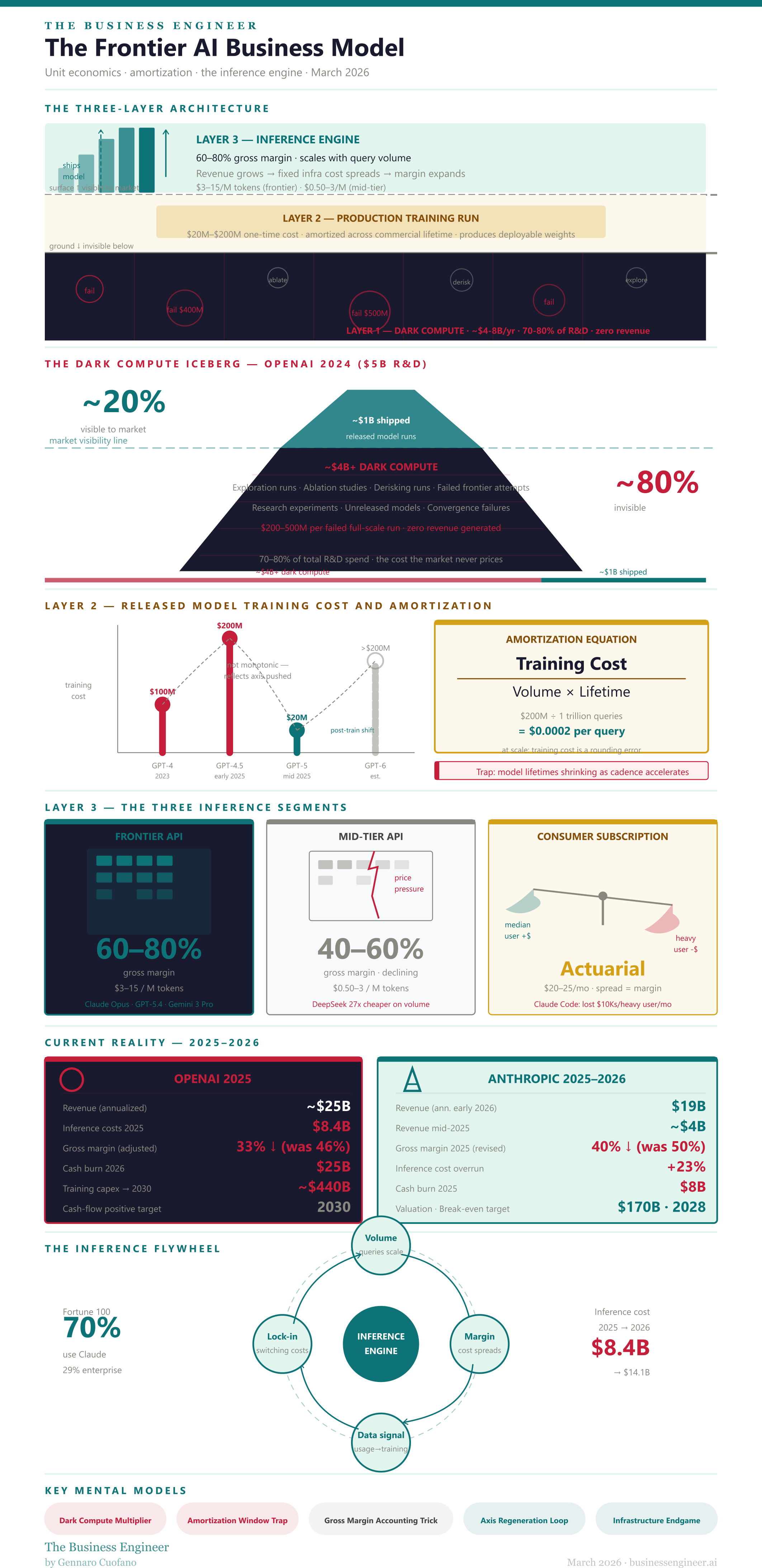
The economics invert the conventional AI capex narrative. Instead of chasing 80% gross margins like a software company, OpenAI positions itself as a utility-like compute operator where volume — not margin — pays for the next training run. Altman even expects intelligence itself to become fungible, shifting durable advantage toward whoever operates the largest, cheapest compute fleet.
That reframes distillation. "Distillation becomes less existential if copied capabilities compress prices while OpenAI's total usage expands faster than its margins shrink," the post notes. The threat isn't that cheap clones exist; it's whether OpenAI can keep growing inference volume faster than commoditization erodes unit economics.
The strategy mirrors hyperscaler logic — AWS and Azure compete on scale and price, not software margins. OpenAI's bet is that frontier models remain differentiated enough to sustain modest margins across a massive base, a claim that will be tested as open-weight models and cheaper rivals squeeze the mid-tier.
Altman did not disclose specific revenue or margin figures in the comments. The full "Invest Like The Best" video is linked in the original post.
Key Takeaways
- Altman says inference volume, not margins, will fund OpenAI's training.
- He expects fungible intelligence and compute scale as moat.
What to watch
Watch for OpenAI's next funding round or infrastructure announcement that quantifies this bet — specifically any disclosed inference revenue run-rate or compute capex figures. Also track whether Altman repeats this framing in OpenAI's next developer conference or earnings-adjacent event, signaling a formal shift in investor messaging.