CLI-Universe, a terminal-agent task synthesis engine, fine-tuned Qwen3-32B on 6K trajectories to hit 33.4% on Terminal-Bench 2.0. The result beats models 10x larger, suggesting data quality over quantity for agentic tasks.
Key facts
- CLI-Universe synthesizes terminal-agent tasks from real-world materials.
- Qwen3-32B fine-tuned on 6K trajectories.
- Achieved 33.4% on Terminal-Bench 2.0.
- Outperforms models 10x larger.
- Training data is grounded, not synthetic toy problems.
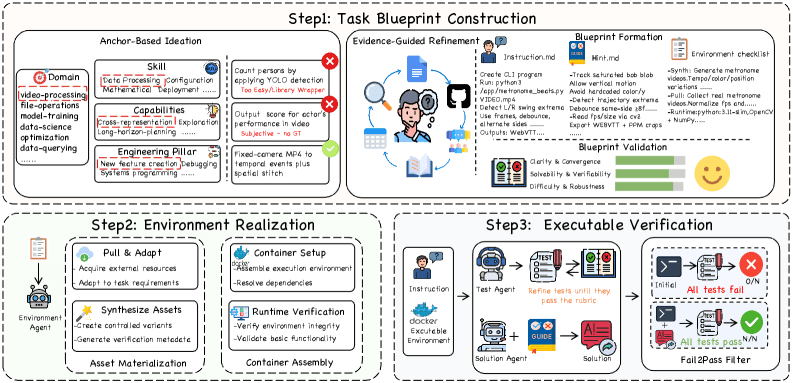
CLI-Universe is a principled engine that synthesizes verifiable terminal-agent tasks grounded in real-world materials. According to @HuggingPapers, the system generates tasks that are not synthetic toy problems but rooted in actual terminal usage patterns, making benchmarks more realistic and harder to game.
The key result: Qwen3-32B, fine-tuned on just 6,000 trajectories, scored 33.4% on Terminal-Bench 2.0. This outperforms models 10x larger, implying that the synthesis method produces higher-quality training data than existing approaches. The paper does not disclose which larger models were used for comparison, nor the exact training compute, leaving some gaps in reproducibility.
Why this matters more than the press release suggests
The result flips the scaling orthodoxy for agentic tasks. While language models often benefit from more data and parameters, CLI-Universe shows that principled task synthesis can achieve competitive performance with far less data. This mirrors findings from other recent work on data curation—like the 2025 DeepSeek-R1 paper—where smaller, high-quality datasets outperformed massive web scrapes for reasoning.
The unique take: CLI-Universe challenges the assumption that terminal agents need large-scale, human-annotated or synthetic data. By grounding tasks in real-world materials and providing principled verification, the engine creates a tight feedback loop between task generation and agent training. This could reduce the cost and complexity of building command-line agents, which are critical for DevOps, system administration, and automated debugging.
Technical details and limitations
The paper does not specify the exact trajectory format, tokenizer, or training hyperparameters. It also does not release the full Terminal-Bench 2.0 dataset or the CLI-Universe code, though the authors claim they will open-source. The verification mechanism is described as "principled" but not detailed—likely involving deterministic checks against expected outputs or state transitions.
A limitation: the benchmark itself is synthetic, and real-world terminal tasks involve edge cases like permission errors, network timeouts, and non-deterministic outputs that no current benchmark captures well. The 33.4% score, while impressive against larger models, leaves room for improvement.
What to watch
Watch for the open-source release of CLI-Universe and Terminal-Bench 2.0. If the code and dataset are available, expect rapid replication and extension by the agentic AI community, potentially leading to a new standard for evaluating terminal agents.