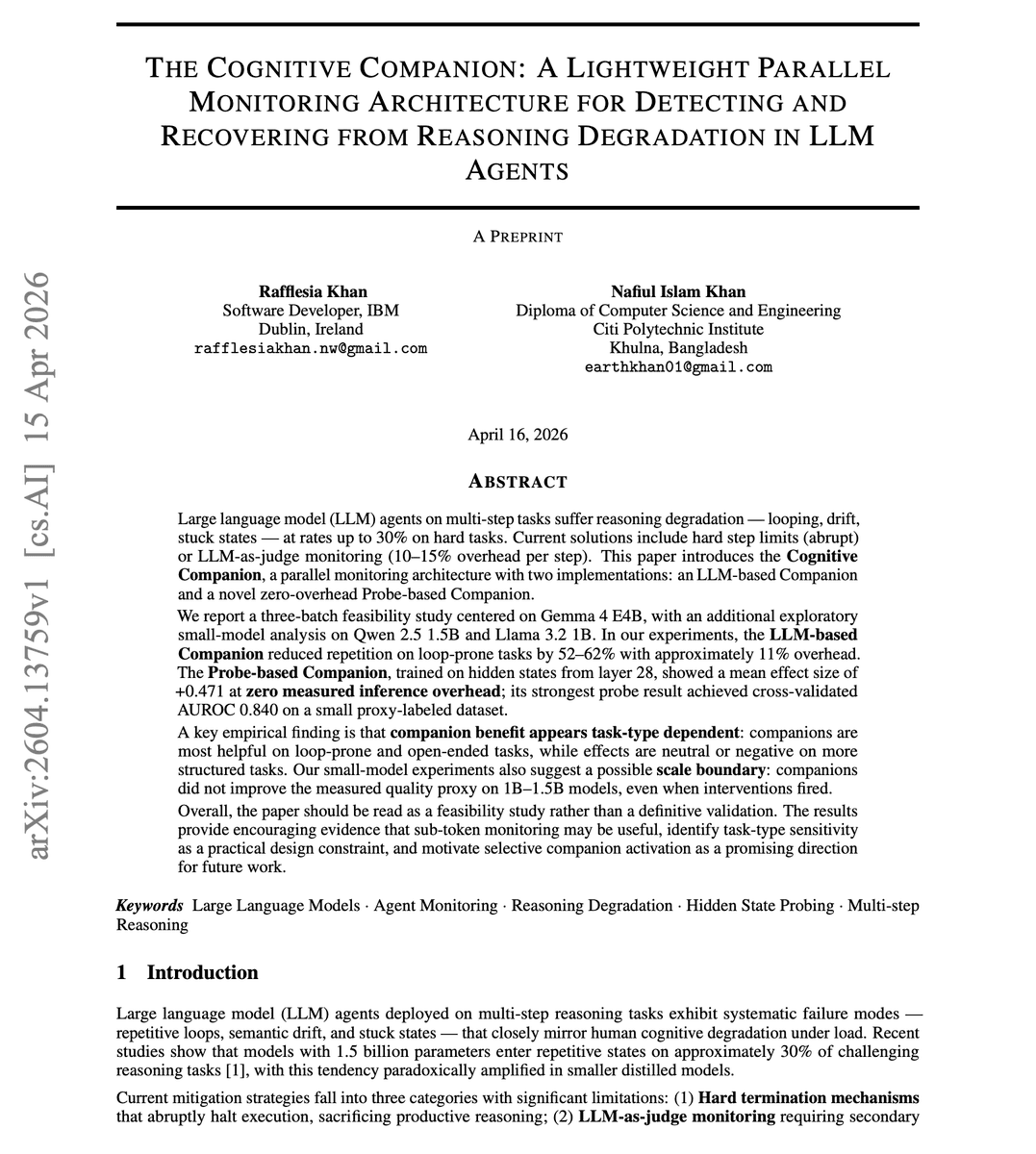
LLM-based autonomous agents frequently fail on complex, multi-step reasoning tasks. They get stuck in repetitive loops, drift off-task, or simply stall, with failure rates reaching 30% on hard problems. Existing solutions are costly: imposing hard step limits prematurely terminates valid reasoning, while using a secondary LLM to judge each step adds 10-15% computational overhead.
New research proposes a smarter, more efficient middle ground: the Cognitive Companion. This parallel monitoring architecture comes in two variants—an LLM-based judge and a novel Probe-based monitor that reads the reasoning model's own hidden states to detect degradation, all with zero additional inference overhead.
What the Researchers Built

The team designed a monitoring system that runs in parallel to a primary LLM agent (the "actor") performing a reasoning task. The companion's job is to detect when the actor's reasoning quality is declining—signaling a potential loop, drift, or stall—and optionally intervene by suggesting a corrective action (like "try a different approach").
The key innovation is the Probe-based Cognitive Companion. Instead of making additional, expensive calls to another LLM, this variant trains a simple logistic regression classifier on the actor model's internal representations (hidden states) from a specific layer—layer 28 in the experiments. During the actor's existing forward pass, the probe performs a single matrix multiplication on these states to produce a probability score indicating whether reasoning is degrading. This adds no measurable inference overhead.
Key Results
The companions were tested on a suite of challenging reasoning tasks known to cause agent failures, including GSM8K (math), HotpotQA (multi-hop QA), and open-ended planning tasks.
Reduction in Repetition (loop-prone tasks) 52-62% Comparable mean effect size (+0.471 Cohen's d) Computational Overhead ~11% (extra LLM calls) 0% (reads existing hidden states) Detection Performance (AUROC) Not explicitly stated 0.840 (cross-validated) Best For Loop-prone & open-ended tasks Loop-prone & open-ended tasksA critical nuance emerged: the companions provided significant benefits on loop-prone and open-ended tasks but showed neutral or even negative effects on well-structured tasks (like straightforward math). Furthermore, smaller actor models (below 3B parameters) often failed to act effectively on the companion's guidance, even when a problem was correctly identified.
How It Works: The Probe-Based Monitor
The technical core is elegantly simple. During the training phase:
- The actor model runs on a dataset of reasoning trajectories, some of which end in success and some in failure (loops, drifts).
- The hidden state activations from a middle layer (chosen via ablation studies) are extracted for each reasoning step.
- These hidden states are labeled as coming from a "healthy" or "degrading" reasoning trajectory.
- A logistic regression model is trained to classify the hidden state as predictive of impending failure.
During inference:
- The actor model runs normally, generating hidden states at each step.
- The trained probe performs a single, lightweight operation:
probability = sigmoid(W * h + b), wherehis the hidden state vector. - If the probability exceeds a threshold, the companion can trigger a pre-defined intervention (e.g., prepend a corrective instruction to the actor's next prompt).
The entire monitoring process parasitizes the actor's forward pass, requiring no new tensor computations beyond the classifier.
Why It Matters: Selective, Efficient Monitoring

This work moves beyond the brute-force paradigm of universal monitoring. The results clearly indicate that monitoring is not always helpful and can be detrimental on tasks where the agent's native reasoning is sound. The future it points to is selective activation: deploying cognitive companions only for tasks or task segments where the risk of reasoning degradation is high.
The Probe-based Companion provides a practical path there. It offers a low-cost, always-on sensor for reasoning health. Developers could potentially use it to dynamically allocate expensive LLM-as-judge resources only when the cheap probe first raises an alert, creating a hierarchical, cost-effective monitoring system.
The failure with small models (<3B params) is equally instructive. It suggests that the ability to utilize feedback is a separate capability from the ability to generate or monitor reasoning, a crucial consideration for building robust agentic systems with smaller, more efficient models.
gentic.news Analysis
This research directly tackles a growing pain point in the industry's shift toward AI agents. As we covered in our analysis of OpenAI's o1 model, there is intense focus on improving the reliability and robustness of LLM reasoning. The Cognitive Companion approach complements architectural advances like o1's internal search by providing an external, lightweight sanity check for more standard agent frameworks. It's a tool for making existing models more reliable without requiring a full model replacement.
The finding that monitoring can hurt performance on structured tasks aligns with emerging principles in agent design. It echoes lessons from Google's SIMA project, which found that overly restrictive guidance can hamper general game-playing agents. The optimal agent system likely involves situational awareness, knowing when to deploy constraints or corrective feedback.
Furthermore, the use of a simple linear probe on hidden states is part of a broader trend toward interpretability and control via model internals. This follows work from Anthropic on dictionary learning and steering vectors, and from OpenAI on linear probes for truthfulness. The success here suggests that actionable signals for high-level problems like "reasoning degradation" can be found in surprisingly simple, linear projections of activations, opening a path for highly efficient runtime oversight.
Finally, the 3B-parameter threshold for effective intervention highlights the ongoing challenge of the capability gap between large and small models. As the industry pushes for cheaper, faster, on-device agents, techniques that work flawlessly with GPT-4-class models may fail with smaller, distilled models. Robust agent frameworks will need to adapt their oversight mechanisms to the capability level of the actor model, a significant engineering challenge.
Frequently Asked Questions
What is a Cognitive Companion?
A Cognitive Companion is a parallel monitoring system for an LLM-based agent. It analyzes the agent's reasoning process in real-time to detect signs of failure—like getting stuck in a loop or drifting off-topic—and can suggest corrective actions. The research proposes two types: one that uses another LLM as a judge, and a more efficient one that uses a simple classifier (a "probe") trained on the main agent's internal brain activity (hidden states).
How does the Probe-based Companion work without slowing down the AI?
It adds zero inference overhead because it doesn't make any new calls to the neural network. Instead, it "eavesdrops" on the data that is already being calculated inside the main AI model as it thinks. It takes a snapshot of the model's internal state from a specific layer, runs it through a pre-trained, very simple mathematical filter (logistic regression), and gets a yes/no signal about reasoning health. This extra step is computationally trivial compared to running the full AI model.
When should I use a monitoring system like this for my AI agents?
According to the research, you should consider it primarily for open-ended or loop-prone reasoning tasks where agents are known to fail regularly. The study found that on well-structured, straightforward tasks (like simple arithmetic), adding a monitor provided no benefit and could even slightly hurt performance. The guidance is to deploy this selectively, not universally, activating the companion only when the risk of reasoning degradation is high.
Can I use this technique with small language models (under 3B parameters)?
The research indicates significant limitations here. While the Probe-based Companion itself can be trained and run on small models, the study found that models below approximately 3B parameters were often unable to effectively act on the companion's corrective guidance. The small model could be told it was going off-track, but lacked the capability to successfully change its course. For small models, alternative failure recovery mechanisms may be needed.